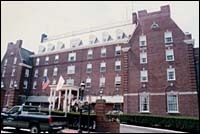
Viking, room occupancy was
reported at a three-year
low.
If the state legislature does not roll back the hotel room tax, tourism advocates believe it could cost the state more than $25 million in lost meetings and conventions business.
Because the state’s room tax is the highest in New England, according to the Rhode Island Hospitality and Tourism Association, the state faces the possibility of a “marked loss of business and a corresponding loss of jobs,” the organization said.
Seifert Systems Invests in Energy Efficiency to Strengthen Operations
For manufacturers, energy is more than just another operating expense. It plays a critical role…
Learn More
Tim Grillo, a spokesperson for the Rhode Island Hospitality and Tourism Association said there are several bills pending in the legislature, with most just redirecting part of the proceeds from the tax to municipalities.
One bill, however, would roll back the tax by 1 percent, and that Grillo said has passed the House, but still needs Senate approval. The 1 percent is the additional room tax that was added last summer as a means to pay back the $25 million Heritage Harbor Museum bond issue. That bond issue was defeated by voters in November.
In early January a bill to roll back the tax passed the House of Representatives with virtually no opposition. However, in the state Senate, Grillo said it has met with some opposition from Senators who see the funds being retained in the state’s general fund or distributed to municipalities.
Grillo maintained that the state’s room tax at 13 percent (6 percent room tax and 7 percent sales tax) is the highest in the region and well above the national average of 11.7 percent.
“It sticks out like a sore thumb if we’re the highest in New England,” Grillo said. He estimated that the 1 percent drop in room tax would cost $2.2 million, but would be offset because of the business that would not be lost.
“Let me reword it, like an old cliché,” said Bob Gentry, a former Hospital Association chairman and vice president for Eastern Resorts Company in Newport, which owns six times shares in Newport and Jamestown. “It’s the 13 percent stupid. If it were only the 1 percent we were talking about, what’s 1 percent? But we’re talking about 13 percent, which puts us as the highest tax in New England.”
In particular, the association and its new coalition of chambers of commerce and tourism councils formed to fight for the reduction in room tax, believe a higher room tax will cost the state as much as $25.3 million.
“This negative impact would be due to individual and group travelers electing not to come to Rhode Island, to come to Rhode Island with fewer attendees, to come to Rhode Island for a shortened duration, or to come to Rhode Island less frequently,” said John W. O’Neill, professor of hospitality management at Johnson & Wales who last fall completed a study for the Hospitality Association. “This negative impact equates to a loss of approximately $25.3 million annually.”
More than the casual visitor, O’Neill suggested that it was the convention and meeting planners who would be most aware of the higher taxes.
“The people who are acutely aware of that are the people who are booking 100, 200, 300 rooms at a time,” he said. “They scrutinize that particular issue.”
Gentry, while his business now does not rely on conventions has spent 30 years in the hotel business, many at hotels that cater to conventions. He said the tax matters to meeting planners who are trying to make a tight budget.
He said that while no one is ready to make any estimates on what business might have been lost because of the tax increase last July, the Newport Visitors and Convention Bureau occupancies during the last six months of last year were their lowest in three years in the city.
“I don’t know why,” Gentry said. “But I do know the last six months were the worst in the last three years. Did the 1 percent play a role? Maybe it’s too early to say, but I don’t think the economy was going south in July, August and September when people didn’t come down here.”
O’Neill based his estimates on his own and previous research, interviewing at random, he said, a number of meeting planners and travel writers.
Additionally, he said, while it is too early to measure the impact of last summer’s 1 percent room tax increase, it is possible to measure the impact of Rhode Island’s prior room tax increase that occurred on August 1, 1989.
He said that in the year after the August 1, 1989 Rhode Island hotel room tax increases, Rhode Island hotel occupancy rate declined by an average of 6.9 percent, while nationally it was increasing by 2.5 percent. Overall hotel occupancy was down in New England by 2 percent.
O’Neill and the hospital association characterize the hospitality industry as Rhode Island’s largest industry, passing the $2 billion mark for the first time in 1997, and, O’Neill said having a total economic impact in 1999 of $2.72 billion, according to a University of Rhode Island study.
The outcry to roll back the room tax comes at a time when Rhode Island is considered, at least by one source, as among the most expensive areas to vacation.
While Grillo acknowledged that room rates might be high here, he said they were comparable with Boston and Cape Cod.
The Automobile Association of America’s annual vacation cost survey, published last summer, said, however, that Rhode Island is the second most expensive place in the country to vacation, behind Hawaii. The survey was based on the cost of lodging and meals for a family of two adults and two children.
Hawaii was by far the most expensive with a combined cost of $443. Rhode Island was second at $271, while Massachusetts was fourth at $261. Driving Rhode Island’s cost was lodging, which was also second at an average of $157, behind Hawaii at $301, and above Massachusetts at $144. Rhode Island’s meal costs were tied for 10th, below Massachusetts.
Gentry and Grillo both disputed the AAA numbers, saying that another study by Smith Travel Research for American Motel and Hotel Association for the year 2000 found the average Rhode Island room rate at $95.06, compared to Massachusetts at $111.84.
Given that, Gentry and Grillo said Rhode Island room rates are competitive, but the taxes are not.
“As everyone tries to reduce taxes, Rhode Island is headed 180 degrees in the opposite direction. In today’s economic climate this just does not make any sense at all,” Gentry said.