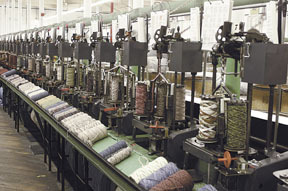
braided rugs.
Design center helps businesses compete
Design and innovation are the keys to revitalizing Rhode Island’s
manufacturing base and could make a difference in extinction or revival of the
industry, according to Cheryl Faria, director of the Center for Design &
Business.
Beyond Cash Donations: How New Forms of Giving Are Transforming Not-for-Profit Accounting
Evolving Funding Landscape for Not-for-Profits Not-for-profit organizations are being asked to do more with less,…
Learn More
“Design and innovation absolutely can increase jobs and restore manufacturing,
but the mindset has to change,” Faria said. “Sometimes it’s not so much what
you’re manufacturing, but how you run your business.”
The center, established seven years ago, is a joint venture between Bryant
College and the Rhode Island School of Design geared toward helping local inventors,
artists and businesspeople bring their ideas to fruition.
“With manufacturing going overseas, (design is) key … to economic prosperity,”
she said. “And it’s a key for creating and maintaining a successful company
here. You have to look at what you make and (determine) how to make it better
– it’s a new way of thinking.”
Manufacturing new, exciting, fun and feel-good products is the country’s ace-in-hand,
Faria said. Production costs will continue to rise, and there’s no way for American
manufacturers to make the same product cheaper than Sri Lanka; so quality, feel
and the overall product experience are new focal points.
Colorful computers, cars, cell phones and kitchen appliances have taken over
the markets; Faria said the new Volkswagen Beetle is part of the “how-do-you-feel-when-you-drive-it”
marketing. Even the potato peeler has been transformed from something strictly
functional to something fun.
“They’re talking about it in a full manner – it’s not just what it looks like,
but how it feels, how it feels to be there and the quality of the product,”
she said. “That speaks to design – it’s about the experience.”
Color also differentiates products, she said, which is something for which
consumers have shown they’re willing to pay more.
The center has held 65 roundtable reviews and brainstorming meetings between
designers and businesses that are interested in a fresh approach since 1997,
Faria said.
Pawtucket-based Colonial Mills, a maker of custom braided rugs, wanted to
expand their products and tap into new markets. After their roundtable session,
designers showed them how to use different materials, textures, patterns and
shapes to add variety.
The suggestions only enforced the direction in which the company was going,
said Lynne Minchello, marketing manager for the company.
“Things have really changed because we’re trying to get into a new market
and change people’s perception of braided rugs, as a process,” she said. Colonial
Mills has three licensed collections, two of which the company is in the process
of introducing. One collection called Simply Home has six patterns with 23 available
colors, which provides 8 million standard options, she said.
“People tend to think of braided rugs as oval rugs with neutral colors,” Minchello
said. “Now (with the new products) you can’t tell they’re braided unless you
look closely. Most of our rugs are also indoor/outdoor; they’re not just made
of wool.”
Minchello said sales have “definitely increased,” and without raising costs.
In fact, the company was able to reduce prices on some rugs through more efficient
production.
Central Tools Inc. in Cranston wanted to redesign and update its central product
– automotive repair lights. With the help of the center, the company designed
a new model that feels good in mechanics’ hands, is sturdier than the original
and can be hung overhead with a hook or stood upright.
The design center also helped Lincoln-based ChemArt Company, which makes Christmas
ornaments for the White House, to expand into non-holiday products including
one-of-a-kind items and memorabilia.
Rhode Island is a creative state by nature, Faria said, with a richness of
resources and outlets for design and innovation.
“Our niche (should be) more on how to build what we already have,” she said
of Rhode Island’s manufacturing base. It’s not just about bringing old products
to old markets, but new products to old markets, old products to new markets,
and so on, she said.
Ten years from now, Faria said she sees manufacturing getting better.
“Our real edge is our ability to think and create, and to think across company
(and industry) lines,” she said. “We have a lot of focus and energy and a lot
of resources directed toward that.”