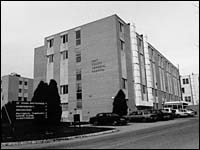
Kent County Memorial Hospital
officially after 50 years.
Now on the eve of its 50th year in operation Kent County Memorial Hospital officials celebrate its past and brace for its future.
“This is a time for us to come together and celebrate an asset of this community,” said John Hynes, president of Care New England, Kent County’s parent organization. “It’s a time to recognize the people that came before the building. People now and after need to continue that commitment. It’s been called an imperishable gift and we need to take it forward.”
Seifert Systems Invests in Energy Efficiency to Strengthen Operations
For manufacturers, energy is more than just another operating expense. It plays a critical role…
Learn More
“This is a milestone for the organization because of how it’s grown and what we have made it,” said Dr. Robert Baute, president and chief executive officer of Kent. “But it’s also a stepping stone for us to continue in the future. The theme is continuing our commitment and what we are doing is stepping into the next five decades.”
First opened with 90 beds in May 1951, Kent County Memorial Hospital was the result of collaboration between local physicians who felt the institution would help meet the health care needs of the surrounding community.
With each passing decade have come marked changes to the hospital. In the early 1960s the hospital added 100 beds. Another 100 beds were added in the early 1970s, and an additional 160 beds were added in the 1980s, many of them as part of the hospital’s rehabilitation center.
“This was a natural area of growth,” Hynes said. “Following World War II many businesses had developed in the area, Quonset was active and we saw huge increases in population.”
Meeting the needs of the surrounding community has always been a top priority for hospital officials. Kent was the first hospital in the state to institute a hospital-based home health care center in 1963. In 1965 Kent opened its own Intensive Care Unit and in 1975 the hospital opened an outpatient surgery center.
“The first year that we did outpatient surgeries the hospital performed about 100 of them,” Hynes said. “Last year that number reached almost 13,000.”
Today, referred to as Kent Hospital, because its scope of patient care extends beyond the boundaries of Kent County, the hospital is governed by a 26-member voluntary board of trustees. With a staff of more than 400 physicians, 318 volunteers and 1,482 employees, the hospital sits upon 57 acres in Warwick and serves approximately 200,000 residents of Central Rhode Island.
Outpatient services have remained a priority for hospital officials as a Cardiac Cath Lab and a Women’s Diagnostic Imaging Center have both been added within the last 10 years.
“We have significantly developed our outpatient services,” said Baute. “We believe it’s an important way to provide the services that are needed by the community we serve.”
But like any traditional business, Hynes said there is concern that the hospital will not be able to continue growing at its current pace. The recent collapse of a merger between Care New England, which also includes Women and Infants and Butler Hospitals, and the Lifespan network, which includes Rhode Island, Newport, Bradley and Miriam Hospitals, could mean more difficult times for the hospital in the future.
“I think the merger was potentially a lost opportunity,” Hynes said. “We haven’t given up working with Lifespan short of a merger, but the merger would have created opportunities for both organizations that might take longer for them to do individually, some won’t even be possible.”
Changes in federal legislation following the Balanced Budget Act of 1997 have also impacted many of the hospital’s policies, including a once-thriving home-care program.
“Basically, the legislation cut the number of allowed visits in half,” Hynes said. “And though people in the community will tell you they benefit enormously from these visits, unfortunately today there are fewer people benefiting from this type of care.”
The legislation also resulted in cutting a portion of federal funding to hospitals – something both Hynes and Baute agreed is difficult to manage.
“A hospital is like any business,” Baute said. “You need to allow for enough revenue to provide the services that you need to provide to the community. You have to find a way to maximize that level of service.”
Looking to the future, Baute said, one of his greatest concerns is a potential lack of health care workers including both physicians and nurses.
“There is a national shortage of nurses right now to the point where there are hospitals getting nurses from other countries,” he said. “People will always need medical care. As we get older, and people are living longer, we are going to need even more medical care.”
Both Baute and Hynes, who came to the hospital in the early 1970s are amazed with technological advances that have been made in medicine — when the hospital first opened antibiotics were a the “new thing,” while today it’s a possible cure for leukemia.
“(The advances) are a reason people stay in this field,” Hynes said. “To be a part of that, react to that and be able to share with people what is happening — that’s what it’s all about.”
The hospital plans to celebrate its 50th year beginning with an Open House and Student Art Show on January 21, when the public is invited to visit the hospital, participate in health screenings and tour some of its facilities. January also marks the beginning of the Lights of Hope Celebration — a program sponsored by the hospital’s auxiliary that offers the public a chance to celebrate the anniversary by recognizing their loved ones through the purchase of special lights that will adorn the trees surrounding the hospital. An official birthday part will take place in May and the year-long recognition culminates with a gala ball in November.
“We are very fortunate to have some of the people that put in the first shovels here to celebrate with us,” Hynes said. “Very few institutions can say that. This is a nice place for us to pause, look back, and celebrate.”