Tunneling for sewer project entering its second year
The dashboard hula girl jiggles wildly atop a monitor an operator
uses to guide a 290-ton steel inchworm through the earth below Providence. Earplugs
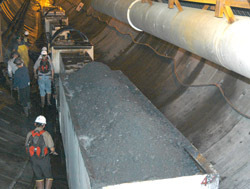
and hard hats are the uniforms of choice, as chunks of rock are constantly dumped
in and out of muck buckets, headed for the surface.
Seifert Systems Invests in Energy Efficiency to Strengthen Operations
For manufacturers, energy is more than just another operating expense. It plays a critical role…
Learn More
A fine layer of black soot covers the operator and the other 20 workers on and around the 30-foot-high tunnel boring machine.
The 60 rock cutter wheels on the 225-foot-long machine have been boring through the shale and sandstone for a year now, leaving a 2,500-foot tunnel behind it. The tunneling is part of a first phase, which is expected to be completed in 2007. Designed especially for the Narragansett Bay Commission’s combined sewer overflow project, the machine is tunneling along Allens Avenue toward downtown.
“You like our office?” John McDonald asked visitors to the tunnel. He’s been a ‘sandhog’ – an informal job description – for 15 years and works on the top level of the boring machine. When asked about his workday, he said, “It’s always busy down here so the days go by fast.”
McDonald helps man the machine that costs about $1 million to operate a week. Some of the workers arrived with the machine’s owner, Shank/Balfour Beatty, from California; others came from Boston and the Big Dig; and others are from Rhode Island and have never worked on a machine like this. They are drilling a 3-mile-long tunnel for the project that will contain storm water and sewer overflow until it can be treated at the commission’s facility at Fields Point.
The boring machine and the sandhogs who drive it are a major component of the $314 million first phase of the sewer project, designed to reduce drastically the state’s storm water and sewage overflow problems. The first phase includes the tunnel, running from the commission’s treatment facility off Allens Avenue, into downtown Providence, under the State House and ending at The Foundry off Promenade Street.
The tunnel will also connect to seven drop-shafts (six of which have been built) that will drain into it.
Phase two will involve building two near-surface interceptors along the Woonasquatucket and Seekonk rivers that will channel water into the tunnel. Phase three is another deep tunnel similar to Providence’s that will start at the Bucklin Point Wastewater Treatment Facility in East Providence and run up the Blackstone River into Pawtucket.
It is expected to take more than 20 years and $750 million to complete the entire project.
It’s been almost a year since the boring machine was lowered into the ground and began chewing up bedrock, and already it has tunneled past Honey Dew Donuts on Allens Avenue and under the Route 95 overpass, according to Curtis Batten, tunnel superintendent for Shank.
The crews work an average of eight to 10 hours a day. There is one production shift and two maintenance shifts, when workers lower supplies and equipment down the shaft, check the machine and replace dulled cutter wheels. The production shift works from 6:30 a.m. to 4:30 p.m.; the first maintenance shift arrives at 4:30 and works until 12:30; the graveyard shift is 12:30 a.m. to 6:30 a.m.
Standard work attire is Big Bird yellow foul-weather gear, rubber boots and soot-like black dirt and water. All the sandhogs wear hard hats, which they cover with decals and stickers, but only some use yellow earplugs to block out the constant grinding of the machine. They drive the trains that carry people to the machine and muck buckets full of rock back to the bottom of the shaft.
“A lot of them are a little hard of hearing,” said Rich Bernier, manager of construction for the Narragansett Bay Commission. “(Aboveground) the work sounds like loud drum beats.”
The temperature increases at least 10 degrees at the boring machine; back at the entrance, it’s cooler. Traveling down the 280-foot vertical shaft in an elevator, the smooth but bumpy rock surface glistening, it’s reminiscent of a Disney World ride, but once at the bottom, one look into the tunnel ahead provides a reality check.
At the bottom of the shaft, a machine flips the contents of the buckets onto a conveyor belt that runs to the surface. Workers make sure the two lines of track are clear of rock and mud; others supervise the conveyors and empty trains. Sandhogs with the task of spraying the muck buckets resemble workers on an oil rig, with a spray of black water covering them.
Lunch is served on large utility cable spools, only slightly cleaner than every other surface, at the bottom of the shaft.
The crew working on the two levels of the boring machine is in more comfortable clothing – hard hats, jeans and T-shirts. A sticky coating of black dust covers every surface, making these sandhogs look more like mechanics than boring machine operators.
One operator mans all the large switches and buttons for the machine. Near the control panel, a dirt-covered miniature Jesus statue offers his open arms to the crew.
The machine grinds rock 4 feet at a time. The cutter head is powered by 20 hydraulic motors, driven by 12 hydraulic pumps and electrical motors pumping out 3,400 horsepower. After tunneling 4 feet, the machine retracts its shield jacks, pushing 10-inch-thick concrete liner pieces into place. Then it will continue on its way, grinding for 4 more feet, then stopping again. It uses each concrete piece to move forward.
Operator Reese Tatge, on the top level of the machine, trains new workers. Brothers Zack and John McDonald, from Boston, install and supervise large metal bars that push the concrete sections apart at the tunnel’s ceiling, forcing them into place.
According to Batten, it takes the sandhogs seven minutes to install an entire concrete ring in the tunnel. Cranes below the body of the boring machine lift the parentheses-shaped slabs into place.
Rubble is channeled through the inside of the machine’s body on a conveyor belt, which will be dumped into the muck buckets. On the way to the buckets, it’s sprayed with a mixture of foam and water to minimize dust.
According to John Kaplan, resident engineer for Gilbane/Jacobs (a joint venture between Providence-based Gilbane and Jacobs Engineering Group in California) and construction manager for the project, the machine drills about 30 feet to 40 feet per day. For every foot of tunnel mined, 40 yards of material goes to the surface. A pump system sends 700 gallons of water per minute to a surface retention pond to keep the tunnel from flooding.
The drilling is going slower than Shank and the commission expected, Bernier said. The bedrock is harder, making the work more tedious. The workers are constantly alternating between sandstone and shale, Kaplan said, so drilling speed fluctuates.
“Typically there’s a learning curve here until about halfway through,” Bernier said. “We’re only a quarter of the way, so there’s always that period” of uncertainty.
One thing that is established is a tight schedule. Nothing ever goes to the surface empty. Cranes operate everything on the surface, so the elevator only goes up after enough rock has been sent to the conveyor.
“It’s a 10-hour day for these guys, but it’s a game of minutes,” Batten said. “That’s why the elevator comes up at certain times so as not to keep the (machine) from mining.”
The tunnel, when finished, will hold more than 60 million gallons of combined sewage, and will reduce the volume of combined sewer overflow discharge by 40 percent each year. The commission expects it will also reduce shellfishing closures by 47 percent in the northern half of Narragansett Bay and 77 percent in the southern half.
Sandhogs are a superstitious bunch. No one brags about the machine or the project, and no one favors publicity, recognition or pats on the back until the project is finished. Batten was quick to pass on any recognition to other tunnel workers.
“We don’t care to talk about the project before it starts,” said Mike Shank of Shank/Balfour Beatty when the project began. “No one likes to claim responsibility before it’s successful.”