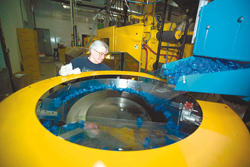
Peggy Droulet, an employee at Polytop Corp., a Slatersville manufacturer, feeds safety caps into an automation system. The company is expanding but is having trouble finding skilled workers.
Industry evolves with technology, skilled labor hard to find
Polytop Corp. is expanding into a new building a few feet away from its manufacturing facility in Slatersville, but the company is struggling to find skilled replacements for the 25 employees they’re training for automated jobs in the new plant.
Seifert Systems Invests in Energy Efficiency to Strengthen Operations
For manufacturers, energy is more than just another operating expense. It plays a critical role…
Learn More
“(The industry) has a lot of technology but what we don’t have is a good supply of skilled people,” said Deborah Pannullo, vice president of operations at Polytop. Pannullo has administered training programs for manufacturing workers for 30 years, including Polytop.
As the company has adopted new technology, it has become harder to find replacement skilled workers. The company manufactures plastic dispensing closures and devices.
Polytop is not alone. The state Department of Labor and Training is projecting a loss of more than 8,000 manufacturing jobs from 2002 to 2012, and while that is no surprise to manufacturers or industry experts, they recognize a lack of an adequate training infrastructure for the next generation.
“It’s always alarming when you’re talking about job loss, but it’s going to continue,” said John Cronin, CEO of the Rhode Island Manufacturers Extension Service. “We need to do it better, with new technology and lean manufacturing. These jobs have become more sophisticated.”
In order to apply the advanced technology and lean manufacturing practices, however, the industry needs to replace some of those lost jobs with higher-skilled and better-paying positions.
“We’re having trouble finding (skilled) people,” Cronin said. “This is serious across the board. Our workers have to be smarter than (foreign) workers and the only way to do that is through education, training and community.”
Rhode Island has School-to-Career, and the newly opened Exeter Job Corps Academy, both of which connect students to people and hands-on experiences in industries including manufacturing. RIMES recently completed its Workplace Skills pilot program with Davies Vocational Technical High School in Lincoln and two newly added high schools, North Kingstown and Coventry, and a few local colleges and universities have partnerships with manufacturers, but this is perceived to be not enough.
“There is an educational and business structure, but no system that is high-performing,” said Cronin. “The system is designed for people … to go to college. There are initiatives, but it takes time. To have an innovative culture, we need to have the infrastructure that supports going from school to the work force.”
The state labor department reported that manufacturing employment is expected to drop from more than 62,000 jobs in 2002 to 53,785 in 2012, a 13.5 percent loss. The 2012 Opportunities report projects large losses in textile mills (32.7 percent or 1,457 jobs); leather and allied products (30.2 percent or 95 jobs); nonmetallic mineral products (37.2 percent or 314 jobs); primary metal (27.2 percent or 528 jobs); and fabricated metal products (20.3 percent or 1,781 jobs).
“The decline in manufacturing is something that’s occurring nationwide, and it’s not just a loss of companies, but (it’s also due to developing) better ways of doing manufacturing,” said Donna Murray, chief of Labor Market Information programs for the DLT. “As companies rely more on robotics to process their product, a lot of jobs (that were) once done by hand no longer need to be.”
Production employment, which includes manufacturing and food service production jobs, is also expected to decline 9.3 percent, but more than 10,000 openings by replacements are also projected. And those positions will need to be filled, Murray said.
“Occupational jobs have changed – they need people to fix computers versus snap sunglasses together,” she said. “Better jobs would be if team assemblers were replaced by machinists. But we’re still seeing a need for replacements.”
Polytop has been forced to train existing employees for the new highly automated production facility, said CEO Bill Masser. Over the next three to five years, the company will add 25 to 30 new jobs.
“The people running these systems are higher skilled than we have anywhere else,” he said. “We’re taking the best people we have and have started to train them. It’s going to cost us $100,000 just to train the first 10 people.” As to whether he thinks the current school system adequately prepares students for a high-skilled manufacturing job, Masser said, “not from what I’ve seen.”
Polytop plans to train 40 employees total for the new jobs, he said, and the jobs left vacant from the training are also high-skill jobs. Pannullo said their difficulty is symptomatic of a larger problem.
“School systems, even at the high school graduate level, do not supply (students) with the right mindset for working,” she said. “College teachers need to understand that the work force is demanding different things now. There is a gap.”
One positive shift in manufacturing is the growth and projected growth in biotech and pharmaceutical-related manufacturing. The DLT report projected 98 new jobs in chemist positions and 24 new jobs for chemical technicians, due to growth in those areas from 2002 to 2012.
“There has been growth in health care and transportation, a result of the growth and aging of the population,” Murray said. “In manufacturing, we can do more with less, so the population is not having the same effect on manufacturing. Chemical manufacturing is our bright spot.”
Cronin said manufacturing needs work force improvements, more training programs and more of an emphasis on technical education in schools. Pannullo stressed a renewed focus on basic skills.
“I think we need to go back to junior high and high schools and focus on the fundamentals,” she said. “We’re the school systems’ customers – not every student goes to college. The more sophisticated we get, the more sophisticated a person we need and it’s not happening.”