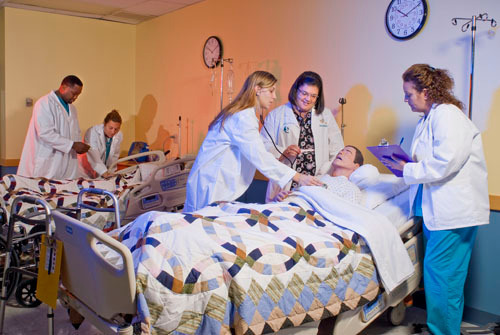
Seeing an opportunity in the much-lamented shortage of nurses, the New England Institute of Technology is preparing to launch a new nursing program in March.
The school, which already offers health programs such as training for occupational and physical therapy technicians, will open the new associate’s degree program to about 50 students, some of whom will be eligible to obtain a nursing degree in as little as 15 months.
“The timing for this seemed particularly right,” said Steven Kitchin, vice president of corporate education and training.
Indeed, the five existing nursing programs in Rhode Island – at the Community College of Rhode Island, Rhode Island College, the University of Rhode Island, Salve Regina University and St. Joseph School of Nursing – have been operating at capacity for several years, turning away hundreds of nursing applicants every session.
More recently, the stalled economy has been blamed for forcing older nurses to stay on the job longer instead of retiring, leaving fewer openings for freshly graduated nurses.
But health care experts and state labor officials insist that the sector is still primed for growth, with many employees reaching their retirement years just as an aging population would need more care.
In fact, the Hospital Association of Rhode Island projects that the state will need as many as 4,500 new nurses by 2014.
That might explain why the association has been supportive of New England Tech’s entry into the nurse-training business.
“We’re actually very excited,” said Ruth Ricciarelli, executive director of the hospital association’s Center for Health Professionals. “We’ll be getting a supply of nurses in as soon as 18 months.”
The NEIT program earned the approval from the R.I. Department of Health’s Board of Nursing in November.
The school has selected Karen Haidemenos to lead the new program, while two other faculty positions recently remained unfilled.
Hiring faculty has been a problem for other schools in part because registered nurses can often earn more than instructors.
For instance, an associate professor of nursing at CCRI earns about $48,000 annually – about the same as a first-year registered nurse working for the state’s largest health system Lifespan, not including overtime.
Still, Kitchin is not overly concerned. First of all, the private school can offer more pay than the public institutions.
“But we don’t believe this is strictly a money issue,” Kitchin said. “We’re going to offer the excitement of a new program that an individual will be able to mold.”
Responding to concerns that NEIT may woo teachers from other nursing programs, Kitchin said that shouldn’t be the case. With other NEIT programs, the school has often relied on people knowledgeable in their field who might not have experience in front of students.
The NEIT program is starting out relatively small, with 50 students. CCRI has more than 300 nursing students for its associate’s degree program, while in the four-year programs, URI has about 170 enrolled, RIC has 160 and Salve has about 50, according to the hospital association.
NEIT plans on dividing its inaugural set of students into two groups of 25. Those who need the full number of credits are expected to complete their studies in 21 months. The other set of students, who already have some of their liberal arts requirements, can finish in 15 months, Kitchin said.
Haidemenos, who holds a master’s degree from URI and is working on a doctorate, has spent the last year developing the nursing program, including buying state-of-the-art teaching equipment, including mannequin-like patient simulators.
The school will house the nursing program at its Center for Technologies in Warwick, but the school’s health programs are expected to move to a new campus in East Greenwich next fall, Kitchin said.
Getting an associate’s degree in nursing won’t be cheap at NEIT.
Kitchin said the tuition will run about $40,000 for the 21-month program and about $30,000 for the shorter program. That’s compared to about $9,130 at CCRI.
The price tag hasn’t deterred many prospective nursing students.
“We’ve been very busy in the interview process,” Kitchin said. •