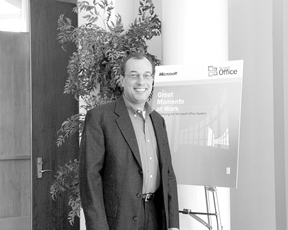
New England district.
Microsoft
regional manager discusses Rhode Island market
Michael J. Kosek
Seifert Systems Invests in Energy Efficiency to Strengthen Operations
For manufacturers, energy is more than just another operating expense. It plays a critical role…
Learn More
Position: General Manager of Microsoft’s New England District
Background: Kosek began his career with Microsoft 12 years ago as a
corporate account executive. Prior to that, he held positions in technical,
sales and sales management with several organizations, including Unisys, Ungermann-Bass
and the New York State Education Department.
Education: B.S. in computer science with applied mathematics from the
State University of New York Albany.
Age: 43
Residence: Bedford, N.H.
Kosek is responsible for overseeing the sales, marketing and consulting
for Microsoft’s software and services business for the six-state New England
District. In 2002, his district brought in revenues of $238 million and employs
more than 60 people.
He was at the Rhode Island Convention Center in mid-November to introduce
the company’s newest product, the Microsoft Office System, which the company
has tailored from a suite of personal productivity programs into a system of
integrated desktop applications and solutions for businesses.
Q. Microsoft is obviously the operating system pretty much everyone uses.
How much growth do you really see out there in terms of market share?
A. In terms of market share and how technology is being used, we think
where we are today is really just the tip of the iceberg. We see technology
evolving greatly over the next 10 or 12 years. Even with the Office launch,
some of the key innovations Microsoft includes in technology is really helping
the technology industry move forward. So, for example, when we released Windows
XP a year and a half ago, only 10 percent of the consumer population had digital
cameras. But when we released Windows XP we included technology so that you
can simply take a digital camera, stick it into your PC, have it transfer to
the PC and see it right there on your screen. That helped, over the last year
and a half, the number of people who own digital cameras increased from 10 percent
to 50 percent. So when you take a look at technology driving a consumer-based
industry, or the use of technology, Microsoft has really put a lot of effort
into creating more innovation within our products. Microsoft is investing $6.8
billion in R&D this year, that’s probably the highest of any company in
the world. And it’s a pretty significant figure in comparison to our annual
sales.
Q. Do you see that R&D process being more consumer- or business-driven?
A. It’s a combination of both, I mention the digital camera because
it covers both. … From a business perspective there are a lot of new technologies
that can be introduced into the organization to improve efficiencies. Better
collaboration, being able to monitor where deficiencies are in a business process
and being able to apply very easy technology to define those issues in that
process and fine-tune it.
Q. Is Rhode Island following the trends of the New England IT marketplace?
A. I think they are. And Rhode Island is certainly one of the largest
states within our, well, six states (laughing); larger than at least one … I
think if you look at technology adoption in terms of verticals, and that’s pretty
consistent across the world – financial organizations may adopt technologies
a little bit faster than say, manufacturing, but that’s OK. Applications are
written for different industries and maybe some of those organizations are using
technology as a competitive weapon vs. a business process, but again, it depends
on the organization and the verticals. But I would say Rhode Island is consistent
with the rest of the United States in terms of adopting technology.
Q. In selling to the Rhode Island market, are there any big differences?
A. No. What we try to do is introduce solutions to the customers,
and that’s not unique to Rhode Island, but it’s no longer providing just bricks
and mortar, it’s providing key solutions. And what you see with the Office System
today is that we are providing solutions. It’s not simply a word processor,
it’s not simply a spreadsheet. It’s asking what is the business problem and
how can we solve that? Everywhere now it’s about providing the specific business
solutions and not just the products.
Q. Among all this talk about the economy, do you see that companies are
willing to begin investing in their infrastructure again?
A. I think it is. If you look at (the amount of money companies spend
on IT), it’s approximately at 2.8 percent growth right now. And we find that
this is a great time for organizations to invest in more information technology.
If you take a look at how information technology can be revamped to increase
those business efficiencies and get better customers. … One way that many organizations
are attracting new customers is through technology. If you look at the Web services,
if you look at some of these retail organizations – in the past they always
had retail stores. Now it’s basically click-and-mortar vs. brick-and-mortar.
Improved technology and efficiencies can drive more customers to their organization
and increase sales. We just don’t think to be technology-stagnant at this point
in time is the right thing to do.
Q. There’s been all of this talk in Rhode Island of building up a critical
mass – not only of infrastructure but of people able to perform high-tech jobs.
How close do you think Rhode Island is to that critical mass?
A. I think Rhode Island is pretty consistent with the other states,
at least what I see through New England. Rhode Island has a lot of technology-based
organizations. You’ve got from the Naval Underwater Warfare Center to Raytheon
to Textron. You’ve got some large organizations and some small organizations
that are very innovative and technology-based, from Web developers to many of
our solution providers. We have solution providers located in Rhode Island that
dovetail into Microsoft’s business very nicely. These are organizations that
sell Microsoft-based products that help customers implement and deploy Microsoft
products. … We see those types of organizations growing, these small- and medium-size
organizations growing much more than say, some of the larger organizations,
just based on the economy.
Q. What’s the next big thing in software?
A. One of the things that many organizations are facing today, that
I think we need to do a better job on, is the area of security. If you look
at the security area, we’re doing a lot of great things. There’s a huge initiative
at Microsoft called the SD3 framework; it’s basically how we are approaching
security in our products. The name stands for secure by design, secure by default
and secure by deployment. Those are three initiatives that we are taking very
seriously and working with many of our customers to make sure that the hackers
and the villains that are trying to exploit organizations and release viruses
and break down these infrastructures are caught. We’re working with law enforcement
agencies to make sure those people are caught and we’re hoping that through
this process, our products will be much more secure-aware. …
Q. Anytime a widespread virus comes along, it seems that the finger is
always pointed at Microsoft as somehow being responsible. What sort of burdens
are there when you’re the guy the hackers want to get?
A. We’re very fortunate to have a very large market share. Is Microsoft
a target? Yeah, but there’s a lot of targets out there. We’re probably much
more visible because of the size of the market share we do have at this point
in time. But again, we are working very hard to make our software that much
more secure. It’s an industry-wide problem, not just a Microsoft problem. …
It’s a different world out there now. And in the past it used to take close
to a year for people to debug a patch, now it’s getting down to weeks and even
days. So, because of that process of being able to un-code a patch and being
able to interject a virus, we’ve got to be able to change the process ourselves.
Q. As far as Microsoft’s philanthropic work in Rhode Island, do you see
the company ever taking on a larger role?
A. I think over the last couple of years, we’ve had a number of grants
and donations in Rhode Island. (Since 1997, Microsoft Corp. and Microsoft employees
have given more than $446,000 in cash and software to organizations in Rhode
Island such as Brown University, Rhode Island School of Design, Rhode Island
Community Food Bank Association, Plan International, Fusionworks and the Alternate
Learning Project.) We have a couple of key organizations we work with close
to Rhode Island as well – different Boys & Girls Clubs of America (funded
by a $100 million donation from Microsoft, the Club Tech program will be extended
to more than 3.3 million children and teens through every Boys & Girls Club
in the nation over the next five years and has one location up and running in
Taunton) and a number of libraries where we work to do what we call “Bridge
the Digital Divide” and enable charity organizations or people who may not be
fortunate enough to have a PC at home to provide them Internet access and access
to technology. Those types of programs we’re always looking to continue.