to figure out how to make the
streets down here bustle.'
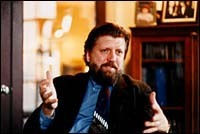
There’s an intensity in his eyes that easily reveals a passion for the arts.
It shows when Oskar Eustis talks of the theater, or about Trinity Repertory Company and its potential, about Providence and the vision for a downtown arts district, about Rhode Island, the community he calls home with his wife and young children, where they have been able to establish roots, a rare commodity for an artist.
Rhode Island's Market Has Changed. Developers, Builders, Investors and Sellers Must Change With It.
By Emilio DiSpirito IV License Partner | Engel & Völkers Oceanside Leader | The DiSpirito…
Learn More
You see, Oskar Eustis believes in all of those things, and believes that with the right combination of individuals, of support, energy and vision, you can turn a wooden stage into a city park, and a city street into a vibrant downtown arts district.
Envision for a moment the streets near Trinity Repertory Company or Providence Performing Arts Center, filled with people, bookstores and art galleries, cinemas and cafes and the other businesses that thrive in that kind of environment.
This is the vision that Eustis has for Providence downcity, a vision that is still more akin to an artist’s dream than to reality.
“We’re going to have to figure out how to make the streets down here bustling at night,” he said recently from his top floor office at Trinity Rep, where he is artistic director. Eustis reconfirmed his commitment to Providence recently, withdrawing his name for consideration to head Yale’s drama program.
“The district has not become a destination,” he said. “There’s not enough critical mass to draw people.”
The downtown arts district has been among those areas discussed often during the rehabilitation of Providence, the true cornerstone of a renaissance that so far has seen rivers moved and shopping malls built, while the arts district remains merely a dream.
The Rhode Island Foundation, United Way and others have joined in a downcity project that they hope will attract a movie theater, move the Traveler’s Aid, and spark some of the revitalization that Eustis and others envision.
The downtown arts district needs to be a destination, Eustis said, and one way for that to happen is to build the artists’ lofts, the downtown housing that has been planned since the passage of legislation providing tax incentives for those living and working in the district.
“Housing makes all the difference in the world,” Eustis said. “If you have a neighborhood, services will follow.”
Few cities Providence’s size boast of a downtown arts district as a destination, but Eustis also believes there are few cities Providence’s size that have the same “collection of world class arts and educational institutions.”
When he thinks of similar types of districts, Baltimore comes to his mind.
With the revolving loan fund developed by the Rhode Island Foundation and other initiatives, Eustis sees the downtown arts district taking shape within as soon as two years, the same time frame that his theater, Trinity, expects it to take to open its newest theater in the former Citizens Bank Building – The Citizens Theater at the Pell Chafee Performance Center.
And it’s that center that Eustis also sees as central to his vision for Trinity’s future.
The new space, he said, will allow Trinity to also act as a presenting organization, bringing works into Providence that have never been seen here before, and providing a space for local groups to present their works.
Eustis is also committed to upgrading the quality and support of Trinity’s own training program (the conservatory), making it “competitive with anybody in the country.”
And, he is on a mission to improve artists’ compensation, to “seriously tackle the shameful level of compensation” provided members of the repertory company that have become committed not only to the theater, but to the community. To provide them, Eustis said, with compensation that allows them to live with “dignity and respect.”
“All those things are my dreams, what I want to happen,” Eustis said.
These are also times of change for Trinity Repertory Company, as it plans for a new theater (the Citizens building), takes its place in what it hopes to be a vibrant arts district, and finds itself without its managing director of three years, William Wingate.
“Bill is a serious loss,” Eustis said. “He’s probably the most experienced manager in the American theater. He handled this with class, grace and plenty of planning.”
As a result, Eustis said, Trinity has an opportunity to try to attract “somebody who can push the organization to a whole new level.”
A time of change, of audiences that Eustis said are getting younger, an average of seven years younger than five years ago when he arrived, and double the size, because the work that the company performs “appeals to them.”
And it is a time of change, for the company that is a combination of new talent and some that drifted away during the Ann Bogart era, like Keith Joachim and Ricardo Pitts Wiley, who are now performing more frequently with the company with which they had been involved for years.
“We’re bringing people back and bringing new people in,” Eustis said. “For the company to be successful it needs a halo to extend out, to be broad and inclusive.”
It also needs to celebrate creativity, something upon which Eustis thrives.
“I’m happiest,” he says, “when I find a way to structure something that unleashes the creativity in individuals.”