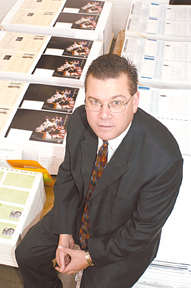
Robert Nangle
Meridian Printing
Location: 1538 South County Trail, East Greenwich
Type of Business: High-end printer in commercial and art reproduction
markets
Seifert Systems Invests in Energy Efficiency to Strengthen Operations
For manufacturers, energy is more than just another operating expense. It plays a critical role…
Learn More
Year Founded: 1978
Employees: 82
Annual Sales: WND
Web: www.meridianprinting.com
Over the course of its 25 years, Meridian Printing has seen changes in its name, its owners and its technology. But Meridian President Robert Nangle said the one thing that doesn’t change is the quality of the company’s product.
In February, Nangle, along with Steven Lee, now Meridian’s executive vice president, decided to perform a management buyout and take the reins of the company from a conglomerate in Ireland. Since joining the company in 1997, Nangle said he had seen more and more of management’s time being taken away for meetings with its parent company, which became more of a distraction than a benefit after some time.
“We knew we were on the market and we thought about what might happen if another conglomerate bought us,” Nangle said. “We decided that we wanted to preserve the company as it is today and continue on with that 25 years of history. It was a good opportunity. We have a good reputation and good employees and we wanted to keep it local.”
Meridian focuses on two markets within the high-end niche printing business, Nangle said. On the commercial side of the business, the company prints everything from corporate brochures and annual reports to sell sheets with a client list including the Pawtucket Red Sox, Citizens Bank, Boston Beer, Swarovski and A.T. Cross. Meridian also does work for several colleges, including the Rhode Island School of Design, Bryant College, Johnson & Wales University and Bentley College.
The company’s other market includes art and photography reproduction for books, posters and gallery shows that feature artists such as Ansel Adams, Annie Leibovitz, Richard Avedon and Irving Penn.
“These craftsmen are people who really care about the final results,” said Nangle, adding that it’s the little things that make a difference like 5,000-watt lighting fixtures in the press room and the company’s willingness to tweak the ink until the image is right.
“It’s their art and it’s really important to get it to a pleasing color and get a match that’s much closer to the original,” he said. “People who hire us have high expectations and whether we’re working on a brochure or something from a museum, the job is going to be treated the same.”
That care paid off this year when the printing company was named the North American Printer of the Year by Sappi, a producer of fine coated paper, for Meridian’s “100 Years of Harley-Davidson” book. Nangle said it was the first year the company had entered the contest, where its work was selected out of more than 3,100 entries from more than 600 printing companies for the prestigious award.
Meridian was originally founded in 1978 by Dennis Glass, who opened for business in West Warwick with two single-color presses under the name Union Printing.
In 1982 Glass renamed the company and bought land on South County Trail in East Greenwich where the 30,000-square-foot facility is located today. In 1996, with a significant amount of consolidation going on within the printing industry, Glass sold the company to an Ireland group.
In Nangle’s early years with Meridian, he oversaw more acquisitions in the United States by the group as they bought another four niche printers, but as chief operating officer in 2001 and 2002 he helped sell all but one of those companies off. When it became Meridian on the block, Nangle and Lee, who had joined the company in 2000 to head up operations, decided to buy the business themselves.
Meridian now operates three six-color presses, one five-color press, and two two-color presses, running two shifts a day, one full and one usually three-quarters full, depending on demand.
Around 25 employees work in the press room, another 30 are split between pre-press and bindery work and another dozen work in sales and marketing. The remainder of the workers are in accounting, customer service and estimating, a division necessary because, Nangle notes, every job at Meridian is a custom job. Even to produce letterhead is not a cut-and-dry job with a set price list.
In the past seven years, Nangle said the company’s dealt with a huge shift toward digital, but adds that productivity saved is equaled by cost of equipment to support the technology. He said Meridian has never had to lay off workers, although over the years, as people have retired some positions haven’t been replaced.
Over the next year or two, he said the company is looking to grow responsibly, making capital expenditures to add another press and duplicating some of its pre-press equipment for plans to grow within its own industry 5 percent to 10 percent a year.
“The employees are really the key to the operation,” Nangle said. “So many people can say they have 20 years experience in the printing industry, but here, there’s a lot of people who say they’ve got 20 years experience with Meridian. That’s what makes us that much better an operation.”