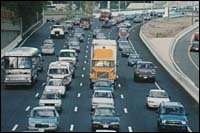
ease congestion on RI's highways.
(Photo, Tom Croke)
There is legislation pending at the General Assembly that calls for a bar code to be put on the back of your driver’s license — that would enable a police officer to swipe the license to record information. The idea is to allow the officer to move along the participants of a minor accident more quickly.
Saving even a minute or two, according to state Department of Transportation Director William Ankner, is invaluable in terms of maintaining traffic flow — and preventing additional accidents.
Beyond Cash Donations: How New Forms of Giving Are Transforming Not-for-Profit Accounting
Evolving Funding Landscape for Not-for-Profits Not-for-profit organizations are being asked to do more with less,…
Learn More
For example, for every minute that it takes a Rhode Island State Trooper or municipal police officer to clear up a minor accident, traffic congestion is increased by four minutes. And the likelihood of a related fender-bender increases as well.
“The faster it gets cleared up, the better,” said Ankner.
The bar code technology is one of several examples that Ankner cites in pointing out that the condition of Rhode Island’s highways and roads — and the traffic flow along them — is indeed improving.
Other examples, he said, include the increased use of mounted cameras that send real time images to the Traffic Operations Center in Providence, and the increased and better use of signs.
“We have had a tendency to put up signs that Rhode Islanders understand, but not necessarily signs that can be understood by people from outside of the state,” said Ankner.
Satisfied customers
Ankner’s comments come on the heels of a U.S. Department of Transportation report
showing there has been a significant increase in the number of travelers who are
satisfied with the conditions of the country’s major highways.
The report, Moving Ahead: The American Public Speaks on Roadways and Transportation in Communities shows that 65 percent of highway travelers are satisfied with the major highways they travel most often. This represents an increase of 15 percent since the completion of a similar study in 1995 by the National Partnership for Highway Quality.
Travelers, according to the U.S. DOT report, cited increased satisfaction with regard to pavement conditions, safety, bridge conditions, visual appeal, and travel amenities.
The reviews, however, were not entirely glowing.
About 20 percent of respondents’ expressed dissatisfaction with the overall highway system – a 6 percent increase compared to the 1995 survey.
Travelers said they wanted better traffic flow and more effective ways to decrease traffic volume. Respondents also said they wanted highway projects to be more sensitive to local communities and transit services and bicycle and pedestrian facilities improved and increased.
The findings of the report do not surprise Ankner.
Overall, he said, U.S. highways and roads “have been moving in a direction and trend that has been positive.” As for areas in which respondents see room for improvement, Ankner again found no surprises.
“The issues that need to be addressed are the same issues we are trying to address in Rhode Island,” said Ankner.
For example, Ankner points out that Rhode Island, like a lot of states, must take advantage of technology and better manage its highways and traffic systems because simply adding new roads or expanding existing ones is not an option.
“You’re not going to see a lot of new capacity in our roads — you are not going to see new lanes coming in,” he said. “We’re going to have to manage our roads better.”
Ankner said traffic lights, for example, are now being viewed as systems.
“Historically, we looked at our traffic lights one at a time,” said Ankner. “Now we look at them as a corridor. The timing mechanisms are electronic. You start putting in a light system that allows the lights to talk to one another — and you can begin to platoon traffic when you need to.”
Sean Durgin, general manager at New Penn Motor Express, Inc., a Cranston trucking company, gets feedback from his drivers — many of whom spend their days traveling from Rhode Island to the New York/New Jersey area and back.
For the most part, said Durgin, the reviews are good — with the exception of the stretch of highway running through Connecticut.
“The worst area is in Connecticut — everything after that is fine,” he said. “And Rhode Island is fine.”
Durgin also has in-state drivers who pile up the miles on Routes 295, 146 and 195. They report few problems along Rhode Island’s interior highway system.
As for technological advances, Durgin is all for them. Although he suspects that most of his unionized drivers — who make about $29 per hour after eight hours — are not likely to complain too loudly because of a traffic tie-up.
Ankner expects the Rhode Island roads to earn even higher marks in the coming years. He is also quick to point out that Gov. Lincoln Almond’s “Fix It First” program is working. Four years ago, said Ankner, 34 percent of the pavement in Rhode Island was labeled in poor condition — 16 percent of that very poor. Last year, he said, 23 percent of the pavement in the state was in poor condition — 6 percent of that very poor. And next year, said Ankner, 13 percent of the pavement in the state is projected to be in poor condition — with 0 percent in very poor condition.