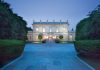
Touro Synagogue in Newport is putting the finishing touches on a $2.6 million renovation.
Nestled in Newport since 1763, Touro Synagogue has become a symbol of Rhode Island’s founding principles of religious freedom and tolerance. But until recently, the symbol had been suffocating.
When Touro underwent a structural analysis in 1997, the results contained in an 800-page report were grim. The outside of the colonial-style structure was buried in 22 coats of paint, preventing air from venting from the brick walls, trapping moisture and spawning mold. What’s more, the roof timbers were buckling.
Beyond Cash Donations: How New Forms of Giving Are Transforming Not-for-Profit Accounting
Evolving Funding Landscape for Not-for-Profits Not-for-profit organizations are being asked to do more with less,…
Learn More
“All of this began to raise red flags that a building that had been around for 250 years was self-destructing,” said Michael Balaban, CEO of the Touro Synagogue Foundation, which maintains the landmark.
“If intervention did not take place,” Balaban noted, “the building itself would have collapsed.”
The synagogue’s decline was an issue of national concern. Touro is the oldest standing synagogue in North America, attracting about 30,000 yearly visitors, many of them Jewish worshipers who consider the building a shrine, Balaban said. “Jews come to the site in awe that it’s still there.”
With Touro’s status as a national treasure, the U.S. National Park Service drafted plans to preserve the relic. Also, the synagogue foundation launched a capital campaign in 2002 to pay for the overhaul. The preservation project began last May.
“Because of the age of the building and its historic significance, it kept me up at night,” said Eric Greene, a project executive for Shawmut Design and Construction, the contractor for the $2.6 million undertaking.
Using modern techniques to preserve the two-story structure, Shawmut installed a gutter system around the slate-shingled roof to prevent further water seepage into the building. The multiple layers of paint, which had trapped moisture in the walls, were removed with non-toxic foam. Masons repointed the bricks, and then painted the outer walls with a porous coating.
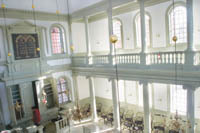
Inside the synagogue, crews peeled off 50-year-old wallpaper, exposing mold that had festered for decades, and repainted the inside walls. They salvaged some of the wooden fixtures inside the 4,400-square foot building, Greene said, using epoxy to repair corroded areas. Others were replaced. And sagging timbers in the ceiling were reinforced with steel.
Some difficult restorations forced the firm to outsource work to specialists. Rotted window sashes were sent to Heartwood Building & Restoration, in Hawley, Mass., and brass chandeliers were repaired by Newman’s Ltd. in Newport.
To comply with today’s building codes, the project required installing a sprinkler system and fire alarms. The boiler was replaced, as was the plumbing. With touch-up paint applied two weeks ago, Greene said, the building now only needs a certificate of occupancy.
Balaban said that Touro’s congregation, made up of 135 families, has had to conduct religious services in a temple within its office building on the other side of Touro Street. For larger functions, he said, the congregation has used facilities at the Vanderbilt Hotel, Salve Regina University and other buildings in the religious community.
The overhaul is the latest chapter in the synagogue’s long history. Originally designed by renowned architect Peter Harrison, the building is one of only 28 sites covered by the National Trust for Historic Preservation. Others include Frank Lloyd Wright’s Pope-Leighey House and Montpelier, the home of James Madison, both located in Virginia.
With the project complete, services should resume in the synagogue within weeks, Balaban said, and tourists should be welcomed in again by Memorial Day weekend.
Most important, a historic landmark has been preserved.
“I think many people grow up with the impression that the Jews came here in the aftermath of the Holocaust,” Balaban said. “The synagogue shows that we have been here since the beginning of this country.”