cation professor.
Rhode Island’s economic development leaders have been successful over the last few years attracting companies in an industry with huge upside potential for capital investment and job creation: biopharmaceutical manufacturing.
Now, the state is moving to make sure a dearth of skilled workers doesn’t short-circuit the budding sector, which could add as many as 1,000 jobs in Rhode Island over the next five years.
A new biopharmaceutical manufacturing “training institute” being planned in Rhode Island would be the first of its kind in the country, providing hands-on training for would-be operations technicians in the highly specialized field.
Rhode Island's Market Has Changed. Developers, Builders, Investors and Sellers Must Change With It.
By Emilio DiSpirito IV License Partner | Engel & Völkers Oceanside Leader | The DiSpirito…
Learn More
“These jobs are today’s equivalent of yesterday’s middle-class manufacturing job,” said Christopher “Kip” Bergstrom, executive director of the Rhode Island Economic Policy Council, which is spearheading the new institute. “With a high school diploma and some specialized training, you can support a family. It’s a decent job.”
Starting salaries for operations jobs at the new Immunex Corp. facilities in West Greenwich, for example, will be $34,000, according to the company.
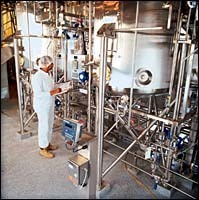
The Seattle-based firm began construction in West Greenwich late last year of a new 250,000-square-foot, $500 million cell-culture manufacturing facility, which will include 20,000-liter bioreactors (the biotech industry generally uses bioreactors smaller than 2,000 liters).
The new building will join a retrofitted plant of similar size, which is expected to win federal approval later this year to produce Enbrel, Immunex’s hugely successful rheumatoid arthritis drug. The two facilities will employ a total of 700 workers, according to the company.
The state’s other large biopharmaceutical firm is Dow Biopharmaceutical Contract Manufacturing Services, which last year announced plans to add a 114,000-square-foot extension to its existing facility in Smithfield, a move that would add “several hundred jobs.”
The policy council last year surveyed Immunex, Dow and a number of large biopharmaceutical companies in Connecticut and Massachusetts about their staffing and training needs. The findings reflected a need for a hands-on training program to help quell the shortage of skilled workers facing the biopharmaceutical industry here and nationally.
Young biotech firms need manufacturing workers as they struggle to make the transition from research-based enterprises to manufacturers of large quantities of biotherapeutics. Although many of the state’s higher education institutions have strong biomedical programs, curriculum generally is focused on research, which doesn’t necessarily translate to the manufacturing skills required by the biopharmaceutical industry.
“After meeting with industry representatives, as well as members of the state’s higher education community, our team reached the conclusion that a hands-on training program would fill a critical need,” said Joseph P. Hammang, director of science and technology for the Economic Policy Council.
The Rhode Island Human Resource Investment Council last month awarded the policy council a $100,000 grant – renewable for two years – to begin the development of the training institute. But the bulk of the funding will come from the companies themselves, Bergstrom said, and the policy council is working with several firms to obtain additional assistance.
Those include Dow, Immunex and Amgen (which is in the process of acquiring the Seattle-based company), Pfizer and Bristol Myers Squibb (which both have manufacturing operations in Connec-ticut) and Genzyme and Millennium Pharmaceuticals, two large biotech firms based in Cambridge.
The institute needs about $300,000 annually during its first three years to hire a small staff – including an executive director from the biopharmaceutical field – and to develop curriculum with input from the industry.
During those initial years, the not-for-profit training facility will be housed at a temporary location, where workers will gain first-hand experience on biopharmaceutical machinery and equipment, instructed by industry employees. Organizers envision trainees getting the required experience to slide easily into a manufacturing job after just three months of intense training.
New biopharmaceutical-manufacturing workers now are trained on the job, which poses operational risks, Bergstrom said.
“It’s a process that’s extraordinarily complex, and it’s easy to screw up and put millions of dollars worth of product at risk,” Bergstrom said. “But you have to learn on the job. You can’t learn it sitting in a classroom, so it’s a Catch-22. This is going to be a better way for these companies to spend their training dollars than the way they’re spending them now.”
About $6 million is needed to construct a new building and another $4 million will go toward equipment. The institute’s executive director will work to garner financial assistance and capital investment from the biopharmaceutical firms.