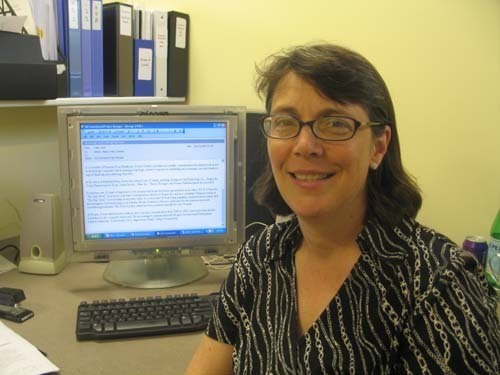
Christine M.B. Smith has been the executive director of the R.I. Science & Technology Advisory Council (STAC) since it was created in 2006. Since its start, STAC has distributed about $5 million in grants to approximately 30 research teams at 27 local institutions and firms, including $1.1 million awarded to six collaborative research projects earlier this month.
But now STAC – which falls under the umbrella of the R.I. Economic Development Corporation – is feeling the effects of the state’s budget problems. Gov. Donald L. Carcieri’s fiscal 2010 supplemental budget asked legislators to cut the budget for STAC’s grants.
Smith recently spoke with Providence Business News about the funding, as well as the effects of recent changes within the EDC on STAC.
PBN: The governor had proposed cutting $200,000 from the $1.5 million budget for STAC’s collaborative-research grants, but that would jeopardize the state’s effort to win a five-year $20 million extension of the National Science Foundation’s Experimental Program to Stimulate Competitive Research (EPSCoR) program. How have you responded to that move?
SMITH: We explained to the governor that this is a state match to our EPSCoR funding that comes into the state from the National Science Foundation. It’s a state match in that the NSF was looking for significant programming, on the state’s part, to support science and technology. That was a commitment that we need to keep. The governor absolutely agreed. He’s been very supportive of STAC and he instructed the budget office to send a restoration to the General Assembly.
Beyond Cash Donations: How New Forms of Giving Are Transforming Not-for-Profit Accounting
Evolving Funding Landscape for Not-for-Profits Not-for-profit organizations are being asked to do more with less,…
Learn More
PBN: Then why was the proposed cut suggested in the first place?
SMITH: It’s one of those things. The governor is very supportive of level-funding STAC. [The proposed cut] was something that came out of the budget office, not from the governor. When we were able to explain to him that [the grants] had been caught up in the lists of places to cut, he was very strong in saying, “No, I firmly believe in supporting this.”
SMITH: The process is that he sends amendments [to the General Assembly]. We’re not the only ones. There’s a whole list of amendments that are going in. There’s a process where, since we were suggested [for cuts] we now have to be restored [by the General Assembly]. … [The grants] are fairly small amounts of assistance that are given to promising research entities. They’re going to business as well as the institutions.
It’s part of the economic-development package. We need things all along the continuum.
PBN: So the money hasn’t necessarily been restored.
SMITH: We’ve approached the staff of the General Assembly asking that they also support the restoration.
PBN: But the fact that the governor is trying to reverse the budget office’s initial recommendation, you must feel that’s a vote of confidence for STAC?
SMITH: I think that’s why STAC has enjoyed its success, in part, because the governor has been supportive, [House] Majority Leader Gordon Fox has been extremely supportive. Leader Fox and [Sen. William] Walaska were our original legislative sponsors, and they have continued to be supportive of STAC.
PBN: The EDC underwent an intense review last year, which led to a highly critical report of the state’s economic-development efforts. Was STAC part of that review?
SMITH: Yes, STAC was part of that review. Actually, STAC was pointed to as one of the initiatives that they wanted to see future EDC [plans] modeled after. It’s about collaboration, it’s about going out into the community where the assets are, trying to create connections and bring people together around a common purpose.
SMITH: STAC is here at the EDC because it is believed that it’s extremely important to align what STAC is doing as an economic-development initiative to the overall mission of the EDC. Yes, Keith’s leadership will impact us because it’s important to stay aligned, but listening to him and knowing him – he’s been on our board – I think we’ll be going forward, as we have, on the same trajectory.
PBN: Aside from the grants awarded through STAC’s Rhode Island Research Alliance, what other initiatives are you involved in?
SMITH: STAC also championed an innovation tax credit. So between the $1.5 million we have to use in collaborative research, we have about $500,000 a year to award to small companies – most of them have been startups – because they have to have under $1 million in revenue. These are companies with intellectual property, so they don’t have a traditional balance sheet. They’re going out into the market trying to raise capital. When Isis Biopolymer [a manufacturer of patches that deliver drugs through the skin] was first being formed, it received an innovation tax credit and had only a few employees at the time. [It now employs 40 people.] It’s a success that STAC has contributed to by helping them with the innovation tax credit.
We look for companies who have a need, but also a high likelihood of success. We look at the management team, the business plan. We do a lot of due diligence. It is an investment from the state, and we take that very seriously. … We’ve helped about 10 companies over the last two to three years. •
INTERVIEW
Christine M.B. Smith
POSITION: Executive director of the R.I. Science & Technology Advisory Council
BACKGROUND: Smith worked as the international trade director for the state from 1987 to 1991, and then served as a program manager for various nonprofits and corporations. She joined STAC when it was created by state statute in 2006.
EDUCATION: Bachelor’s degree in foreign service, 1982, Georgetown University
FIRST JOB: A counselor at Camp Watchaug, a youth day camp in Charlestown, at age 16
RESIDENCE: East Greenwich
AGE: 49