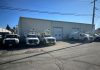
on Allens Avenue in Providence.
A $4.5 million federal grant will energize a local initiative to put more Alternative Fuel Vehicles on Rhode Island’s roads.
The grant is from the Congestion Mitigation Air Quality Improvement Program (CMAQ) administered by the Federal Highway Administration and will result in the construction of five new fueling stations for Alternative Fuel Vehicles.
Rhode Island's Market Has Changed. Developers, Builders, Investors and Sellers Must Change With It.
By Emilio DiSpirito IV License Partner | Engel & Völkers Oceanside Leader | The DiSpirito…
Learn More
The state has already used $1.1 million in CMAQ funds to build small stations at the University of Rhode Island and in Middletown.
Today there are some 300 AFVs travelling on Rhode Island roads and only a handful of service stations.
“We had to buy the cars,” said Janice M. McClanaghan, chief of energy and community services at the Rhode Island State Energy Office. “And the cars couldn’t live with out the stations, but we didn’t know which to do first. It’s just like that old cliché” (what comes first the chicken or the egg?).
In 1992, in an effort to cut US dependency on foreign oil Congress passed the Energy Policy Act, known as EPAct , which required that by the year 2001, all new vehicles purchased by state agencies and 90 percent of new vehicles purchased by utility and federal agencies run on alternative gas.
But the legislation didn’t require building filling stations especially designed to meet for AFVs.
And according to Ocean State Clean Cities Coalition, a public-private partnership supported by the US Department of Energy, without the filling stations the state has no “infrastructure” to support the advancement of AFVs. The organization’s main goal is to increase the use to AFVs in the state.
“The state as well as some private businesses have bought a number of electric and pressurized natural gas cars,” said Harry Knickle, associate dean of Engineering at the University of Rhode Island and a member of OSCC.
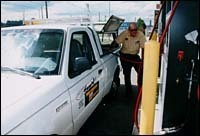
The state currently runs a satellite station at the University of Rhode Island and another one in Middletown. Providence Gas has two refueling stations in Providence – one on Allens Avenue and other on Dexter Street, and Valley Gas has one station in Cumberland. According to OSCC that’s not enough. Providence Gas officials say their site also serves as a fill-up station for about 15 other Rhode-Island based businesses.
“It’s been a very difficult investment for the state to make,” said Steve Woerner, OSCC executive director. “A good size station costs close to $700,000 and a tiny little one costs close to $250,000.”
And now with five new stations set to come on line in the next six years — where they should go has become one of OSCC’s discussions.
“We have talked a lot about where to put these stations so that we have reasonably good distribution around the state,” he said.
Plans now call for the development of a new station in Cranston for close to $700,000 and another station at TF Green Airport in Warwick for close to $375,000. According to McClanaghan, the Rhode Island Public Transit Authority is also planning on creating a station on Elmwood Avenue — a project that comes with a $1.7 million price tag.
“RIPTA’s station will be for its buses and trolleys,” she said. “The others will be open to public and private fleets.”
And though federal requirements only require that state filling stations be open to public and private fleets, Woerner said OSCC is currently looking for a way to open the service up to anyone that drives an AFV. Providence Gas currently provides service to any AFV vehicle at its Allens Avenue location, but Woerner said it’s difficult to manage.
“What owners have to do now is work out a private billing arrangement with Providence Gas,” he said. “They don’t have any user friendly swipe machine — we are currently trying to get a grant for that. It’s important that these stations become more user-friendly.”
And while many single car businesses, and residents have yet to catch on to the idea of AFVs and electrical cars, Knickle said it’s his hope that eventually the idea will catch on.
“If someone is driving here from Washington DC and they need a way to charge their battery, or a way to fill up with pressurized natural gas, they will need a place to go,” he said. “We want to have that.”