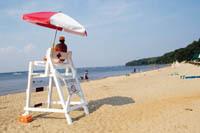
A LIFEGUARD watches swimmers at Goddard Park in Warwick, one of the sites frequently affected by beach closures due to contamination.
With recent heavy rains washing tainted runoff and sewage into Narragansett Bay, beach closings are way up from last year, pinching profits at businesses in affected areas.
Beaches in Rhode Island already had lost 150 days due to pollution as of July 14, compared with 65 days during the entire summer of 2005, according to the R.I. Department of Health. Officials attributed the spike to this year’s roughly 50-percent increase in rain.
Seifert Systems Invests in Energy Efficiency to Strengthen Operations
For manufacturers, energy is more than just another operating expense. It plays a critical role…
Learn More
“One of the things that we have found is that storm drains tend to be a major source of contamination,” said the department’s Ernest Julian, a staff scientist. Runoff fills the storm drains with bacteria from animal feces near and along roads, which then flows into the Bay, he said.
Beachgoers add to the problem, by feeding seagulls and leaving food that attracts other animals, all of which leave bacteria-laden waste that gets washed into the ocean, Julian said.
Failed sewer systems are another culprit. Middletown’s sewer pump station on Wave Avenue failed two weeks ago, Julian noted, resulting in the discharge of about 1.25 million gallons of sewage into the ocean. That led to the closure of the beach at the Atlantic Beach Club and of Easton’s Beach (also called First Beach) in nearby Newport.
Julian said the department tests for enterococci – bacteria that are found in the guts of humans and other animals – to measure the fecal content of the water, and it closes the beaches if bacteria levels exceed a threshold (in salt water, 104 bacteria colonies per 100 milliliters). Human exposure to the bacteria can lead to nausea, headaches and other ailments, he said.
As usual most of closings have been at beaches along the northern half of Narragansett Bay, due to a combination of failed sewer systems and high runoff from densely populated areas.
The vast majority of the 119 licensed beaches in the state, meanwhile, have remained safe for swimming.
Still, businesses near the affected beaches have been losing sales as pollution warnings scare people away. Few know the burden better than David M. Gravino, owner of Iggy’s Doughboys and Chowder House on Warwick’s Oakland Beach, which the Health Department says is among the most frequently closed.
“It’s a problem that happens every year – but this year, it’s a lot more,” said Gravino, whose parents founded Iggy’s in 1989, at a beachfront stand that had been open since 1924 under the name Gus’s. The tainted water has been keeping bathers away, he said, cost Iggy’s its lunch crowd. “There’s no one there.”
Sales this year are down by about 40 percent, Gravino estimated, while swimming bans are up by about 20 percent. He added that higher gas prices and rising interest rates might also be causing people to spend less at restaurants.
Gravino owns a second Iggy’s restaurant near Narragansett’s Scarborough State Beach, another location that has been shuttered at times this year. But, he said, that restaurant is less dependent on beachgoers. “People [there] are on vacation, so it doesn’t matter if the beach is closed or not – they’ve got to eat.”
Another Oakland Beach business, Express Food Mart II, just a few blocks from the water, has also seen its customer count dwindle due to poor weather and beach pollution, said Sandy LaFlamme, a store clerk. (The owners were not available for comment.)
In Middletown, local officials have been taking heat over what some business owners and beach operators have called the town’s failure to remedy its sewer-system problems, said Town Administrator Jerry Kempen.
The Atlantic Beach Club remained closed last week, after a failed sewage pump allowed more than a million gallons of sewage to seep into the water. Kempen said the town planned to meet with the owners of the beach club, who had not replied to messages before press time.
Kempen said it’s a “gross misconception” that nothing is being done. The town passed a $4.5 million bond referendum in November 2004 to repair the sewer system, Kempen said. This spring, the town completed a $2 million project to prevent sewage leaks. Plans are to spend the remaining bond funds to repair the notorious pump station on Wave Avenue by early next year.
Yet the problem isn’t just faulty sewers, Kempen said. Runoff from state highways is a factor too, and the town suspects that high bacteria levels in its storm water may be due to illegal septic systems.
“We know it’s a problem. It’s probably been a problem as long as people have lived here,” Kempen said. “It’s just never been identified before.”