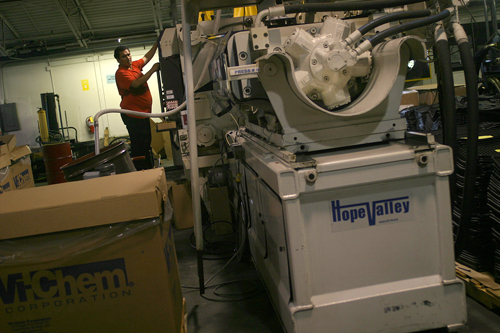
The box-like machine, which weighs about a ton, sure doesn’t look like R2-D2 or C-3PO of “Star Wars” fame.
For starters, the apparatus at Hope Valley Industries in North Kingstown does not walk, talk or come with little flashing lights that wink and blink at you. The machine looks like many other pieces of industrial equipment, fitting neatly into the huge, mold-making machines that Hope Valley uses to manufacture millions of car mats every year for such customers as Mercedes-Benz, Volkswagen and Audi.
But these robotized machines mean more to Thomas A. Melucci, president and CEO, and his son, Craig C. Melucci, vice president of Hope Valley, than any futuristic robot ever could, because they save the company time, improve quality and, the Meluccis maintain, have even resulted in the hiring of more employees, not fewer.
Tucked away in the rolling green farmlands of Slocum village, in a one-story structure that looks like a contemporary home, Hope Valley Industries has managed to be successful without government help at a time when many local manufacturers are suffering.
The company recently snared the North American contract to make floor mats for Mercedes-Benz and is working on obtaining more work from the prestigious automaker in the form of a global contract, according to Thomas Melucci. Hope Valley holds the domestic contract and recently won the global contract for the Volkswagen and Audi brands and does work on a regular basis with dozens of other automakers.
With 70 employees, Hope Valley Industries custom makes floor mats for each carmaker, consisting of a molded vinyl that looks and feels like heavy rubber but actually is made of elasticized polymer. A big selling point, Tom Melucci said, is the fact that the mats are recyclable, so they can be returned to Hope Valley, where they are melted down and replaced free of charge.
The company has been using two robotized machines in the mold-making process for about two years, recently purchased a third and plans to order three more – including a “Roboshot” all-electric-injection molding machine. The latter will reduce energy consumption by 50 to 80 percent, with cycles advertised as 5 to 50 percent faster than hydraulic machines.
“The robots are very important to us,” Tom Melucci said. “They take a lot of operator errors out of the equation,” said his son, Craig.
Hope Valley is not alone among manufacturers in its use of robotized machines.
“There are even robots that do stretch-wrapping for pallets,” he said. “They are well-used in operations that are not human-friendly, such as spray painting. The thinking is, if it looks like an unsafe operation, get a robot to do it.”
In his work as an engineer, Dwinnells said he has programmed robots, and they require a lot of software. “They have a lot of computer power,” he said. Special federal Occupational Safety and Health Administration regulations apply to their use, he added.
With the machines, Hope Valley is equipped to make its own molds for car mats. Tom Melucci said many manufacturers have to buy such molds.
Craig Melucci explained that the robots ensure both sides of the mold align perfectly. When the mats are made, the machine has an extended arm that reaches into the enclosed apparatus, retrieves the mats and places them in designated areas – work once done by human hand. “Now, the employee on the machine is able to do other things and can run multiple machines at once,” Craig Melucci noted.
Available in both domestic and imported versions, the robots can cost from $100,000 to as much as $250,000.
The Meluccis dismissed the idea that the robotized machines are taking the place of human employees. “They are not necessarily replacing jobs,” Tom Melucci said. “The robotized machines give us better control over the efficiency of [the mat-making] machines, which get the material out quicker than before. Because we’re turning out product faster, we need more people to do packaging” and other related tasks.
Hope Valley employees have shown no marked aversions to their robotized colleagues, just curiosity, the Meluccis say.
“They don’t know what to make of it, but I think they appreciate the fact that we are trying to be more efficient so we can better compete,” Tom Melucci said.
In spite of the challenging economy and slump in the market for auto-related products, Melucci said the man-hours worked at Hope Valley have not been reduced because “new ventures enabled us to broaden our base,” such as a recent move into making door mats for residential customers. •