INTERVIEW
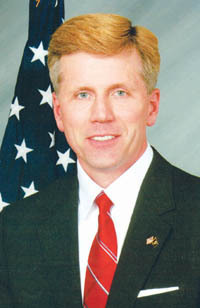
Charles E. Summers Jr.
Title: New England regional administrator, U.S. Small Business Administration
Background: Before being appointed to his post by President Bush in March 2005, Summers was state director for U.S. Sen. Olympia Snowe, R-Maine, from 1995 to 2004. He was elected in 1990 to the state senate in Maine, serving on committees focused on state fisheries and taxation. Summers grew up in his family’s hotel business and has managed motels in Bangor and South Portland, Maine, and has owned and run his own small businesses.
Education: B.S. in leisure studies, University of Illinois, Urbana-Champaign, 1983.
Residence: Scarborough, Maine
Age: 46
Charles Summers knows about the challenges of running a small business, having grown up in his family’s hotel business and then owned a convenience store and managed motels in Maine before entering politics. Now, as the New England SBA regional director, he helps other business owners. He spoke with PBN on the way back from a visit to Block Island.
Rhode Island's Market Has Changed. Developers, Builders, Investors and Sellers Must Change With It.
By Emilio DiSpirito IV License Partner | Engel & Völkers Oceanside Leader | The DiSpirito…
Learn More
PBN: What frustrations did you face as a small business owner?
SUMMERS: Workers’ compensation costs, health insurance costs, taxes and regulations. I had a convenience store where I worked seven days a week. … But that was OK, because while growing up, my parents ran an old hotel and restaurant. We literally lived at the hotel. And I grew up working at the front desk, washing dishes, waiting tables, tending bar – whatever needed to be done. So running my business was nothing new, except for the fact that everything was my responsibility. So I understand keenly what it’s like to have to pay the bank back, and what it’s like to have to worry about paying the bank back.
PBN: What do you do as head of the SBA in New England to help small businesses with those same issues?
SUMMERS: Well, certainly when I’m out on the road talking to small business owners, it seems like the first things out of their mouths are concerns about taxes, health insurance and regulations. [While] I’m not in a position to set policy, I do pass those concerns on to my boss, who in turn passes them on to President Bush.
PBN: What do you tell business owners who look to you for policy changes?
SUMMERS: The SBA doesn’t set policy – Congress does. But I can empathize with business owners, and we can try to help them in terms of securing financing for them or getting business counseling for them through our business partners such as SCORE and The Center for Women & Enterprise and the Small Business Development Centers.
PBN: How do you think the SBA can become more useful to small businesses?
SUMMERS: I think we have to continue to work hard at meeting face to face with business owners, be out on the street and talking with them in their places of business. Because let’s face it, they don’t have the time to run around looking for a government agency such as the SBA. So it’s incumbent upon us, and Rhode Island District Director Mark Hayward, to be on the road and be on the streets, if you will. I like to call us a Main Street agency, because we really are.
PBN: What are some of the misconceptions about the SBA?
SUMMERS: We’re constantly doing outreach and making people aware that we don’t actually make loans; we guarantee those loans. We make them aware of our business counseling and how it doesn’t cost anything. We try to reach out to kids that are in business school, letting them know about the agency and about our services.
PBN: Is there anything that the SBA is doing to help small technology startups?
SUMMERS: Through our Small Business Development Centers, many of which are located at universities, community colleges and business schools, we offer entrepreneurs counseling services early on in the process of starting a business. We’ve helped many businesses that started out as great ideas: Ben & Jerry’s, FedEx, Champion Sportswear, Staples are all businesses that started with us.
PBN: Has the SBA been effective in reaching young entrepreneurs?
SUMMERS: We need to make better use of technology. We’ve got a great Web site, SBA.gov. But we’ve got to improve and expand the Web site. We can’t have our Web site designed and never go back to update it. Yet like anything in government, change takes a while.
PBN: The SBA now has The Center for Women & Enterprise in Rhode Island. What are some of the challenges that women face when starting and managing a business?
SUMMERS: Even in 2006, there seems to be, at times, the perception of a glass ceiling for women in business. Women need to understand that The Center for Women & Enterprise can be a resource partner. They can sit down with someone who is going through the same exact thing that they are going through.
PBN: What’s the key to running a small business?
SUMMERS: Our national administrator always says that small business is all about relationships. And that is so true. If there is anything I can get across to you, it is that we try to form relationships with small businesses and try to help one at a time. The great thing about this agency is we can offer the personal attention that people need, and it’s not going to cost them anything.
PBN: The SBA is primarily known for backing loans, yet you have mentioned the counseling services several times.
SUMMERS: If small business owners had to pay for this type of consulting, they couldn’t afford it. There are people who have 20-year relationships with their business consultants through the SBA, so the relationship really extends beyond just getting them off the ground, helping them write their first business plan, or showing them how to get loans from the bank. It’s three or four years down the road, when maybe they run into a bump in their business, they can go back to their business counselor and ask, “What did you do with your business, and how can I change?”