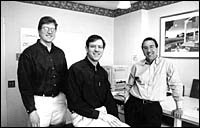
Kieshinski. (Photo, Tom Croke)
Jason Harry, Ph.D., is president of Sensory Technologies, Inc., a medical device start-up company working on neurotherapy technologies designed to improve sensory function in people with diminished sensation resulting from disease, aging, stroke, and trauma.
If it sounds a bit complicated, it is. But talk to Harry and his approach becomes crystal clear. His is a success story – one with a happy ending, or beginning — for Providence, and Rhode Island.
Beyond Cash Donations: How New Forms of Giving Are Transforming Not-for-Profit Accounting
Evolving Funding Landscape for Not-for-Profits Not-for-profit organizations are being asked to do more with less,…
Learn More
And it is a story that represents concrete validation that the state’s Slater Centers of Excellence are indeed paying dividends. STI represents just what the state’s Slater Centers of Excellence are all about. Entrepreneur gets seed money and grows — and grows.
Throw in the fact that Harry happens to love Providence and all is good with this marriage of idea, capital and hard work.
“It is easy to fall in love with the prospects of doing business in Providence,” he said. “It’s a wonderful place to do business – more congenial to start-up companies, compared to Boston where rents are so much more expensive.”
STI is located on Waterman Street, just a short walk from Brown University, where Harry served on the engineering faculty for five years – before going into the medical supply business in Boston.
A sports medicine market
Using initial technologies licensed from Boston University, which holds a
patent as a result of the work of James Collins, a professor of bio-engineering,
STI is working in neurotherapies.
“We are interested in commercializing a sensor enhancement technology,” said Harry. “The circumstance we would hope to address are deficits in the so-called mechanical senses. The touch senses – and the joint angle sense – the subconscious awareness of where your joints are in space.”
Harry said STI’s initial plan is to focus on possible sports medicine applications. He believes the mechanical senses represent an area that has not been overly studied.
“If you have a problem with your eyes or ears – there are lots of efforts to address those,” said Harry.
The technologies STI is developing may benefit everyone from the weekend skier who has wrenched a knee to the professional athlete who has twisted an ankle.
“The primary focus will be on joint injuries, especially the lower extremities,” he said. “Knees will be a major focus.”
Third-party validation
Harry first approached the state’s Slater Centers in 1999, contacting what
was then called the Rhode Island Center for Cellular Medicine.
Those first conversations did not result in funding direct, but did fuel Harry nonetheless.
During much of that year he spent evenings and weekends working on a business plan. It was apparently an impressive one, because when he visited the Slater Center for Biomedical Technology in April of 2000, he came away with a $75,000 loan by May.
Dr. David Livingston is the executive director of the Slater Center for Biomedical Technology and was responsible for providing Harry with that early funding.
“The area for his technology – the medical area – is quite under-served right now,” said Livingston. “There is a need for medical technology.”
Harry also benefited from his personal approach to business.
“We find him to be a focused, enthusiastic and determined individual,” said Livingston. “We felt that he would inspire the confidence of investors, which he obviously has.”
Tracey A. Dodenhoff is the executive director of the Slater Center for Design Innovation. What impressed Dodenhoff about STI was that “he demonstrated a depth of knowledge of his industry and an ability to attract talented people.”
Harry followed that experience up with a visit to another Slater Center, the Slater Center for Design Innovation. There, the company secured an additional $50,000 in October of 2000.
“The money was important,” he said. “But so was the third-party validation. Both Slater Centers sent the business plan out to other third parties.”
And with the Slater Centers, said Harry, it has not been a situation where he received a loan and then fell out of contact. In fact, STI’s relationship with both Slater Centers remains strong.
Dodenhoff, for example, said she continues to meet with Harry and his STI team biweekly.
“We’re helping them through the product development process, which includes choosing a design firm,” she said.
Impressing Pharos
The idea behind the Slater Centers is to provide seed money. With STI, the
loans provided worked in just that fashion.
STI officially opened its doors in January of 2000. The company continued to make favorable – and profitable – impressions.
By spring 2000 talks were already under way with the Waltham, Mass.-based Pharos, LLC, which focuses on developing new businesses.
Pharos was already familiar with – and very impressed by – the technology that STI was employing.
“The thing that got them to call back was the technology,” said Harry.
Getting out to such a good start impressed Pharos, a company that like STI, got started in early 2000.
Early this spring, Pharos made a $1 million investment in STI that will be used to accelerate the company’s research and development program in sensory enhancement technologies.
Pharos was formed in 2000 by George N. Hatsopolous, Ph.D., the founder and longtime chief executive officer of Thermo Electron Corp. Hatsopolous has been joined at Pharos by leading medical device executives from Thermo Electron. The principals at Pharos are actively involved in advising STI’s management on all phases of product development and business execution.
“We are very pleased to have formed a relationship with Sensory Technologies,” said Hatsopolous. “Their goals fit very well with our interest in fostering the development of revolutionary technologies that meet societal needswe believe STI’s technology has excellent potential.”
Harry sees Pharos as a different kind of venture capital outfit. They bring to the table not only money – but professional resources and a desire to lend support from everything from engineering to marketing.
“Their business plan at Pharos is to find medical device companies that they can actually help,” said Harry.
STI has also received a $50,000 Small Business Innovation Research (SBIR) grant from the U.S. Department of Education’s National Institute on Disability and Rehabilitation Research.
The grant is specifically being used to explore early prototypes of electrical stimulation devices that enhance touch and joint senses.
Big fish, small pond
STI’s early success is welcome news to a city – and a state – so determined
to provide a home for technological start-ups. For Harry, the advantages of the
area are many. In addition to the lower rents and practical conveniences of coming
and going, Harry sees an advantage in being a bigger player in what may be a smaller
market.
“Simply put, it’s being a bigger fish in a small pond,” he said. “If we were in the Boston market it would be much harder to generate interest.”
Harry is also convinced that he can attract the skilled employees to be successful.
“I’m confident,” he said. “I don’t see any reason not to be confident. We are not that far from the hotbed of medical research in Boston. In fact, I think it would be easier to attract someone from Minneapolis to come work in Providence, than in Boston.”
Stephen Kleshinski, executive vice president, James Niemi, director of engineering, and Todd Zive, research and development engineer, round out the STI team.