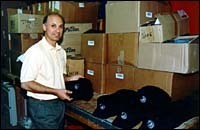
East Coast Embroidery Inc.
(Tom Croke)
Name: East Coast Embroidery Inc.
Owner: Constantine Vavolotis
Location: 375 Waterman Avenue, East Providence
Type of business: Custom embroidery, screenprints
Year founded: 1986
Employees: Eight
Annual Revenues: WND
When Constantine Vavolotis first opened the doors of his East Providence embroidery shop he knew it would be successful. His wife told him so.
Seifert Systems Invests in Energy Efficiency to Strengthen Operations
For manufacturers, energy is more than just another operating expense. It plays a critical role…
Learn More
His wife, Maureen, then a graduate student at Bryant College in Smithfield had, at the suggestion of her husband, used the idea of opening an embroidery shop as a project for one her classes.
“She needed a topic and I suggested it,” he said. “Back then (embroidery) wasn’t necessarily a household thing. She took the idea to her group and they proceeded to do all of the homework. By the end of the semester, it sounded like something I should consider doing.”
Today, East Coast Embroidery is celebrating its 15th anniversary. The company designs logos and embroiders hats, shirts, and jackets, as well as doing some screen-printing.
Vavolotis concedes it has been a wild ride, and there have been days when he’s questioned his decision to go into the business.
“At some points it definitely wasn’t fun anymore,” he said. “There were moments when I first started that I definitely thought that this wasn’t for me. I sometimes still have those days, but the sun still shines and the door is still open.”
When the company first opened, a lot of its work was done with one major client — American Tourister Luggage Company. Vavolotis said that, at the time, American Tourister had a custom division that made bags for different computer companies like Compaq. East Coast Embroidery would embroider them.
“It was contract work for us,” he said, “a lot of contract work.”
And when Tourister closed its custom division five years later, Vavolotis had the confidence and the business to continue without one of his major clients.
“At the time that the division closed we were doing some major growing,” he said. “We were able to put more emphasis on other products and be successful.”
In fact, the early 1990s were the company’s busiest time.
“We couldn’t answer the phone, it was so busy,” he said. “It was great to start out experiencing that.”
But there were drawbacks.
“It put so much pressure on me and the business,” Vavolotis said. “It wasn’t a comfortable pace. We couldn’t keep up with our clients and it just wasn’t fun.”
Today, the phone rings constantly, the sound of the sewing machines fills the air, and Vavolotis is in the office only briefly between making his own sales calls.
Business, he said, is good.
“The key to any successful business is staying in touch with your customers,” he said. “It helps that I am a part of that.”
Eight percent of the com-pany’s clients are businesses, which Vavolotis said his company has gotten through trade shows, advertising and word of mouth. Fifty percent of the company’s business is in the state while the other 50 percent is on the national level.
“We have a broad spectrum of clients that range from the individual to the large company,” he said.
What has helped his business, Vavolotis said, is that many companies have accepted a “relaxed dress code” for their employees, which often can includes a polo shirt with the company’s logo embroidered on it.
“When dress down days became the norm, it was like a magnet for us,” he said. “Some companies change for the entire summer, and that has been good for us.”
According to Vavolotis, companies come into the store or email a logo they are interested in having embroidered — though his company can and does design logos, Vavolotis said, many companies already have their own. Then that logo is transposed into thread through a process known as digitization and sewn on to a shirt, hat, or some other object.
“The average production time is about one or two weeks,” he said. “That seems to be acceptable. Hats conceivably can be done faster because we carry them in stock.”
For other items, such as shirts and jackets, Vavolotis said he depends on distributors to deliver in a timely manner when putting an order together.
“The days of inventory are over,” he said. “For years we kept too much inventory and it didn’t move.”
While his product may at one time have been unique, Vavolotis today said competitors are always entering the market.
“Every year there are more and more companies out there,” he said. “It’s not easy. A lot of people are looking for price.”
Another challenge Vavolotis said is getting clients to pay that price.
“Making sure that the cash flow happens is one of our greatest challenges,” he said. “We try and limit certain clients we feel will be a problem. We basically try to stay with a strict policy of monitoring.”
And like the ride he has been on for the past 15 years, Vavolotis is unsure about what the future holds for his business. But whatever it is, he believes he is ready.
“I have an idea of where I would like to go,” he said. “But I think the business will evolve as time allows it to.”