Technology, increased wages propel industry
While not every industry can make the same claim, the boat and ship building business in the Ocean State is alive and well.
“We are bursting at the seams right now,” said David MacBain, partner and chief engineer at New England Boatworks in Portsmouth.
Seifert Systems Invests in Energy Efficiency to Strengthen Operations
For manufacturers, energy is more than just another operating expense. It plays a critical role…
Learn More
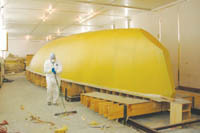
Crediting innovation and technology improvements that have helped increase productivity, Boatworks is now manufacturing about three larger boats per year, a feat that would not have been possible 20 years ago. Employment is at an all-time high with workers using state-of-the-art composite materials for lighter, stronger and faster boats than their aluminum and wood predecessors.
But as always, there is still room for improvement, with the two most significant obstacles being the availability of trained workers and waterfront real estate.
“The level of skill has come up for the type of boat we are building now and consequently the pay scale has come up quite a bit,” said MacBain. But even with the increased wages, it is not easy to find people who want to “work their tail off building a boat,” said MacBain.
In fact, the average annual wage in 2003 for the industry was $41,469, 19-percent higher than the average private-sector wage of $34,860. According to the R.I. Department of Labor and Training, the average annual wage (not adjusted for inflation) for the marine industry in 1985 was $24,129; in 1995 it was $33,848; and in 2004 it was $42,050.
In addition to current pay levels, the outlook is strong as well. A report from the state labor department counted 3,616 workers in the ship and boat building industry in 2004, while at the same time predicting that the number of jobs in the sector will remain steady through 2012, as compared with expected drops in overall manufacturing jobs.
Employment at Boatworks has increased about 10 percent a year over the last eight years, according to MacBain. Currently, there are 110 employees – the highest number in the history of the company.
Andy Dzykewicz, senior project manager at the Rhode Island Economic Development Corporation, concurs. He said most boat builders in the state want more workers, have jobs available and are trying to expand but cannot find a skilled work force.
The International Yacht Restoration School in Newport, established in 1996, offers a two-year certificate program in boat building and continuing education courses for shipyard employees. Terry Nathan, president of the school, said students are equipped with the basic boat building techniques that provide a foundation for continued education. In June, a class of 32 will graduate, with students from Maine, Washington, Greece, France and Germany. Each year, about 200 people are certified through the continuing education program.
Real estate is a more complex issue. Boatworks would like to build more production space but has no room to expand. The company occupies 11 buildings with about 50,000 square feet of indoor space.
The state and the Navy are negotiating the release of between 30 and 32 acres (five of which are a peninsula that is unusable) of former Navy land for use by Boatworks, Hinckley Yacht Brokerage, Alden Yachts and a consortium of smaller boat service providers in the Melville area of Portsmouth.
Discussions date back about six or seven years, said Bill Clark, director of business development in Portsmouth, and are based on the stipulation that the land could only be used for current businesses to expand.
Clark anticipates the transfer of the land to the state to take place before the end of the summer. The EDC would then facilitate the transfer of land to members of the Portsmouth Marine Partnership. Predictions are for between 150 and 160 new jobs and about $9 million in additional facilities.
To a large extent, technology has made the current boom in Rhode Island’s shipbuilding possible. Computer-aided design (CAD) and project management software programs developed over the last five years have helped to make the production of boats more efficient.
Twenty years ago, a full-scale model of a boat had to be drawn, using much time and resources. It would take about a month to translate the plans on paper that would allow production to begin. Now that process can be done in a matter of days, said MacBain.
Additionally, about 25 percent of the work – cutting of mold frames, machining and millwork – is done off-site, work that was once done in-house. The result is more time and cost savings, allowing a boat builder to work on different pieces of different projects at the same time.
“It’s like a Henry Ford way of doing things with multiple processes going at the same time,” said MacBain.
For example, a piece of a boat can be designed with computer software, with the designs e-mailed to a parts fabricator, with the piece back at the plant for assembly within a week. Once plans for a boat have been approved, the team can start production within three days.
A 50-foot racing sailboat can be built in about five months compared with a year in the 1980s. And Boatworks should know, having built racing craft for the Stars and Stripes America’s Cup racing team led by Dennis Connor.
Gerry DiSchino, CEO at Hinckley, predicts a strong future for the boat building and repair industry. Rhode Island is an attractive place to buy a boat because of the repeal of the luxury tax in 1993, an established labor force and the allure of Narragansett Bay, he said.
Keith Stokes, president of the Newport County Chamber of Commerce, said the redevelopment of the west side of Aquidneck Island is part of a larger vision to preserve the area as a leader in the boat building and marine trade industry.