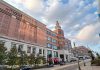
THE GILSON Campus in Lincoln.
To keep up with the rapidly growing pharmaceutical field, Gilson Inc., has opened a laboratory in Lincoln and created a Scientific Advisory Board (SAB). Gilson, a supplier of precision liquid handling technology and chromatographic systems opened the 6,000-square-foot Center for Integrated Discovery Technology (CIDT) in a portion of the space formerly occupied by CytoTherapeutics at 701 George Washington Highway, in July.
W. Raymond West, technology director for Gilson, said the laboratory was created as a place where vendors of instrumentation can integrate their technology to achieve better solutions for drug discovery. The laboratory, West said, is designed to showcase to visitors what is happening, but still contains the functionality of a working lab.
Beyond Cash Donations: How New Forms of Giving Are Transforming Not-for-Profit Accounting
Evolving Funding Landscape for Not-for-Profits Not-for-profit organizations are being asked to do more with less,…
Learn More
Rhode Island was chosen as home for the facility because of its access to airports, its scenic beauty and the cooperation of the Rhode Island Economic Development Corporation, West said.
“We found this space almost by accident,” he said. “But it really seemed to provide the tools that we felt were necessary for success.”
In fact, the CIDT is the first facility of its kind where vendors can come together to resolve issues, integrate existing technology and explore new possibilities, for the sole purpose of improving drug discovery. West said the SAB is a key element in achieving this goal, as they will help to define and prioritize projects.
“Everyone on the Scientific Advisory Board understands the need for drug discovery and development in today’s marketplace,” he said. “They will provide the overall strategic direction from a scientific sense. We will know that from the very initiation of the product that we have relevance, creditability, and that we are delivering something that the companies want.”
West said unlike other company boards, the 12-member SAB is made up of mostly people in the field instead of academics, and functions only as a consultant. The board will meet twice a year to discuss important issues and give guidance to the CIDT’s activities. Each board member serves for a fixed period of time, West said.
“Twelve of the 13 people on the board belong to companies,” he said. “They committed time without any numeration on our part, so they indeed recognize how valuable this effort is.”
Currently the board has representatives from: Thetagen of Washington; Arqule of Massachusetts; Pfizer of Connecticut, and Pfizer of the United Kingdom; Glaxo-Wellcome, Ltd., of the United Kingdom; Merck & Co., of Indiana; Brigham Young University of Utah; Bristol-Myers Squibb of New Jersey; Amgen, Inc., of California; and Smithkline Beecham of Pennsylvania. Dr. Roderic O. Cole of Pfizer is chairman of the board.
West said more companies and academics are encouraged to participate in CIDT through proposing projects and contributing resources.
“The board doesn’t talk about specific drugs in development,” he said. “We talk about needs. They all have needs for specific equipment to get things done.”
West said the center will focus primarily on short-term projects which can be delivered in three to six months.
West said the 50-year old company based in Michigan with offices in France and Italy, has a history of partnerships with other companies, and intends to continue partnering with pharmaceutical companies as long as it is successful for everyone involved, West said.
“Gilson has always had a strong relationship partnering with other companies, because we realize that we don’t have all the technology,” he said. “We have done very well in terms of serving the needs of our partners and plan to really emphasize the pharmaceutical field. What we are doing in Rhode Island we really view as the future of product development in the company, and we really believe will have a huge impact on the industry as a whole.”