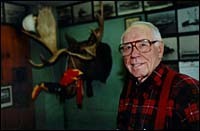
attached to his office wall.
Name: Luther H. Blount
Profession: Investor, entrepreneur, semi-retired from the shipbuilding
business he founded in 1949 and the cruise line he founded in 1966.
Education: Wentworth Institute of Technology, a 1937 mechanical design
and engineering graduate.
Age: 84 1/2 — “I’m right in the middle.”
Family: Five children, 14 grandchildren.
Walk into Luther Blount’s office at his shipyard on the Warren waterfront and you come face to face with the head of a giant moose, colorful fake parrots hanging from its antlers.
Beyond Cash Donations: How New Forms of Giving Are Transforming Not-for-Profit Accounting
Evolving Funding Landscape for Not-for-Profits Not-for-profit organizations are being asked to do more with less,…
Learn More
For a moment it’s difficult to comprehend that Blount is a Rhode Island shipbuilding legend, an inventor who holds 23 patents, nearly all relating to shipbuilding and shipping equipment.
But look a little farther along the walls of his crowded office, beyond the antlers and dangling parrots, and view pictures of dozens of the 308 ships built at his shipyard on the Warren waterfront. Models of ships rest easily on the shelves next to books that tell of the history of shipbuilding in this country, books with chapters devoted to his own contributions. And papers, lots of papers related to his inventions and the dreams he still holds mid-way in his 85th year.
This is Luther Blount, “the ice man’s son,” who now receives letters of praise from the sons of those in upscale homes on Rumstick Point, those to whom he delivered ice, the families now that have traveled on the cruise ships he built and on the cruise line he operates.
This is Luther Blount, the inventor whose latest idea is an unsinkable boat — if the Titanic were made that way, he says, it would never have sunk.
This is Luther Blount, who recently announced his retirement, only retirement to him means that he doesn’t feel obligated to come into the office, so he comes in anyway.
Wearing red suspenders over a bright plaid flannel shirt, Blount flashes his impish smile when asked whether he really calls this retirement.
“I own the company, and I own the shipyard and I own the plans,” he says. “Umm. Semi (retirement). I don’t have to come to work quite as early. I can leave a little earlier. I can take off easier, but I still am kind of tied down.”
Even though he sold the inventory of his shipyard and turned over pending contracts ($5 to $6 million) to James Barker, whose family also has a long tradition in the marine business, and named his daughter, Nancy, president of the three-ship cruise line, Blount remains central focus of the two operations — the Blount Barker Marine and American Canadian Caribbean Line. He oversees them with a kindly, stern hand, worried about their future.
“He (Barker) pays me a percentage of the profit on those (contracts) and a rent,” Blount says. “If he doesn’t make it, then he has to guarantee me he isn’t going to leave me in the red. Then I buy everything back again.”
But Blount is far more involved than that, as he walks out to the yard, past the boats under construction to a pier, where a stubby looking tugboat sits in the water, launched earlier that day and as sturdy as they come, Blount says. It will travel across country, taken apart in sections and loaded onto special trucks for delivery to a buyer in San Francisco.
“I get a high like this morning when we launched a boat, of creating something that works,” Blount says.
Built kayak at 17
That’s really the story of his life. Creating things that work, from the kayak,
the first boat he built when he was just 17, to the cruise line, the outgrowth
of tuna trips with friends off Block Island, a cruise line that is now in the
steady hands of his daughter.
“With her there, it means, let’s see if she can keep it going,” Blount says, that smile crossing his lips once again. “At least it’s not going to be on my time, if it happens.”
And “if” may mean that first safety problem, or the threat of competition from another carrier with plans to cruise the same intercoastal waterways as Blount’s three small cruise ships. But Blount remains confident that if the company holds to his philosophy of making sure the customer gets his or her value even if it means the profit margin shrinks, then it will thrive. And on the cruise line, safety comes first.
“Every time I go to bed at night, with three boats going, it’s like three 747s going,” he says, his fingers crossed and with a tap on a nearby wooden shelf. “So far we’ve got a pretty good safety record. We got the record because we watch everything so careful. You can’t really be 100 percent stress free.”
He’s been at since 1949, after he returned from the Army and opened the shipyard. The cruise line was to follow 17 years later. But to listen to Blount, you know that this was a family that was destined to make their living around the water.
Great-great grandfather
“My family has been around boats for a long long while,” he says, telling the story of his great-great grandfather, a seaman who was scooped up on the streets of London at age 19 by British naval authorities under the practice of impressment, which was a common means at the time of fillings ships’ rosters. He was put aboard the HMS Guerriere.
“They grabbed him and he didn’t even go home to see his mother. He was real ticked off, but then they got in that battle with the Constitution and he was taken prisoner,” Blount says.
The battle, during the War of 1812 happened on the afternoon of August 19 some 600 miles east of Boston. The Guerriere was so badly damaged that it eventually had to be sunk. Fourteen Americans and 79 British sailors died. Blount’s great-great grandfather survived and was taken prisoner.
“He didn’t want to go back to England, so he told the Americans he would do anything,” Blount says. “They said there’s only one thing you can do. We won’t put your name on the list, but when you get to Boston you jump off because we have to account for everybody. So he got to Boston. It was summertime, so he jumped overboard and went ashore looking for work and a guy said you know anything about making anything with cotton go down and see this guy down in Pawtucket.”
Blount says that in England his great-great grandfather had worked in textiles, so in about 1812-1813 he went to work in that Pawtucket mill, fell in love with a woman who had come to the mill from Cape Cod, married and parented 10 to 12 children.
“My great grandfather, I was named for him, he was lost in the Civil War aboard a ship,” Blount says. “Everybody in the family on both sides had something do with the water. They were either fishermen or mariners.”
For Blount, however, no matter how much the love for the sea, soon after graduation from Wentworth Institute of Technology in 1937 he went to work in a textile mill in Putnam, Conn. as an assistant plant engineer. He remained there until 1945 when he went into the military.
When he returned from the military he settled on a farm he bought in Putnam and “I sort of became an entrepreneur. My family — nobody that I can remember really had a job. They would like — they call it entrepreneurs now — they had their own business, their own thing. My father had an artificial ice plant when I was 12-13 years old in Barrington. My uncles either worked for my grandfather’s oyster company or in some kind of outfit the family was hooked in with. It was sort of unnatural for me to go out and get a job.”
So it wasn’t unnatural when he founded Blount Marine in 1949, all the while maintaining a strong work ethic that he feels may be lost on some of today’s younger generation.
“Today, the kids, so much they’re seeing on TV,” Blount says. “They’re not doing what they should be doing. I could pass as a carpenter a long time before I was a sophomore in high school, because I had to help my father build stuff around the ice plant. I picked up a lot of easy trades.”
Maritime inventions
Building and inventing have been his life, and he rattles off a long list of maritime inventions and innovations that he says never made him rich. “There’s no invention that I ever had that lasted very long,” he says, “because some other guy who could sell it better would come along and make it go further.”
Now, his keen mind still incorporating the wisdom of generations with an energy that won’t quit, he has taken out his 23rd patent, on a high-tech boat that he says won’t sink. He’s tested it for three years on a 40-footer, and now plans to build an 80 footer that can hold 149 passengers and be used as a commuter – “a practically unsinkable lightweight catamaran. If the Titanic had been built under this patent, Blount can prove it would not have sunk.”
It’s quite a claim from the unsinkable Luther Blount, but listening to him and seeing all he has done you come to believe it. There’s little on the water that Luther Blunt, inventor-entrepreneur, hasn’t accomplished.
And all this from the son of the owner of an artificial ice house, “just the ice man’s son.”