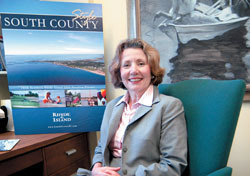
South County Tourism Council President Myrna George says the state's tourism industry is better served with regional councils.
Myrna George
Position: President, South County Tourism Council
Beyond Cash Donations: How New Forms of Giving Are Transforming Not-for-Profit Accounting
Evolving Funding Landscape for Not-for-Profits Not-for-profit organizations are being asked to do more with less,…
Learn More
Background: George, who grew up in South County, served on the South County Tourism board of directors before becoming president of the organization in September. As a state representative for Coventry, East Greenwich, Exeter and West Greenwich, George served as a member of the House Finance Committee and the Educational Accountability Committee.
Education: Community College of Rhode Island, Bachelor of Arts from Almeda University
Age: 58
Residence: Warwick
PBN: How do you feel about proposals to do away with regional tourism councils and create one statewide body?
George: There has been legislation on this for years. During those years (the South County Tourism Council) has continued to grow and prosper the tourism industry of Rhode Island. We are the third-largest contributor to that industry in the state. The problem with having one central council is that the South County Tourism Council’s job is to promote, preserve and protect the southern end of the state. It would be very difficult to do that from one central location. In 1986, there was a central tourism bureau, and it wasn’t working. The Legislature, in all its wisdom, decided to regionalize tourism bodies. That regional concept has led to a $4.7 billion industry with 60,000 employees. That is fairly impressive when you consider that tourism involves developing a product and preserving the integrity in those regions. Doing that from a central location is problematic.
PBN: If it was unsuccessful then, why try it again?
George: A good deal of attention has been given to centralizing. We are all uniquely situated. We do work together with Newport and Block Island and if Providence needs something, we will work with them. There is always room for improvement. Each of us in each region is willing to look at that, however, in many different areas throughout the state, whether it’s busing, education, or food distribution, bigger is not always better. Things sometimes get done better at the grassroots level. There is no evidence that anyone can do it better than we can. In the case of Blackstone Valley, 20 years ago, no one knew where or what it was. Bob Billington (Northern Rhode Island’s tourism director) has positioned it in such a way that takes advantage of every asset it has. Because we are located in the areas we promote, we are sensitive to the nuances that make it what it is. We promote small businesses in this area, where in Providence, it’s big business.
PBN: Does South County need more hotel development?
George: Yes, we have done research that shows we do. We have two or three – perhaps four – hotels that are poised to open. One is the Lighthouse Inn in Galilee, which is currently closed; The Procaccianti Group and Joe Paolino are planning to renovate it and have it open before this season. There is also a hotel in purchase in sales in Coventry, as well as a project in the South County Commons. You need a lot of hotel rooms to be a tourism destination, but we are not a convention destination, we are leisure, so we have many bed-and-breakfasts in the area. The extra rooms will go a long way in addressing the lack of accommodations.
PBN: Bed-and-breakfasts seem quintessential to the South County character.
George: Yes, and we do a lot of partnering with Block Island and Newport when people can’t get rooms, but there are larger hotel accommodations in parts of this region.
PBN: What is South County’s biggest tourism draw?
George: Beaches, beaches, beaches, all day long. It’s a laid-back, serene atmosphere that is much more ecology-based. We are home to one of the best oceanographic schools in the nation at the University of Rhode Island with Dr. Robert Ballard (founder and president of the Institute for Exploration at Mystic Aquarium in Mystic, Conn.). We also enjoy some of the most pristine coastline – you can’t overrate 100 miles of beaches. We also have 18 public golf courses, seaside shopping, we have fine restaurants … we get a lot of people who come here to admire our boardwalk, Arcadia, the natural resources – it’s a much more family-oriented destination. We also have a number of museums.
PBN: The Travel Industry Association reports that areas with beaches attract more families, and those travelers typically stay on vacation longer and spend more money than other travelers. I would think that makes this area a great destination for them. What else would you like to see added to this region to increase tourism?
George: I would love to see the USS Saratoga at Quonset Point and an aquarium because we have this oceanographic school nearby. There is logic to having the Saratoga at Quonset because of it being a former naval base during World War II, and it would provide meeting space and would add to the area’s historical content. We are also in close proximity to the veterans’ cemetery and relatives would like to see that. There have been discussions about adding a complement to Mystic Marina that would address underwater activity. I would also like to see improved signage in this area and increase it, like the wildlife preserve. We have to identify our visitor sites better.
PBN: Are you doing anything to create reasons to visit South County during the off-season?
George: We are looking at ways to get tourists here year-round, maybe by developing tours at Galilee. We are testing ideas.