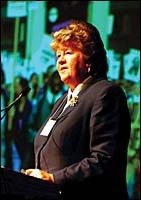
Name: Jean F. MacCormack
Position: Chancellor UMass Dartmouth
Residence: South Dartmouth
Seifert Systems Invests in Energy Efficiency to Strengthen Operations
For manufacturers, energy is more than just another operating expense. It plays a critical role…
Learn More
Age: 55
Background: MacCormack started at the University of Massachusetts Boston as a faculty member more than 20 years ago. During her tenure she has also served as a dean, a vice chancellor for administration and finance, and then a deputy chancellor in Boston. She took over the top job at UMass Dartmouth in 1999.
Education: A bachelor of arts from Emanuel College and a master’s and doctorate in education from UMass Amherst.
PBN: Talk a little bit about the University of Massachusetts and specifically how UMass Dartmouth fits into the UMass system.
MacCormack: There are five University of Massachusetts campuses. Dartmouth is the smallest in size. In the fall we will have 8,300 students. We have been growing by about 1,000 students in the last three years. That is partly due to the raising of standards in the UMass system as well as its reputation. We are ranked by US News & World Report in the top ten of regional public universities, and have been for the last five years. We are ranked in the top 32 in public and private schools in the Northeast. We have five colleges – engineering, nursing, visual and performing arts, the college of arts of sciences and a school of marine science and technology. About half of our students live on campus. We have three sites outside of Dartmouth. We have the new Advanced Technology Manufacturing Center in Fall River – where our engineering and business schools are partnering with industry in the region for the development of new processes and products. Our students also work there so they get apprenticeship experience. We have the school of marine science and technology, which is right on the water in New Bedford. Our college of visual and performing arts has a full campus in downtown New Bedford. And we are opening a new continuing education site at the old Cherry & Webb store in downtown Fall River. The interesting thing is that the institution grew from a merger of Durfee Tech (the former Bradford Durfee Textile School) and New Bedford Tech (the former New Bedford Textile School) and first became SMTI – Southeastern Massachusetts Technical Institute, then became SMU (Southeastern Massachusetts University). Then we became part of UMass. So we sort of came to Dartmouth to grow and now we are going back to the cities to respond to those populations that might not come to the campus.
You mention the technology center where do you see it going? Is it the first step in building a relationship between the university and local business?
We see ourselves trying to be sort of a hub. I have used three terms to talk about us. First, I want everybody to be engaged. If you really love what you do you generate enthusiasm. The second thing I want is to be embedded in the community. Instead of just saying that we do things for the community we see ourselves as a part of the community. We take our intellectual resources, our faculty, and our students out into the areas that the community is concerned about. I see something like the Advanced Technology Manufacturing Center as a way to do that. For example, in Fall River there is a manufacturing base that is changing and shifting. In order for that to be successful they need to have the best concepts and the best processes. There might be people that have the best idea but don’t have the capability to do the research and development – we could help with that. The center has its own incubator so we take those businesses that have the ideas and provide them with the technical support they need. On the business side, we graduated 1,300 students but they can’t stay in the region because there aren’t enough high skilled jobs. So we need to see what we can do to stimulate economic development. We aren’t in the economic development business, but we can see what we can do to use our resources with the business, school, and non-profit communities to be a good citizen. What that means for us is my third thing – evolving. We are young enough and agile enough as an institution — we go back to 1885, but as a university campus here we only go back to the 1970s – that we can change. I always say that if you aren’t growing or changing, then you are dying.
How difficult is it in these economic times to maintain your growth pattern while at the same time facing budget deficits and state cuts?
It’s a real challenge, but the public university is about access. Obviously it’s about access to excellence and being able to have access to an affordable education. For us quality is key. So when you grow you have to be sure that you can offer new students the same thing that you have offered the older students. Here we had room, within our mix of classrooms, within our mix of programs and within our mix of faculty to add students without radically changing the class size. New students also generate new revenue so if you take the revenue that you need to serve them you still end up with a little bit more. Certainly with the Commonwealth’s budget situation – we are anticipating a budget reduction like everyone else – it makes it harder to grow. If you were staying stationary maybe you could deal with fewer people, but we had 42 faculty members take the state’s early retirement program last year. We are going to have 1,000 more students with 42 less faculty – that’s difficult. We will hire some of that faculty back on a part-time basis to teach some of the very courses they were teaching before, without the other obligations. We will hire part-time faculty with the goal of replacing at least one-third of those 42 positions by the following year. Our goal obviously is to maintain access and at the same time make sure that students have access to something that is worthwhile.
How many students come from the region?
About 45 percent of our students come from the region. It used to be much higher, but now our schools have a hard time because the schools of origin aren’t performing as well. For some of the students in our region can’t meet the standard – you have to have a 3.0 GPA and 1150 SAT score. But we want to serve people in the community, so we need to help. What I have started to do with the schools is see how we can help so that the students can come.
Is it frustrating for you that as a university founded to meet the needs of the area, less than half of your students are coming from the local communities?
No. I think it’s related to being embedded in the community. There are a lot of services that we could offer besides teaching a course. We would be happy to serve more students from the region, but we also know that we can’t accept students that won’t be successful. Sometimes we encourage students to spend a semester or a year at Bristol Community College. Then they will automatically get accepted here. This year we have a program called Pathways, which we run through our division of continuing education, where we accept 150 students. Many of them are just below entrance standards. These students spend a full semester in regular courses that freshmen would take, but they also participate in a program that provides additional support. If they meet the criteria for a transfer student the following year they will be granted regular admission. For us, entrance standards are one thing, but we are much more concerned about exit standards.
Affordable tuition is a huge part of access – how does the university deal with this issue especially now?
It will cost $5,129 to go to UMass this fall — that’s a $1,000 increase. It costs us about $15,000, so the state subsidizes the rest. We do have the full financial aid. We made a commitment when we raised our fees by $1,000 that no current student would have to drop out. That meant doing some fundraising.
Is there an area where you see the local schools may be weak?
The Massachusetts average for students going to college is one out of three. In this region it’s one out of ten. What that means is the dropout rates are higher in these urban areas. If you have 20 or 30 percent of your students not graduating from high school, and others not achieving fully, then they are not getting to the point where they can come to college. In our region we also have people that feel they can be successful without a college education. That might have been true 20 years ago, but today there aren’t as many opportunities.
Do you feel overshadowed by the larger portions of the UMass system like Amherst?
We are a smaller campus. All of us in the UMass system see ourselves as having a unique thing to contribute. UMass Amherst is a big research university. The Boston campus is an urban campus so it’s targeted to the older student and has no residential. The Lowell campus is very technical but more like us in terms of serving that region, and Worcester is the medical school. We feel that we have some things in common, we don’t necessarily compete with each other. When we compare ourselves to other universities to see how well we are doing we would look to organizations that are the same as us. We don’t look to Amherst because they aren’t the same as us – they have 29,000 students. It is true if things are not going well at Amherst, the flagship institution, that can have some residual negative impact on us. But if things are going well at the campuses, we feel that too.
Where do you see the university 10 years from now?
Ten years from now we will be about 10,000 students. That will be enough for us to have the diversity of programs that we want. I think we have been growing in terms of our research activity — we have about $20 million now, we will be about $30 million by then. I hope that we will be a little more diverse culturally, racially. I think we will still be balancing the affordability and access. We are growing, not so much in size but in depth, quality, and diversity. I hope that we keep this feeling. Our claim to fame is to be this area’s premium regional university.