It’s no secret that the economy was lousy in 2001, and the commercial real estate market was no different.
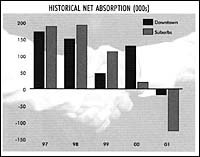
After years of positive absorption, Rhode Island’s commercial real estate market took a step backward this year, particularly in the Class B market, according to CB Richard Ellis New England’s recently released Market Outlook 2002 New England.
In real estate, absorption is defined as the difference between available real estate at the beginning of the year and the end of the year.
In downtown Providence, the report showed 18,275 square feet of negative absorption and a vacancy rate of almost 14 percent. The vacancy was felt most strongly in Class B office space, which saw the vacancy rate grow from 10.5 percent to almost 15 percent. Meanwhile, Class A vacancy rose from 4.8 percent to 7.3 percent.
Beyond Cash Donations: How New Forms of Giving Are Transforming Not-for-Profit Accounting
Evolving Funding Landscape for Not-for-Profits Not-for-profit organizations are being asked to do more with less,…
Learn More
In other areas of Rhode Island, the patterns of negative absorption were even worse. The Rhode Island suburban office market posted negative absorption of 126,007 square feet, and a vacancy rate that rose to 10.5 percent from 8.27 percent. The report stated that over half of the negative absorption occurred in the suburban Providence sub-market, with the balance spread over the East Bay, West Bay and Northern Rhode Island sub-markets.
According to a report from the New York-based property broker Cushman & Wakefield Inc., nationally downtown office vacancy rose 69 percent to the highest level in four years.
There is good news, at least in Rhode Island, say real estate experts.
“The second half of the year is expected to improve as the economy begins to grow at a modest pace,” said Alden Anderson, Jr., vice president and partner at the Providence office of CB Richard Ellis. “I don’t consider this to be a doom and gloom market, by any stretch of the imagination.”
Michael Giuttari, president of Providence’s NAI MG Commercial Real Estate, said the biggest reason for this negative absorption is that companies are downsizing. He spoke of one company he recently dealt with that had offices in Foxborough, Mass., Cranston and Warwick, that consolidated all of its offices in the Foxborough office, which left vacancies in Cranston and Warwick.
“It’s mostly existing space coming back on the market again without leases being completed,” he said.
Neil Amper, vice president of Providence-based Rodman Real Estate, said he is not certain how 2002 will be for the office market.
“The number of phone calls from people looking for new office space has been low,” he said. “There have been more people looking to sub-lease and downsize, and I think it’s a little too early to tell if this is going to continue.”
Market Outlook also highlighted an increase in rental rates. Up by more than 6 percent, the average lease rate in downtown Providence was $19.67 per square foot.
Anderson said that although 2001 was sluggish there were some positive developments in downtown Providence. He said the most noteworthy was the announcement of Starwood Wasserman’s development at Nine Waterplace. A 268,000-square-foot, ten-story office and retail complex located at the corner of Francis Street and Memorial Boulevard, the project will deliver the first new Class A office building in Providence since 1990.
Anderson said he thinks the suburban office market will have a slow start in 2002, but if the economic conditions rebound in the second half of the year he expects the office market to improve with it.
Not suffering quite as badly as the office market in 2001 was the industrial market. Charles Francis, president and partner at the Providence office of CB Richard Ellis, said that after an extremely active 2000, there was very little space available; therefore, the industrial market was unchanged in 2001. Leasing activity was also at a minimum, he said, because the market was driven by users looking to purchase property.
“Our forecast for 2002 is for the steady absorption of industrial space, as it becomes available,” said Francis. “There will be slow to modest growth with little space returned to the market.”