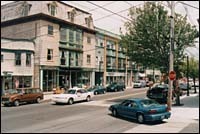
Wakefield. (Photo, Tom Croke)
While many of Rhode Island’s villages and communities may have the capability of supporting pedestrian-based traffic, it appears that in actuality they don’t do so.
That was the consensus of a Walkable Communities conference held last week at Brown University and sponsored by the Governor’s Office on Highway Safety, the state Department of Transportation and the Rhode Island Department of Health.
Beyond Cash Donations: How New Forms of Giving Are Transforming Not-for-Profit Accounting
Evolving Funding Landscape for Not-for-Profits Not-for-profit organizations are being asked to do more with less,…
Learn More
According to keynote speaker Dan Burden, founder of Florida-based Walkable Communities Inc., successful walkable communities are those in which everyday basics like a grocery store, banks, schools, and churches are within a quarter of a mile of each other. In addition, he said, these walkable communities provide pedestrians with five basic things: security, convenience, efficiency, comfort, and a welcome feeling.
“Just as the human body needs nutrition so too does the city, town and neighborhood that you live in,” he said. “We have to create that environment of health, and people will come.”
Burden said much of the decay in transportation systems has come over the last 50 years, as people used “unwise” planning practices to build roads, housing developments and shopping centers.
“Sprawl isn’t here to stay,” he said. “America can’t sustain sprawl. But unfortunately walking cannot support itself – it needs to have fewer impediments.”
A successful walkable community, according to Burden, follows 14 basic principles – the first, and most important of which, is to build for everyone.
“A scene of Grand Rapids, Detroit, or any other city at the turn of the century was packed with people, horses, bicyclists trolleys, trucks and autos,” he said. “Today, many urban streets are void of all human life. Bicyclists and pedestrians are fewer in number, while disabled people are a rarity. Buses and others transit are non existent, or skimpy service is offered in places where walking distances are too great.”
According to Burden, the health of a community is determined by both the number of users, and by the diversity of people coming and going, lingering and exchanging, yet many cities and towns put up “no loitering” signs, or dissuade people from standing around.
“Streets need to become an outdoor living room,” he said. “People today want to associate more. We can see that our way of building hasn’t been working, and we need to change the process.”
But those changes don’t come with a small price tag. But Burden suggests that the benefits far outweigh the costs for programs, such as the planting of trees or changing a roadway.
“Well-designed streets provide safe, efficient movement of all vehicles, while also providing for sanitation, utilities and timely emergency response,” he said. “In fact, quality designed streets determine the property value.”
Ken Payne, senior policy adviser for the Rhode Island General Assembly and the director of a seminar at the conference, noted that good street design “makes good economic sense.
“Economic development is something that people do for themselves,” he said. “Through walkable communities people have the opportunity to do something beneficial to the quality of life in their community, to the quality of design in their community. It’s an opportunity for the niches of our state to be much more attractive.”
According to Payne, a community’s quality of life is directly related to its capacity to provide choices for its residents — the central theme of a walkable community.
“Historically, Rhode Island is a place of lots and lots of villages,” he said. “The question is how to we reinvent this concept.”
And while the answers appeared good in theory, some at the conference didn’t know how easy they would be to attain.
“How do we maintain the character of a village while at the same time making it a good place for economic development?” asked attendee Bob Votava. “Is there a more efficient way of connecting people?”
Payne suggested that the answer may come from planning that involves the community.
“The idea of planning from the top down is not working,” he said. “We need to begin to have planning that is based on the community — that is achieved through a conversation between people. That’s how you get change.”
What became clear from the 100 or so participants at the conference is that the communities and residents of Rhode Island are interested in this concept. They are excited about connecting their developments with bike paths, walking trails, and comfortable sidewalks.
According to Burden, that’s half the battle.
“When we launched this program in my home state of Florida we attracted 24 people,” he said. “Look where we are now.”
The state of Rhode Island is expected to continue its study of walkable communities through a series of six focus groups being organized to obtain input from the public. The groups, being organized through the state Department of Transportation will have representatives from law enforcement, municipal planning officials, transportation officials, advocacy officials, health organizations, and the general public.
In addition, Rhode Island SAFEKIDS, in collaboration with the Rhode Island Department of Health, will be sponsoring a grant program to communities that support walkable communities projects. Approximately eight to 10 communities will be funded with awards up to $10,000 for one year. Requests for proposals are expected to go out this spring.