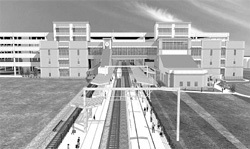
The state Department of Transportation is finishing up the final details for
the Warwick Intermodal Station and will submit a new plan to Gov. Don Carcieri
for approval at the end of this month.
If approved, construction on the $167 million Warwick station could start in the spring of next year and be completed by 2007, with Massachusetts Bay Transportation Authority train service instead of Amtrak as previously planned.
Earlier this year, Amtrak President David Gunn enforced a policy requiring three tracks for each train to prevent stops on a main track, which holds up other train traffic.
Beyond Cash Donations: How New Forms of Giving Are Transforming Not-for-Profit Accounting
Evolving Funding Landscape for Not-for-Profits Not-for-profit organizations are being asked to do more with less,…
Learn More
“That took us by surprise,” said RIDOT Director James R. Capaldi. “The last five years we’ve been working on this project we anticipated Amtrak to stop on the main line (connecting Boston to Providence, New York and Washington, D.C.). Since April, we’ve been working on alternatives.”
To get Amtrak trains to service Warwick, the DOT is working with Amtrak on an agreement that will allow the use of the freight rail track as a train stop at the Warwick Intermodal Station. A master plan is also being developed based on a conceptual design for a four-track design (including the freight rail track) where Amtrak will stop with its regional trains.
In addition to adding extra tracks, the DOT needs to electrify the existing tracks because Amtrak works on electricity, as opposed to MBTA trains that run on diesel fuel. If Amtrak and the DOT come to a service agreement, the additional rails and rail work will cost an estimated $50 million.
Until then, only the MBTA train, which already stops in Providence, will service Warwick.
“We have a good start with the MBTA stopping in Warwick,” Capaldi said. “Amtrak is a building block. We will start with MBTA and build up to getting Amtrak by adding tracks.”
MBTA will also travel farther south to Wickford Junction, where another station is planned two miles away from Wickford Village, North Kingstown, just southeast of where Routes 4 and 102 cross. The Wickford Junction station is estimated to cost $18 million, DOT spokeswoman Heidi Cote said.
Capaldi hopes construction on that site would be complete in 2007.
North Kingstown Town Manager Richard Kerbel said many North Kingstown residents travel to Providence each day to work or to take the train into Boston, adding traffic at the intersection of Route 4 and Interstate 95.
“We need to provide alternative service or deal with the negative impacts of not having it,” said Capaldi. “Route 4 has 175,000 vehicles traveling that road every day, and it isn’t just beach traffic; it made a list of worst intersections, that is unheard of for a rural/suburban roadway.”
Though the DOT wants to extend service farther south from Wickford by Amtrak in the future, Capaldi said MBTA’s service would suffice in the meantime because the market is strongest north of Warwick, pushed by T.F. Green, Logan and Manchester airports.
In return for servicing Rhode Island, MBTA benefits by getting federal RIDOT dollars for improvements and new trains, Capaldi said.
“We don’t own any trains, so we give them some federal money we get for transportation and we get service,” he said.
The Warwick station will be one of the only “true” intermodal facilities in the country, connecting people through rail, plane and vehicles with a parking garage connected to the airport and a “people-mover.”
The Warwick Intermodal Station should boost the number of meetings and events at the Rhode Island Convention Center and hotels south of Providence by offering a connection between T.F. Green and Boston.
“We can’t quantify how much more business we’ll get, but it will improve access to all the hotel rooms we have south of Providence,” said Rhode Island Convention Center Authority Executive Director Jim McCarvill.
The convention center already has the advantage of being 10 to 15 minutes away from the airport, but a rail connection gives the convention center a competitive edge against other states where groups flying into an airport rely on taxis or shuttle buses, he said.
“A rail gives people the sense of having a seamless connection. It might help us convince meeting planners, especially for large groups, to come here because we’ll be tied to more rooms, and planners won’t have to worry about shuttles or taxis,” McCarvill said.