
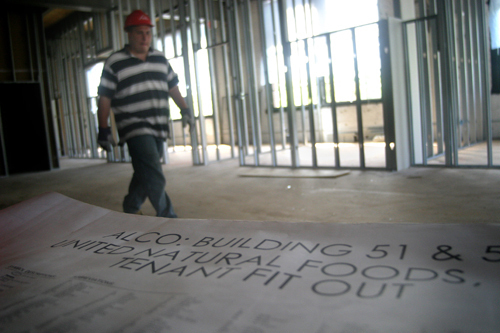
United Natural Food Inc.’s move to Rhode Island – which appeared endangered by the financial troubles of developer Struever Bros. Eccles & Rouse – is no longer in doubt.
United and at least 150 high-paying jobs now are due to arrive at the Struever-owned American Locomotive Works (ALCO) complex on Valley Street in September, four months later than originally planned.
Dayville, Conn.-based United Natural Foods, one of the largest independent distributors for natural, organic and specialty foods, has signaled it was postponing the relocation of its headquarters because construction work at the ALCO site was not moving forward on schedule due to the developer’s money woes.
“The general contractor wasn’t meeting critical milestones,” said Tom Dziki, vice president of sustainable development for United. “We became concerned about the dates.”
Dziki acknowledged last week that Struever’s well-publicized financial problems were a source of anxiety at United.
The Baltimore-based developer reportedly has defaulted on million of dollars of loans for other mill projects out of state. In Rhode Island, numerous subcontractors have filed liens against Struever for failure to pay for construction work done at ALCO and various other mill remodeling projects in Rhode Island.
“We had been following some of the challenges they have been facing,” Dziki said of Struever. “There was a level of concern.”
But he said an agreement has been hammered out that allowed remodeling work on the 52,560-square-foot second-floor office to resume at a faster pace.
Neither side would discuss the details of how the matter had been resolved, although it was clear that losing United as a tenant would have created even greater financial difficulties for Struever.
The company “did what it had to do to get the pieces in place,” said Struever spokesman John Longo.
The United Natural Foods relocation to ALCO is critical to the R.I. Economic Development Corporation, an agency that has been under scrutiny lately with Rhode Island’s unemployment rate on a steady climb to 11.1 percent in April and the state’s fiscal woes growing more severe.
When United’s decision to move to Providence was first announced in October, then-EDC director Saul Kaplan touted the high-paying marketing, accounting and advertising jobs – many of them with salaries of between $60,000 and $70,000 – as what the EDC had been looking for to shift Rhode Island’s economy away from being manufacturing-based.
To woo United, the state offered various incentives.
United had already been given “project status,” a designation that allows companies to receive a sales tax exemption when purchasing building materials and other items – but only when a project adds at least 100 jobs and the added income tax revenue is greater than the exemption.
The EDC last week approved a sales tax abatement of $189,574 for United, based on the state’s economic-impact analysis.
Supporting documentation from the state indicated that United expects to spend $3.4 million in construction at ALCO and another $1 million on furniture, fixtures and equipment.
The company plans to initially bring at least 150 jobs with it – Dziki said that number could be 176 – with the possibility of adding another 90 or so jobs in the next three years. The state estimated the company payroll would be about $17.5 million, with annual personal income tax revenue of $455,517.
A second incentive, under the Jobs Development Act, would cut United’s corporate tax rate, based on how many jobs are created by the relocation.
If the company meets its job projections, the state forecasts United will lower its corporate tax rate from 9 to 6 percent by 2011. (In his fiscal 2010 budget package, Gov. Donald L. Carcieri has proposed a phase-out of the corporate tax that would also reduce the rate for corporations to 6 percent as of Jan. 1, 2011.)
United’s decision to move to Providence is already paying off for some workers. After the relocation was announced in October, the company hired several Rhode Islanders to fill job openings, according to Dziki. He could not immediately provide the exact number of local workers hired.
Those new employees currently work at the Dayville office, a few miles over the Rhode Island border in eastern Connecticut.
While its headquarters will be in Providence, United Natural Foods has a footprint that spreads from coast to coast under seven divisions that distribute everything from organic food to health and beauty aids, and they operate 12 natural-product stores. The entire company employs about 6,100.
Last week, teams of construction workers were at the ALCO site installing metal wall studs and hanging sheets of drywall. Dziki said the company is leasing second-floor space in two buildings at the ALCO complex, but both offices are connected by a bridge.
Because the company is environmentally minded, plans calls for the new offices to be LEED certified.
The company already has entered into a 10-year lease with Struever Bros. Although Dziki declined to specify the cost, the company said in a regulatory filing recently that the lease agreement amounts to $200,000 in fiscal 2009, $800,000 in 2010, $1.1 million in 2011, $1.2 million each in 2012 and 2013, and $7.1 million over the course of the remaining years. •









t