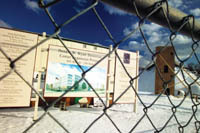
At the Donald W. Wyatt Detention Facility in Central Falls last week, construction crews were building concrete-block walls along a new foundation. A nearby backhoe dumped loads of earth into a dump truck. A prison guard stood with his arms crossed at a gated entrance to the work site.
Construction is rare in Central Falls, the poorest and smallest city in Rhode Island, densely packed with tenements and vacant mill buildings. With factory closings and the steady loss of manufacturing jobs, the city’s industrial base has decayed for decades.
Seifert Systems Invests in Energy Efficiency to Strengthen Operations
For manufacturers, energy is more than just another operating expense. It plays a critical role…
Learn More
Amid this strife, however, the prison business is booming. A major expansion project is under way at Wyatt, promising the city more revenue and jobs, and giving some hope for a citywide revitalization.
The Central Falls Detention Facility Corporation, the quasi-public agency that owns Wyatt, has begun a $46.5 million project to double the prison’s capacity. Within two years, the prison will grow from 77,000 square feet to 185,000 square feet, providing room for 338 more inmates, said Anthony Ventetuolo Jr., president of AvCorr Consultants, which is managing the expansion and other administrative functions.
Plans are to add 65 jobs at the facility, said Ventetuolo, while paying the city about $200,000 more in annual impact fees. He said the budget for goods and services contracts – covering fuel, food, inmate counseling, legal work and more – will go from $4 million to $8 million, pumping more money into the local and state economy.
In fact, the project is expected to inject $82.5 million into the economy in the 20 years following its completion, according to a 2004 study by Kunkel Strategic Services, a consulting firm in Warwick.
Cranston’s O. Ahlborg & Sons Inc., the project contractor, broke ground in August at the prison, located at the corner of High Street and Blackstone Avenue. The first phase, expected to add 184 beds, is slated for completion in July, with 144 additional beds coming on-line when the second phase ends in September. Full completion is expected by May 2007.
The expansion has brought an air of optimism to city government. “When it finally opens up, it’s going to do amazing things for this area,” said Arthur L. Hanson, director of the city’s office of planning and economic development.
Cornell Corrections, the private contractor that handles the facility’s security, has an agreement with the city to give its residents a “first shot” at the new jobs, Hanson said. Also, the facility corporation has leased and cleared a former junkyard across from the prison for employee parking and an 11,000-square-foot training center, erasing a blighted area in the city.
Hanson noted that the former junkyard borders the Blackstone River, along which city and state officials plan to construct a bike path. Improving visibility of the waterway, he said, will hopefully attract redevelopment of the vacant buildings next to the river.
Though a national problem, the decline of manufacturing has hit Central Falls particularly hard because the city had few industries. Once its largest employer, the Elizabeth Webbing complex was shuttered in early 2001, affecting about 400 workers.
“When most of the manufacturing jobs left, what remained was a lot of working class housing and obsolete manufacturing buildings,” Hanson said. The problem almost forced the city into bankruptcy, he said, and led the state to take over financial responsibility of the city’s school system in 1991.
One of the reasons for building the detention facility was to bring economic relief to the city, Ventetuolo said. Completed in 1993, the facility provided the city with $6.5 million in impact fees and other revenue.
Since Sept. 11, 2001, however, the U.S. Immigration and Customs Enforcement has become a more frequent customer of Wyatt, as the nation steps up efforts to detain and expel illegal immigrants. The U.S. Marshals Service, the prison’s biggest client, needs more room to house inmates as well.
“Because of that,” Ventetuolo said, “we’ve been getting urgings from the federal government to expand.”