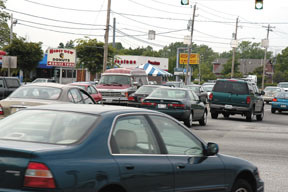
busiest thoroughfares.
A proposal to tax gas-guzzling SUV’s in Rhode Island and use the money to reward people who buy new fuel-efficient electric hybrid cars with a $2,000 rebate has got mixed support from the business community.
The measure, called the Vehicle Efficiency Incentive Program and being considered at the General Assembly, seeks to reduce greenhouse gas emissions in Rhode Island. Many states, including Massachusetts, California and Maryland, either already have or are considering similar incentives, or “feebates,” as a way to clean up their air and reduce greenhouse gas emissions.
The proposed legislation is the product of the Rhode Island Greenhouse Gas Action Plan, created in 2001 by former Gov. Lincoln Almond to develop new environmental policies as part of a regional initiative to lower greenhouse gas emissions to 1990 levels by 2010 and to 10 percent below 1990 levels by 2020.
Beyond Cash Donations: How New Forms of Giving Are Transforming Not-for-Profit Accounting
Evolving Funding Landscape for Not-for-Profits Not-for-profit organizations are being asked to do more with less,…
Learn More
The fee or rebate in the Vehicle Efficiency Incentive Program is based upon the vehicle’s combined miles per gallon rating. A “zero point” is set at the mean miles per gallon rating of all the vehicles now registered in Rhode Island. The owner of a given vehicle covered by the program would receive a rebate or pay a fee depending on whether its fuel economy lies above or below this zero point.
The fee would be zero at the sales-weighted average mpg of the model year vehicles, currently 22 mpg, and would increase linearly to a mean maximum fee of $2000 at 10 mpg. The rebate would also start at zero at 22 mpg and increase linearly to a maximum of $3000 at 50 mpg.
An effective program could reduce greenhouse gas emissions in Rhode Island by about 125,000 metric tons by 2020, if it could induce steadily increased purchases of more fuel-efficient vehicles in the state, with the average for new purchases reaching about 37.5 mpg by 2020, according to an analysis conducted by the Tellus Institute.
The bill’s supporters reportedly include the R.I. Department of Environmental Management, Brown University, the University of Rhode Island, the state’s Division of Public Utilities and Carriers, the Department of Transportation, New England Gas Co., the R.I. State Energy Group and every environmental group in the state.
The measure also has more cautious support from AAA Rhode Island and several other business organizations that support measures aimed at cleaning up the air in Rhode Island.
But after months of discussion by various stakeholders in drafting the proposed legislation, the final version of the bill caused Narragansett Electric Co. and other businesses and lobby groups to pull their support. They say the bill would unnecessarily harm business in Rhode Island.
A decision to include all commercial trucks and light duty vehicles up to 10,000 pounds caused Narragansett Electric to pull its initial support for the measure. That caveat would effectively tax the trucks the utility company uses on the road every day to read meters and do repair work.
Kate Ringe-Welch, a Narragansett Electric representative who cast her Greenhouse Gas Action Plan committee vote against the final bill, could not be reached for comment.
But Gary Ezofsky, a co-chairman of the Business Roundtable, a local business forum on environmental regulation, spoke about why his group decided not to support the final measure now being considered.
“The model that has been embraced thus far is needlessly harsh, targeting fees and rebates that are higher than we really need to encourage them to think about how their vehicles and driving habits impact the environment,” said Ezofsky, who is also president of Lincoln Environmental. “I’m not ready for that, and I don’t think business is ready for that. I just hope that the solutions that we come up with ultimately are ones that don’t make it more difficult to do business.”
Robert Murray, president of AAA Rhode Island, said he saw the proposed legislation as “an admirable attempt to reward people for cleaning the air.” But he and others said that it doesn’t take into account other factors such as how much people drive, not just how much fuel their cars burn. That unfairly hurts people who like big cars, he said.
Lawmakers in Massachusetts are currently considering a similar bill that would place a fee or rebate by gross weight of vehicle. In California, strict mandates for what emissions are allowed from tailpipes were challenged in court by the auto industry. That case, scheduled to be argued in front of the federal 9th Circuit Court, will have a big impact on the future of similar legislation in Rhode Island and other states, said Christopher D’Ovidio, a spokesman for the Conservation Law Foundation.
Maryland enacted a similar law in 1992, but that legislation was overturned because the state overstepped its bounds in creating fuel efficiency ratings for vehicles, which is the federal government’s domain, said D’Ovidio.
The Rhode Island Vehicle Efficiency Incentive Program bill is seen as a long shot for this time, say many interviewed for this story. If passed into law, it could face similar lawsuits from the auto industry or federal air regulators, said D’Ovidio.
But D’Ovidio said supporters of the bill are confident that the measure is fair to the business community, and that they are prepared to push the legislation until it becomes law.
For the complete current issue, visit our subscription Web site, or call (401) 273-2201, ext. 227 or 234.