The last few decades have seen American consumers increasingly reliant on credit to maintain spending, a trend that began in the 1990s.
The federal government is often too ready to oblige.
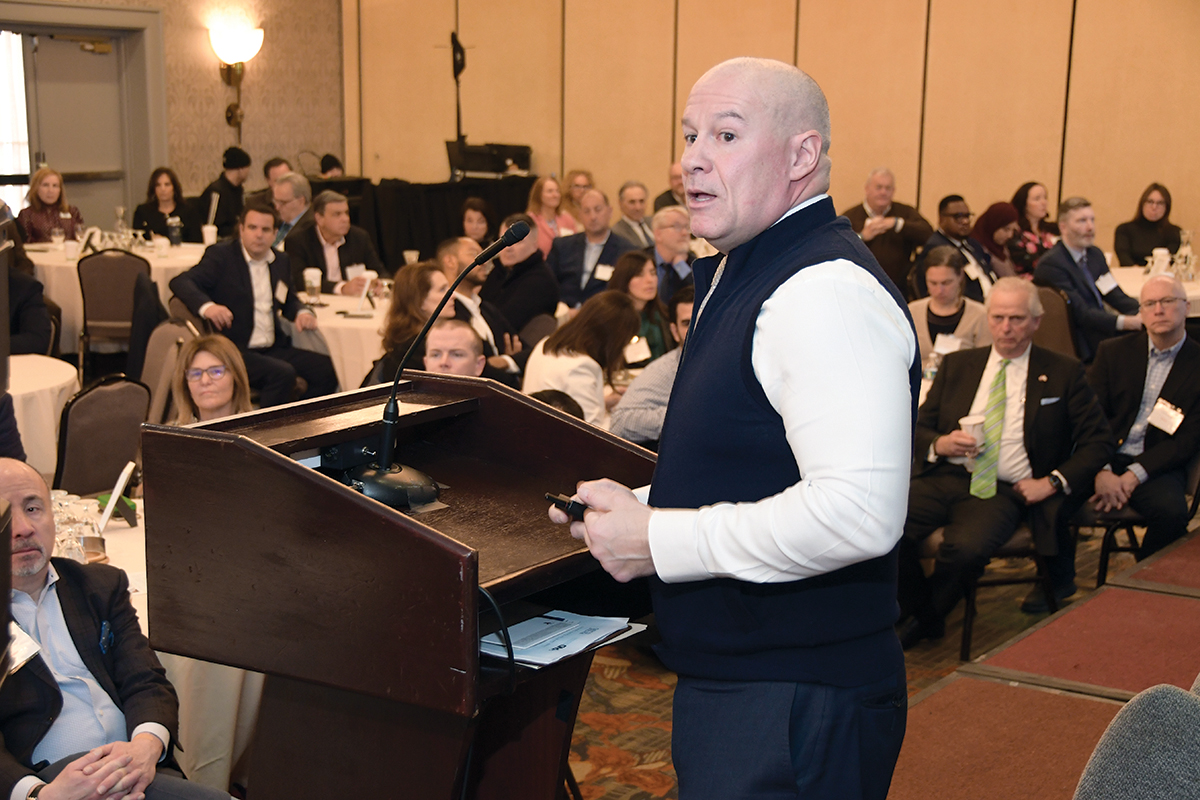
Thomas Tzitzouris, head of fixed-income research at financial services firm Strategas Research Partners, speaking during his keynote address at Providence Business News’ Economic Trends Summit on Jan. 22, said that both major political parties have demonstrated an unwillingness to make significant cuts to spending because of fears that high deficits could provoke “bond market vigilantes” – investors who aggressively sell off government bonds, driving up yields and inflating borrowing costs.
This is especially true during an election year.
“The pain you have to take would be intolerable,” Tzitzouris said.
The prevailing federal monetary policy has fostered more rapid consumer cycles, where excessive consumer stimulus has been consistently injected into the economy, regardless of which political party holds power, he said.
“If $100 million in government spending isn’t working, then we’ll try $200 million,” Tzitzouris said. “If the consumer won’t spend, then you give them more credit. But this doesn’t do much to fix the underlying problem.”
With all of the fanfare surrounding the federal Department of Government Accountability’s effort to downsize, “they brought it just around 6%,” Tzitzouris said. “And look how politically volatile that was. Elon Musk was receiving death threats.”
If spending falls, policymakers will support asset prices and cut interest rates to encourage renewed spending. “We are battening down economic volatility that causes a ramp-up in political volatility,” he said. “This is an endgame for most societies.”
Typically, more income generated from capital than from wages and salaries. But 2026 “should be one of those years when that actually reverses,” Tzitzouris said. “And this is a good thing.”
Inflation is expected to drift slightly lower, maintaining a stable trajectory for most of the year, according to Tzitzouris.
In the mid-range outlook, inflation rates may stabilize just below 2.5%, he said.
Meanwhile, he said, tax cuts are expected to yield around $1,000 more in tax returns, and productivity is projected to rise by 2.5%, yet inflation may reach 4% in the longer term as stimulus paves the way for increased consumer demand.
And while deficits may drop in the near term, budget overruns are forecasted to rise again in 2027, complicating the balance between borrowing costs and consumer health.
The impact of consumer stimulus, larger-than-usual tax refunds and increased business investment linked to events such as the World Cup matches in the U.S. and the country’s 250th anniversary celebration will likely exert upward pressure on inflation throughout the year.
Barring a large geopolitical event, these events are expected to buoy the economy from July until Labor Day.
“It’s going to be a strong economy and a sloppy year for the financial market.” Tzitzouris said.
Rhode Island faces unique challenges, he noted, with labor force participation rates significantly lower than the national average, and years of stagnant birth rates mean fewer buffers against potential economic downturns.
In most metrics, the state is comparatively in the “middle of the pack,” he said.
An exception is lagging wage growth and municipal stress at the local level. This could spell trouble if the state is hit with a housing crisis of a kind not typically mentioned by state officials or progressive advocates.
“We are in bubble territory right now,” Tzitzouris said, adding that a burst in the bubble could lead to a 30%-50% decrease in average home prices “in a state that doesn’t have the income levels to afford this.”