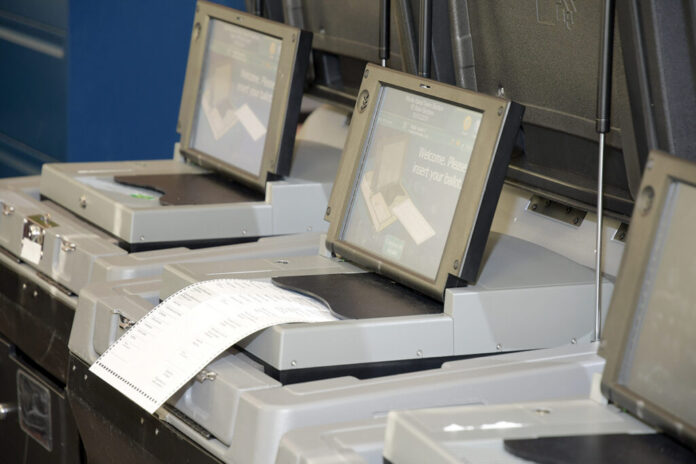
A series of errors plagued the first two weeks of early voting in Rhode Island’s primary elections, but experts say voters can be confident in the results as they turn their eyes toward the Nov. 8 general election.
A misspelled name, wrong headings and wrong candidates appeared on the Spanish-language ballots on some ExpressVote machines during the first two weeks of early voting. That prompted finger-pointing among the agencies involved, a blame game that ended during an R.I. Board of Elections meeting on Sept. 7, in which the voting machines vendor took full responsibility.
But many were left wondering: How did this happen? It was a mix of vague statutes and the use of new technology, election observers say.
“If there’s anything this incident has taught us, [it] is that there’s a lack of clarity as to who was responsible for what,” said Steven Brown, executive director of the American Civil Liberties Union of Rhode Island Inc.
According to state law, the R.I. Office of the Secretary of State is responsible for preparing the layout and format of computer ballots. But it is the responsibility of the elections board and the vendor to test “for logic and accuracy.”
“My understanding is that the secretary of state gave to the Board of Elections the correct information to put into the machine,” said John Marion, executive director of Common Cause Rhode Island. “The vendor, who is under the oversight of the Board of Elections, put incorrect information into the machine.”
The vendor, Election Systems & Software LLC, acknowledged that it used a template based on the 2018 election when preparing the voting machines. While the information was entered correctly in English, the company failed to update some names on the Spanish-language ballots.
In response, the board voted to implement new verification protocols for both the vendor and the Secretary of State’s Office before the general election.
“We look forward to sharing best practices for testing ExpressVote machines and making sure that a mistake like this never occurs again,” said Johnathan Berard, a spokesperson for the Secretary of State’s Office.
This is the first year that the ExpressVote machines are being used, but state law does not properly address the new technology, officials say.
“The old … machines allowed voters with disabilities to mark a traditional paper ballot, whereas the new ExpressVote machines create a ballot card based on the selections made by voters on the touch screen,” Berard said. “New technology necessitates new verification and testing protocols.”
Marion agrees.
“In the long term, we need to change the state law that governs the use of these machines because it was written for the previous technology,” Marion said.
Election observers encourage voters not to lose confidence.
“One of the few great things that happened as a result of the pandemic is the availability of these alternative methods of voting, both early voting and better reliance on mail ballots,” Brown said.
Marion says voters who use the ExpressVote machines can compare their selections with the printed ballots to ensure their vote is accurate.
“At a time when there’s a lot of distrust in elections, having this new technology deployment go wrong doesn’t increase anyone’s trust,” Marion said. “That’s a real tragedy. But hopefully, the state learns from the lesson and doesn’t only make sure this problem doesn’t happen again, but every time they employ a technology makes sure the right policies are in place.”