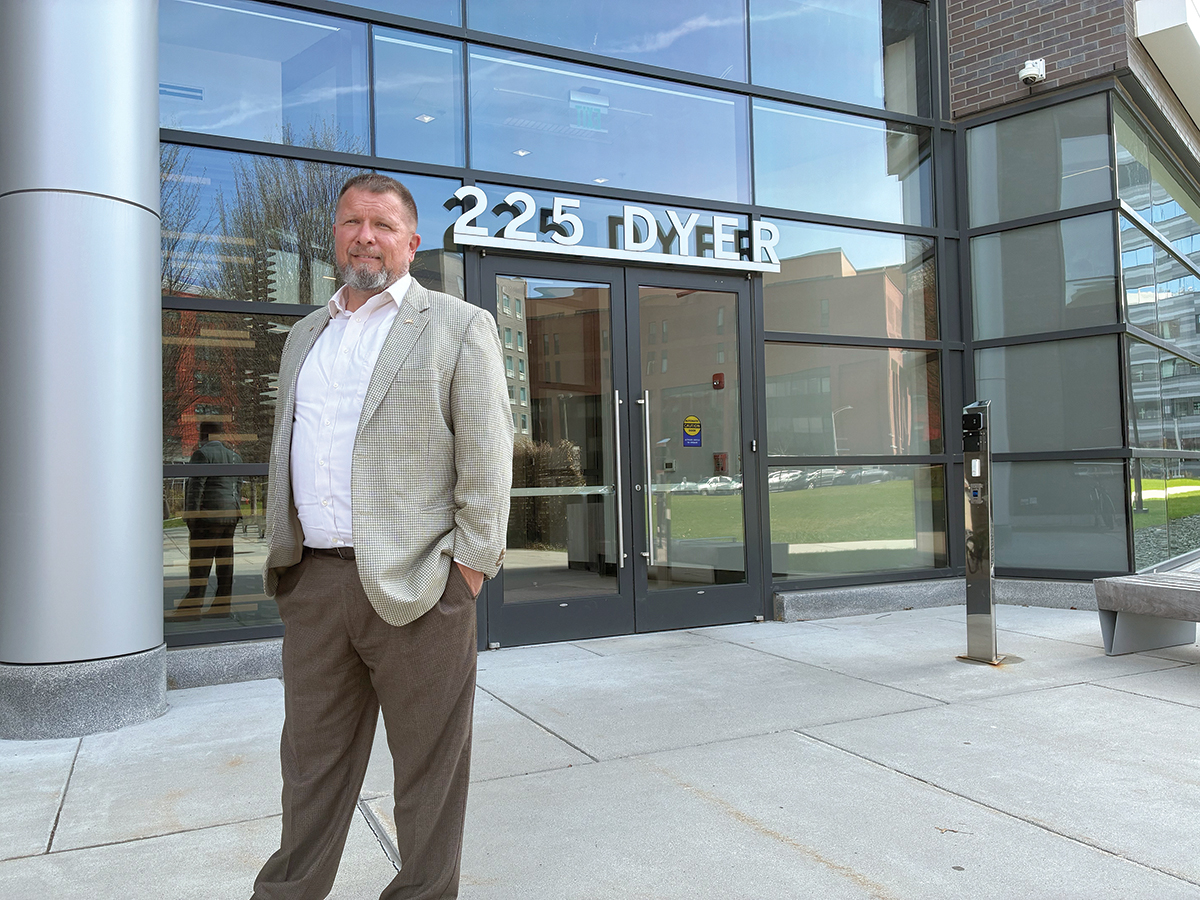
With Rhode Island making a push for the state to become a burgeoning hub for life sciences and biotechnology firms by building lab space and other facilities, David J. Place is looking to add a sandbox, too.
Place, a Republican state representative from Burrillville, has submitted legislation that he says would turn the state into a testing ground for early-stage life science firms, allowing them to apply for temporary exemptions from certain state laws and licensing requirements, where permitted under existing authority, as they test new technologies under lighter oversight.
The “regulatory sandbox” concept – a reference to a safe, contained space where children can play – has been used elsewhere, in tightly regulated environments such as financial technology.
“We are just trying to open our doors to innovation,” Place said.
The legislation has raised questions about whether Rhode Island can safely oversee such a program – and whether the state has the resources and systems to back it.
In a February letter to lawmakers, the R.I. Department of Business Regulation said it would lack the capacity to administer such a program safely, warning it would require a substantial amount of new staffing and regulatory infrastructure.
DBR Director Elizabeth Kelleher Dwyer said the agency “does not have any expertise” in those areas and the new staffing would need to include scientists, investigators and legal counsel.
The department estimated the initial cost of establishing the sandbox framework at more than $30 million. Dwyer also cited the need to build new regulatory infrastructure and noted the likelihood of federal legal challenges tied to waiving requirements.
“We would anticipate considerable federal litigation if we sought to waive federal health and safety laws and regulations,” Dwyer said.
State health officials, too, said the proposal falls outside their regulatory authority.
R.I. Department of Health spokesperson Annemarie Beardsworth said the items referenced in the bill – including potential waivers involving human genetic modification and ethical standards for human and animal research – are not within the agency’s oversight.
Place said the regulatory uncertainty over who would oversee what is what’s holding back innovation.
“Government is always too slow to react to those technologies,” he said. “Sometimes, like now, that becomes a barrier to advancement.”
The bill, which had no Democrat sponsors, was referred to the House Corporations Committee, which held a hearing and recommended it be held for further study.
Regulatory sandboxes were first widely introduced in the financial services sector by the U.K. Financial Conduct Authority in 2016 and have since been adopted in jurisdictions, including Singapore and Australia, as tightly controlled testing environments for new financial products and services.
The model has more recently surfaced in the artificial intelligence arena, through pilot programs and proposals from bodies, including the European Commission under the 2024 AI Act framework.
For Place, the aim would be to use that sandbox framework to make Rhode Island a faster-moving hub for early-stage life science firms that he says are slowed by traditional regulation.
He said the sandbox would allow startups to test emerging technologies under structured oversight without leaving the state for other research corridors.
“Right now, innovation gets blocked because it doesn’t fit neatly into existing frameworks,” Place said. “This gives companies a place to prove what they’re building.”
He added that Rhode Island’s size is an advantage, allowing the state to experiment with policy more quickly than larger jurisdictions.
Dr. Amy Nunn, CEO at the Rhode Island Public Health Institute and an adjunct professor of public health and medicine at Brown University, said faster regulatory movement is not the core issue as Rhode Island proceeds with building a life science hub. The deeper question is whether Rhode Island has the economic and institutional foundation to support a biotech sector at scale, she said.
Nunn said she sees value in Place’s sandbox idea, especially when it comes to testing new technologies and accelerating innovation. But she added that easing rules alone would not be enough to build a competitive industry.
“It’s not a short-term project,” she said. “It takes a generation.”
Nunn pointed to places such as North Carolina’s Research Triangle and Cambridge in Massachusetts, where biotech sectors grew through long-term coordination across government, academia and industry – not through regulatory sandboxes.
She said Rhode Island already has the building blocks of a life sciences economy, including Brown University, the University of Rhode Island and recent state investments in biotech infrastructure. But it still lacks the sustained coordination seen in more-mature hubs.
“I don’t see that happening here like it does in Massachusetts,” she said.
The R.I. Life Science Hub, a state-backed initiative to grow the sector in Rhode Island, referred questions on the sandbox concept to the R.I. Executive Office of Commerce, which referred to the DBR letter.
Still, Place argued the state can use its size to its advantage in competing for life science investment and said the sandbox bill is key to getting there.
“Rhode Island has the potential to be the center of the Northeast,” he said. “We are small enough that it makes us agile enough to implement unique policies.”