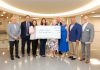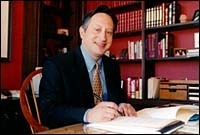
Foundation. (Brian McDonald)
Name: Ron Gallo
Position: President, Rhode Island Foundation
Background: Hired as president of the Rhode Island Foundation in February
1993 after being director of the Jesse Ball duPont Fund from 1988 to February
1993. He had been the program officer for the fund.
Education: Bachelor’s in history from Connecticut College; Master of Science
from Columbia University; Ph.D. in social policy from Harvard University.
Age: 46
Family: Married, three children
Residence: Providence
PBN: The Rhode Island Foundation seems to have really changed direction, becoming more of a community player, working more in the trenches.
GALLO: I think that is exactly right In fact I was reflecting on the first
time we did one of these interviews – it was seven years ago – and at that time
we were just beginning to chart this course, taking the Rhode Island Foundation
from grant maker, reputable grant maker, to being a player in the public agenda
of Rhode Island, on behalf of the people and communities in this state. It may
sound like rhetoric or semantics, but it really was a fundamental change. It (the
endowment) was about $150 million when I arrived in 1993. It is now hovering around
$400 million. We’re beginning to see if there may be different responsibilities
with an endowment of that size and one that is assured to be at half a billion
and one day a billion dollars. What does that mean for the community foundation?
Does it just sit back and make more grants or does it take a different role in
the community?
What precipitated that change?
It was a few things. It was a board that had a great deal of vision and began
to see those possibilities and that came through when they were interviewing for
my position. I had a track record at the duPont Fund of taking a foundation to
a different place. I was very excited about doing that kind of thing here, because
a community foundation, I think, is uniquely positioned, even among foundations
to really make an impact on an area because it is defined by a geography. Unlike
a Ford Foundation that might fund all over the world. And even with the many hundreds
of million dollars they put out there every year it is very diffused. With a community
foundation you can dig deep. A combination of a growing endowment with a board
that was saying let’s go, and really seeing the opportunity of this community
foundation moving into that role is really what prompted it.
Beyond Cash Donations: How New Forms of Giving Are Transforming Not-for-Profit Accounting
Evolving Funding Landscape for Not-for-Profits Not-for-profit organizations are being asked to do more with less,…
Learn More
Seems like you’re focusing on a couple of directions, including what is the
heart of downtown. Where are we with that project?
It is an exciting time to have this conversation because on July 16 Peter Armato
will be joining us as the first president of Downcity Partnership, Inc., a subsidiary
of the Rhode Island Foundation. He’s coming to us from Bellevue, Washington with
a great deal of experience there and Savannah before then, but it’s not just Mr.
Armato himself. It really gets to the heart of what the Rhode Island Foundation
is about, which is identifying important issues and then building a permanent
capacity outside the foundation itself to tackle an issue.
Downcity, most people would agree, is that one area of our downtown that has not moved as quickly as Waterplace Park, the Mall kind of around the perimeter. What it is missing are two things. One is money, but I think that is almost secondary. Yes, we are committing a nine million-dollar loan fund, but it’s someone who gets up every morning and says what does this eight by eight-square block area need. I think that’s what it has been missing, that level of leadership and attention. That’s what Peter Armato will bring, as well as his board and the whole structure of the Downcity Partnership.
In five years what do you hope it looks like?
That’s just about a good time line for a first phase, but ultimately we’re looking
for Downcity, that eight square block area, to be a place that has residents.
That’s the number one thing. It does not have a residential component to it, and
I think most people who study these things agree that any neighborhood that lacks
residents is not an organic neighborhood, it cannot sustain the commerce and even
the other more ethereal components of what make a vital neighborhood. We’d like
to see it to be a place of the arts. We already have four or five terrific arts
organizations there in Black Rep, Trinity, AS220, Perishable Theater. We’d like
to see more of that. We’d like to see art galleries, commerce, everything from
the coffee shop, grocery store, dry cleaners, boutique. It’s doable, because it
is a contained area and it has magnificent housing stock, great architecture.
It just needs leadership. It needs something to happen in codes, which is already
happening. We need a business improvement district and we finally have the legislation
to enable that. I think we’re on the way.
Looking at other initiatives, you’ve certainly addressed health care with the
Neighborhood Health Plan. That was a partnership with them?
It is. It is what we call a program-related investment. This is where, like with
Downcity, they represented our first two departures from our usual invest the
principal and spend the income. We took actually portions of our income, just
a sliver, $9 million in Downcity’s case and a $2 million sliver in NHPI. In their
case what we did was buy their license. They were owned by a Massachusetts entity.
We bought the license, in a sense brought it home to Rhode Island. They converted
from a for-profit to a non-profit and the shares were converted to a long-term
debt to the Rhode Island Foundation. They have a very modest interest of 5.75
percent and principal is due in four payments over the next 20 years, every five
years. The point of it, I think it goes to that leadership, brokering, collaboration
role. We saw we had in our midst an HMO that was well operated – it’s been in
the black the last five, six quarters consecutive– even more importantly focused
on the working poor, which is an important piece of, I think, the growth of this
economy. It’s to stabilize workers at that level. They had this one problem. We
were in a position with this endowment that is relatively unencumbered, to move
in there and to get their fate back in their own hands. Since then they have grown
by 14,000 members, they have a new headquarters, and they were just given a rating
of excellent by the accreditation body of HMOs.
What other initiatives have you been involved in, and where else do you feel
the Foundation will go?
We want to continue to look at those essential issues that strengthen the economy
and civility of this state. And it’s the obvious ones that everybody always talks
about – public education, health care, childcare, and even the arts. I’ll give
you a couple of quick examples. Last year we helped broker $13 million from the
Melinda and Bill Gates Foundation to go to the school district of Greater Providence,
to help with literacy, both in math and reading. We were able to get that because
of our growing stature with national foundations as a value added partner in this
region. It is very clear to us that the Bill and Melinda Gates Foundation would
not have given that $13 million directly to Superintendent Lamb. And this is not
in any way to cast aspersions on her leadership, rather they just wouldn’t have
done that. They wanted to know that another colleague was going to partner with
them, and they chose us. We believe, particularly with the burgeoning immigrant
population in Rhode Island that is centered in Providence, Central Falls, Pawtucket,
but moving to Woonsocket and Newport as well. a first rate public education system
that is able to deal with reading literacy, language literacy and math literacy
is important. Similarly with child care. This is something we’ll formally announce
in September. We are working quietly to put together a child care facilities’
fund with the state, private foundations, some private donors and other partners
that will create a revolving loan fund that will add up to 2,500 new and or improved
slots for child care, again pitched at the lower end of the income stream throughout
the sate.
I see a pattern there, whether it is health are, child care, Downcity, Kids Count, which we helped bring here five or six years ago, public radio, which we helped to bring here – not alone, but with others a couple of years ago. We’re trying to be that entity that creates permanent capacity that can deal with problems in an ongoing way.
What do you perceive as the major problems our state faces, and ones in which
the Rhode Island Foundation can play a role.
Let me preface that. I keep coming back to this theme of leadership, something
that we have been observing here. I think it’s something true of communities our
size. I think leadership has always been an important factor in any community
being able to deal with problems, move ahead, be progressive. And you can fairly
say the 20th century was an industrial era, with places like Providence
with local banks, local manufacturing in particular had a core of important leaders
over that 10 decades that really moved this state forward, when the state moved
forward. What’s sad is that here, like in many cities, we are losing many of those
pillars of leadership as banks consolidate and manufacturing disappears.
I don’t want this to sound pretentious or that we’re the only ones, but I’m increasingly
seeing that the Rhode Island Foundation and other community foundations our size
— and we are in that top echelon of community foundations — are going to have
to step up to the plate as one of the new institutions of the 21st
century that has the capacity to move a region forward.
With that as a backdrop we feel an increased pressure to be smart about that question. What are the major issues that are facing this state that we must be involved with. And we see that first and foremost with large economic development. Because so many of the social ills that we end up funding often accrue to dis-equilibrium in the economy. If we can play some creative role about building a sturdy economy. And we know we’re talking about being strategic and working around the edges.
Increasingly, we want to get into the game of doing really first rate economic analyses of issues, whether they be on the Port or… Not that we would necessarily commission it. When there are sticky problems around economic development, where there are polarized positions, perhaps the Foundation can jump in and see what information, what kind of quality information can be gathered and then disseminated to those who have strong opinion so we can move beyond something that seems locked in a difficult situation.