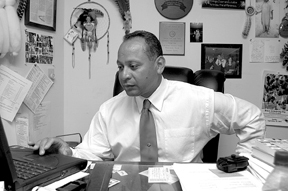
administrative building in Charlestown.
Tribe leader on funding, land, culture and casinos
Chief Sachem Matthew Thomas
Age: 43
Beyond Cash Donations: How New Forms of Giving Are Transforming Not-for-Profit Accounting
Evolving Funding Landscape for Not-for-Profits Not-for-profit organizations are being asked to do more with less,…
Learn More
Position: Leader of the Narragansett Indian Tribe
Background: Prior to becoming chief and serving on the council, Thomas
worked for the Parks and Recreation Department for the town of Narragansett
for about 20 years.
Education: High school, with a year and a half at the Community College
of Rhode Island
Residence: Charlestown
Q. Can you speak a bit about your operating budget?
A. Our operating budget, right now, is about $6.1 million and consists of housing, Indian Health and Bureau of Indian Affairs monies and Department of Justice funds. Unfortunately, $6 million isn’t enough to take care of and maintain 1,800 acres of land, with roads. We have a day-care center, an Indian health clinic, Indian child welfare (like DCYF) and natural resources, police and planning departments. So, to put it in a nutshell, we’re 2,700 members with a high rate of diabetes and breast cancer and other issues just like outside society. We mirror pretty much what the state does, except we don’t mirror its budget. They have a lot more people and space, but again, when you look at the membership and what we have to maintain, $6 million is just not cutting it.
Q. Are you an elected official?
A. Traditionally, you were born into the chief sachem’s position. Until European interference, we went to an electorate process. I am elected. My position is for five years. I was elected to my first term in 1997. I was re-elected in October of 2002. My term will be up in October 2007. So, I’ve got a few years.
Q. Could you describe your current relationship with Gov. Don Carcieri?
A. Gov. Carcieri, in my opinion, really does want to understand the cultural differences between the Narragansett Indian Tribe and the state of Rhode Island. The people around him aren’t helping him very much. I think he has a good heart. I believe Carcieri is trying to understand us.
Q. Can you speak to those cultural differences?
A. Just the way we operate and say and do things – we’ve done them for hundreds of years. If we say we are going to do something, history has shown that we do it. They need to understand that. … There are various entities in the state that help people within the minority community – the Urban League, the Rhode Island Indian Council – that aren’t a federally recognized tribe and don’t have a history. They are just nonprofit organizations. I think some of the officials in the state look at us like they look at them.They need to understand the tribe has had a structure and an organization for years and try to understand it, sit down and discuss it. I believe the governor is trying to do that. But I believe there are people around him that are so fearful of this casino and even of the tribe having any kind of economic viability that they’re constantly throwing wrenches into what is going on. The governor recently named Deborah Smith to be a liaison, which I think is something that should be applauded. He’s trying. He should have chosen a Native American and it might have been easier to understand the liaison. She is African American and highly respected. I respect her. But if I am going to deal with the Italian community, I am going to have an Italian liaison.
Q. Staying with the casino, how close do you think a question is to getting on the ballot?
A. In Rhode Island, you never know. I went to Cancun (recently). I’m in a marketplace and somebody says, ‘Chief Thomas, get that casino. We want that casino.’ On the way back in the Philadelphia airport, the same thing. Even people who oppose it come up to me and said, ‘I don’t support your casino, but I support economic development.’ They’ve said, ‘I’d like to vote on it.’ Many Rhode Islanders have seen what’s happened in Connecticut where our money is going over the borders and they see how it helps the tribe.
Q. Assuming it is successful, what do you see setting it apart from Foxwoods or Mohegan Sun?
A. You would just have to compete. It would be like any business; the General Assembly is going to have to understand that when the bill goes in. If you put the tax rate up too high, you’re not going to be able to compete. In order for Rhode Island to do it properly, they need a tax structure that can compete with the two in Connecticut. And you’ve got to build something that is attractive.
Q. Now the flip side of that, assuming it fails. Is there a plan B?
A. We are going to have to cross that bridge when it comes.
Q. Can you talk about other economic development projects?
A. We’re looking at a seafood co-op. Unfortunately I can’t get into too many others because we have an economic development commission, just like the state does. And they bring us products when they are complete. They certainly have things on the drawing board. Obviously, we need to do something to bring us to self-sufficiency. We don’t like relying on all the federal dollars. They could dry up tomorrow. Bush could take them for homeland security.
Q. Have you seen cuts because of the economy?
A. We have a police department and they basically did away with federal Cops Fast grants and a few others. You could apply for equipment and salaries and help facilitate your police department. And now a lot of those funds have been taken for homeland security. Our Indian Health Services program has been cut. So we have to find where can we tighten our belts. The social services program is the same thing. In order for this tribe to run, at least $15 to $20 million is needed in a budget. We have to look at our children, making sure they have a proper education, proper living conditions. Without proper budgeting, it is difficult to do that. We want the opportunity to get our kids a decent education, because no one told me the American Dream is a monopoly. So with the casino there are two issues. One is obviously the economic benefit. The other is how we had our rights taken away. A lot of it is the principle of the matter. The Chafee Rider stripped us of our rights. So we’ll never give up on either getting our rights restored or the casino in West Warwick. You asked what if it doesn’t get on the ballot? We want our rights restored. If our rights are restored tomorrow, chances are pretty good this tribe would go to West Warwick because nobody has treated us like that town.
Q. We’ve talked about relationships with government, what about ones with the private industry?
A. The problem is how can you attract them to the reservation.
Q. Is that a challenge? And when you say attract them to the reservation do you mean to show them what is here or show them what is here to develop?
A. Both, to see what’s here and what we can do here. I mean GTECH isn’t going to put its headquarters here. First of all we have two ponds that are pristine and we have to be careful in regards to the water. We want to make sure our ponds stay pristine. So what do we put on our reservation? We looked at a water bottling plant and that went belly up.
Q. Why?
A. (The problems) at the time (were) getting shelving space and just trying to compete. For instance I met with Stop & Shop and A&P in New Jersey and all these other places looking for shelving. It just didn’t work out. We looked at a power plant. We had a hard time because we needed fuel to run it. It just wasn’t feasible to do it. First thing you need to look at is how is it going to affect the land? We had one entity that wanted a recycling plant. My tribe doesn’t even want to hear that. You aren’t going to be melting bottles and tires. Our biggest concern is to preserve and protect the property. On our reservation, out of the 1,800 acres, a one-third of it is buildable – that means 600 acres. We have 2,700 members and about one-third need housing. Half of the 600 is immediately gone. So you may have 200 acres or a little more for economic development. Whatever you put there it better be very viable, because if it isn’t you’ve wasted the land. So that’s why we are very picky about what’s going to go on the property.
Q. Do you see the culture changing and you going into the mainstream more?
A. I do. One of the tribes in Connecticut works with its community and have done well. If people can get beyond the ignorance of what they think a tribe is I think the tribe can be helpful to them. When the settlers first came, we worked with them. See the weakness with Indian tribes is, and we still can’t get rid of it, is we’re humanitarians. We’ll sit with you and share what we have. Why be greedy about it. So they existed very well together, until they got greedy and wanted more land and pushed and pushed. Bitterness happened and the scars are deep.
Q. You say humanitarianism is the biggest weakness. What is the biggest strength?
A. I think we are resilient. That is the strength of this tribe. I’ve seen this tribe put out its hand and get kicked, slapped, thrown down, and it stands up. They’re proud. The state has looked at us for 400 years and asks why don’t you just go away or become assimilated into the mainstream. We won’t. And again that gets back to just try to understand us. But it all boils down to power, money and greed. The very things that happened 100 years ago are no different now. The game’s the same but the pieces have changed a little. Now fast forward, you’ve got an Indian tribe that is trying to exist again, who just wants a piece of this pie so we can eat too. We’re trying to do a tobacco shop down here. We want to do a gaming facility. We want a piece of the pie. It is important the tribe with its inherent rights has the opportunity to be self-sufficient. That’s the key. Funding secures stability.