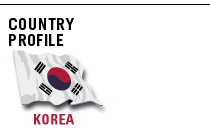
Location: Eastern Asia, southern half of the Korean Peninsula bordering the Sea of Japan and the Yellow Sea.
Geographic Area: 98,480 sq km, slightly larger than Indiana.
Climate: Temperate, with rainfall heavier in summer than winter.
Major Cities: Seoul (Capital, 11 million), Pusan (3.9 million), Taegu (2.5
million), Inchon (2.4 million), Kwangju (1.4 million), Taejon (1.3 million).
Population: 47,470,969 (July 2000 est.).
Ethnic Groups: Homogeneous (except for about 20,000 Chinese).
Languages: Korean, English widely taught in junior high and high school.
Workweek: Monday to Saturday, average 47.5 hours.
Type of Government: Republic
Head of State: President Kim Dae Jung
Currency: 1 South Korean Won (W) = 100 Chun (theoretical)
Exchange Rate: $1US = 1,301 Won (July 30, 2001)
Current Economic and Political Conditions: As one of the Four Dragons of East Asia, South Korea has achieved an incredible record of growth. Three decades ago, its GDP per capita was comparable with levels in the poorer countries of Africa and Asia. Today its GDP per capita is seven times India’s, 13 times North Korea’s, and comparable to the smaller economies of the European Union. This success through the late 1980s was achieved by a system of close government/business ties, including directed credit, import restrictions, sponsorship of specific industries, and a strong labor effort. The government promoted the import of raw materials and technology at the expense of consumer goods and encouraged savings and investment over consumption. The Asian financial crisis of 1997-99 exposed certain longstanding weaknesses in South Korea’s development model, including high debt/equity ratios, massive foreign borrowing, and an undisciplined financial sector. By 1999 it had recovered financial stability, turning a substantial decline in 1998 into strong growth in 1999 and 2000. The major economic challenge for the next several years is the maintenance of the pace of market reforms to restore the old growth pattern.
Seifert Systems Invests in Energy Efficiency to Strengthen Operations
For manufacturers, energy is more than just another operating expense. It plays a critical role…
Learn More
President Kim’s government has opened Korea’s economy to foreign investment and reduced trade barriers. These reforms have accelerated the progression of Korea’s financial and corporate sectors away from the previous state-led economic model toward a commercial free-market model. The rapidly evolving political and economic situation on the Korean Peninsula, as seen in the historic summit between the North and the South, and the partial easing of U.S. trade and investment sanctions against North Korea, may eventually create significant commercial opportunities.
Korea is one of the United States’ biggest trading partners; currently the sixth largest export market. The U.S-South Korean relationship has matured into a close bilateral relationship. The countries share common democratic values and practices and are working together, both in the region and in the rest of the world, to advance democratization and human rights.
Economic Data (1999, in $US)
Total GDP: Purchasing power parity = $625.7 billion.
GDP Growth: 10%
Per Capita GDP: Purchasing power parity = $13,300
Inflation Rate: 0.8%
Trade Balance: $28 billion surplus.
Trade with RI: South Korea is Rhode Island’s 16th largest trading
partner, with $18.1 million in exports in 1999.
Exports $144 billion: electronic products, machinery and equipment, motor
vehicles, steel, ships, textiles, clothing, footwear and fish. Exports trading
partners: US 17%, Japan 9%, China 9%, Hong Kong 7%, Taiwan 4%.
Imports $116 billion: machinery, electronics and electronic equipment,
oil, steel, transport equipment, textiles, organic chemicals and grains Import
trading partners: US 22%, Japan 18%, China 7%, Australia 5%, Saudi Arabia 5%.
Best Prospects for Exports: Wireless mobile telecommunications services, pollution control equipment, semiconductors (non-memory), medical equipment, architectural/engineering services, maritime transportation services, retail services, security and safety equipment, electrical power systems, education and training, drugs and pharmaceuticals, aircraft and parts.
Tariffs, Trade, Taxes, Trademarks
Tariffs: South Korea bound 92% of its tariff line items as a result of the
Uruguay Round negotiations. The average basic tariff is about 8.9%. Under WTO
“Zero for Zero” initiatives, Korea is in the process of reducing tariffs to zero
on most or all products in the paper, toy, steel, furniture, semiconductors and
farm equipment sectors.
Non-Tariff Barriers: The United States has been able to report significant
gains in its long-running effort toward further opening the Korean market to U.S.
goods and services. Korea continues a process of economic liberalization and deregulation,
but the Korea government still maintains a hands-on policy where the economy and
trade are concerned.
Taxes: Korea has a flat 10% Value Added Tax (VAT) on all imports and domestically
manufactured goods. A special excise tax of 10%-20% is levied on the import of
certain luxury items and durable consumer goods. Tariffs and taxes are payable
in Korean won before goods are permitted to clear customs.
Foreign Investment: During the past several years, Korea has emerged as an attractive economy for foreign investors and has shed its decades-long reputation as a difficult or even hostile environment for foreign capital. The Korea Trade and Investment Promotion Agency (“KOTRA”) has opened its Korea Investment Service Center (“KISC”) in order to provide a one-stop service system for foreign investors.
Free Trade Zones: The government has designated several free export zones for the bonded processing of imported materials into finished goods for export. The free export zones are specially established industrial areas where foreign invested firms can manufacture, assemble, or process export products using freely imported, tax-free raw materials, or semi-finished goods.
Trade Finance: Traditionally, most trade and project financing has gone to large Korean conglomerates (chaebol), due to their perceived financial security and immense capital base. The banking industry gave scant attention to domestic small and medium sized companies. This attitude has changed, particularly since the spectacular mid-1999 collapse of Daewoo Group, Korea’s second-largest chaebol. Since then, banks have moved to modernize their lending capabilities and SMEs, particularly information technology firms, have benefited from easier access to bank lending.
Business Etiquette: Americans should be ready to mix business with social life since Koreans base their business relationships on personal ones.
Product Labeling: Product Labeling and Marking: Country of origin labeling is required for commercial shipments entering Korea. The Korean Customs Service (KCS) publishes a list of the country of origin labeling requirements by Harmonized System Code number.
Standards: Korean firms consider compliance with the ISO 9000 Quality Management System necessary in order to compete in the international market.
Patents/Trademarks/Copyrights
Korea is a participant in the WTO’s Agreement on Trade Related Aspects of
Intellectual Property (TRIPS). It is also a signatory to the World Intellectual
Property Organization (WIPO), the Universal Copyright Convention, the Budapest
Treaty on the International Recognition of the Deposit of Microorganisms, the
Geneva Phonograms Convention, the Paris Convention for the Protection of Industrial
Property, and the Patent Cooperation Treaty.
Patents: Patents in the Republic of Korea are protected for 15 years from
publication date and are not renewable.
Copyrights: The Republic of Korea is a member of the Universal Copyright
Convention (UCC), so legal protection exists for all works first published in
Korea or UCC signatory countries.
Key Contacts
Bryant College, John H. Chafee Center for International Business
World Trade Center, Edward Barr, Manager
RI State Directorate, Maureen Mezei, International Trade Director
Contact: Mary-Ruth Foley
Telephone: (401) 232-6566
Fax: (401) 232-6416
E-mail: mrfoley@itdn.net
Website: www.rieac.org
U.S. Export Assistance Center, Department of Commerce
Keith M. Yatsuhashi, International Trade Specialist
Telephone: (401) 528-5104
E-Mail: kyatsuha@mail.doc.gov
U.S. Small Business Administration
Marilyn Bogue, International Trade Officer
Telephone: (401) 528-4585
E-Mail: marilyn.bogue@sba.gov
U.S. Embassy in the Republic of Korea
Address: 82 Sejong-Ro, Chongro-ku,
Address: Seoul, Republic of Korea
Telephone: [82] (2) 397-4114
Fax: [82] (2) 738-8845
U.S. Department of Commerce
Bureau of Export Administration
Export Counseling Division
Office of Export Services
14th & Constitution Ave., NW, Hoover Bldg.
Washington DC 20230
Telephone: 202-482-1455
Fax: 202-482-2387
Website: www.bxa.doc.gov
Embassy of the Republic of Korea
Address: 2450 Massachusetts Avenue NW
Address: Washington, DC 20008
Telephone: (202) 939-5600
Fax: (202) 387-0205
The American Chamber of Commerce in Korea
Ms. Tami Overby, Executive Director
4501, Trade Tower, 159-1, Samsung-dong
Kangnam-ku, Seoul 135-731, Korea
Telephone: 82-2-564-2040
Fax: 82-2-564-2050
Web site: www.amchamkorea.org
English Language Publications
The Korea Economic Weekly
Web site: www.koreaeconomy.com
Korea Herald
Web site:www.koreaherald.co.kr
Korea Times
Web site: www.korealink.co.kr/times/times.htm