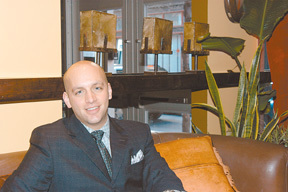
Department of Arts, Culture & Tourism.
Arts group looks to expand programs to neighborhoods
Cliff Wood
Beyond Cash Donations: How New Forms of Giving Are Transforming Not-for-Profit Accounting
Evolving Funding Landscape for Not-for-Profits Not-for-profit organizations are being asked to do more with less,…
Learn More
Position: Director of the city of Providence Department of
Arts, Culture & Tourism
Background: Former deputy chief of policy for the city. Prior to that,
he was a Downcity associate with Cornish Associates.
Education: Master’s degree from Clark University in Worcester, Mass.
Bachelor’s degree from the State University of New York Albany.
Age: 34
Residence: Providence
Q. When did you become the head of the Providence Department of Arts, Culture & Tourism?
A. The department was announced in November – that’s when I officially took the job.
Q. What is the goal of this newly formed department?
A. There are several different goals. We are continuing the tradition
of the cultural affairs office of programming downtown. We’re also expanding
our programming to bring arts to the neighborhoods in conjunction with other
city departments, like parks and recreation. That part is a programming piece.
A second piece is a policy-public service part, which really hasn’t existed
before in a uniform way. That part has me working in partnership, in terms of
arts, with economic development. Mostly it’s working with the new Providence
Economic Development Partnership and the Planning Department. Arts and culture
is an essential and vital part of our identity in Providence and our economy.
In general, we know that cultural tourism attracts more educated tourists that
stay in the city longer and spend more money. They have a higher household income.
So our partnership with the tourism folks – the Providence Tourism Council and
the Convention and Visitors Bureau – is to bring conventions here. That partnership
recognizes the value of arts as a tourism draw. We want to do something that
hasn’t been done before in the city, which is approaching the marketing of the
city more specifically as a cultural destination and doing that in partnership
with other departments in the city.
Q. How will this work?
A. We already have such a broad culture draw and people are already coming to the city. The aim is to harness that power and use it in a way that has us collectively marketing our arts and cultural institutions through a partnership with the tourism folks.
Q. You mentioned a similar arts and culture program in San Diego. Is the Providence program modeled after that?
A. We are not modeled specifically after that. As a matter of fact, they have less than we have in terms of arts and cultural resources. We have the Rhode Island School of Design and Trinity Repertory … the arts are everywhere. We have famous artists. We have the Black Repertory Company, which doesn’t exist in every city. It’s a real privilege to have them all here. We’re trying to package it and make these institutions known even more widely than they are now.
Q. What is the economic impact of arts and culture in Providence?
A. As a single figure, it’s hard to pull out. That’s something that we’re actually working on. It’s one of the first initiatives that we have going on here. But, when we talk about developing neighborhoods or developing buildings that have arts uses, that’s a planning function. How much do you consider arts and culture in planning neighborhoods where arts and culture plays out as well? The answer is quite significantly. Being an educated city that has an arts and cultural focus brings not only those people who want to engage directly, it also attracts secondary and tertiary folks who come because of the environment created by having a city that thrives in that way.
Q. Why is your job a Cabinet-level position?
A. Mayor Cicilline was very deliberate in making this a Cabinet-level position because he recognizes the preeminence of arts and culture in so many facets of Providence. That’s in terms of politics, economic development and community development. That’s where the overlap is and that’s why the mayor wants arts and culture at the table. In a way, my department acts as a bridge to make sure decision makers consider arts and culture in spending resources.
Q. Can you talk about the concept of a one-stop shop for artists who want to move to the city?
A. People have always said they are frustrated trying to wind their way through the bureaucracy of city government – that includes trying to get a permit for something. My department intends to be an interface with the city government if you have arts and culture use. We want to be an interface with those people who want to develop what is essentially a business. It’s my job, because they are artists, to be their connection and help them get through the process in a way that is smooth and predictable. I can help ferry people through the system as an arts and culture representative. That means my relationships with the other city departments become so important. It goes back to us being an intermediary between directors of other departments.
Q. What did you do before you took this position?
A. I was in the policy department for the city.
Q. Was becoming the director of the Department of Arts, Culture & Tourism a big jump?
A. It’s a very different mission and, yes, it’s a big jump. In many ways the scope of the department is less broad. At the policy office, I looked into how we tow cars, how we develop brownfield sites in the city. But (my new position) is every bit as much of a frenzy sometimes. There’s a very big mandate for such a small department.
Q. Pawtucket is pushing its community as an artists’ enclave with the reopening of the Gamm Theatre and development targeted at artists. Do you consider the city as a competitor?
A. No. This whole region is known for arts and culture. I am very happy for Pawtucket and I don’t engage in that sort of competitive thing. In Providence, I can throw a baseball from (City Hall) and hit four theaters that are the same size as (the Gamm Theatre) and are as successful. If I had a better arm, I could hit six. We are blessed with such an abundance of activity. If Pawtucket wants to use arts and culture as a mechanism to move forward, I think that’s a great mechanism.
Q. Can you give me an example of how arts and culture affects a neighborhood? For example, what’s happening on Wickenden Street?
A. I live not far from Wickenden Street. It’s a different aspect of the creative economy. What’s growing there recently that’s really fun to watch is women’s boutique clothing. It’s cool stuff that’s really kind of hip, and from local designers. I think there are two or three of them that are beginning to cluster. There’s artisan glass sold on Wickenden Street in addition to the coffee shops and antique stores. It demonstrates how arts and culture – the creativity economy – builds these clusters of economic and cultural activity. And, we aren’t talking about culture with a small “c.” It’s a place where people go and see each other. It has kind of a downtown feel about it. It’s nice.
Q. Where in the city would you like to see more arts and culture?
A. I think it’s more important to make connections with arts and cultural activities that are already here. For instance, the Columbus Theatre up on Broadway includes a cluster economy with an instrument music store across the street. They show art films. They have Rhode Island Film Festival programs there. There are cafes and music stores. The Everett Dance Theatre off North Main Street premieres its new works in New York City. It is going to start premiering its works in Providence. The aim is to make the connection in people’s minds of all the things that are going on in the city. We are going to spread the type of programming we do for downtown into the neighborhoods. The idea is that if you do it across the city to create a loop where people from one neighborhood will go to the next neighborhood to see a show, for example. That kind of motion is potentially an economic development generator.
Q. Where do you want the arts and culture scene to be in five to 10 years?
A. Arts and culture already plays a big role in Providence and I think it would be difficult to expect it to play a bigger role in the city internally. However, I would like to see in the next five to 10 years arts and culture become more broadly recognized nationally and internationally. It’s really about expanding that consciousness about Providence being a cultural and creative hub the way that we know it is.
Q. Is that difficult given that Providence is between New York City and Boston?
A. New York City is New York City, and that’s that. It’s fantastic. As a small city, I don’t particularly feel that Boston is a threat. Providence has a local character, which is largely defined by this aesthetic and creative class and the arts and culture activities here. They make us uniquely Providence, and not a smaller Boston. There is a whole bunch of people who are attracted to the distinct type of lifestyle that happens in a city like Providence. We bring such unique things to the table in terms of quality of life.