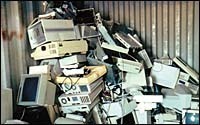
in Johnston. (Tom Croke)
Seventeen thousand pounds.
That’s the weight of computer hardware collected by the Rhode Island Resource Recovery Corporation during just three months of its municipal computer recycling program.
Seifert Systems Invests in Energy Efficiency to Strengthen Operations
For manufacturers, energy is more than just another operating expense. It plays a critical role…
Learn More
The figure doesn’t include computers discarded by businesses, which are ineligible for the free program.
So what is a company to do with old computers it is seeking to unload?
For some, donating the machines is the logical choice.
Barbara Cottam, spokeswoman for Citizens Bank, said her company donates its older machines as a first resort. Area non-profits and schools send letters of interest to the bank, which then donates the computers, as they become available. Cottam estimates Citizens donates some 400 computers to non-profits and area schools each year.
However, some businesses may have irreparable or very outdated machines that they’ve already circulated around their own offices. When it comes time to dispose of the machines, they may be unsure of what to do.
Throwing a computer in the trash bin may seem the easiest choice, but it is also an irresponsible one.
“Computers are loaded with toxins,” said Beth Bailey, communications manager for Rhode Island Resource Recovery Corp. These toxins include lead in the monitors, nickel in nickel cadmium batteries, or lithium in newer batteries, and chromium is used as a hardener in seals and for decorative purposes.
Bailey said her office keeps a list of area businesses that offer, for a fee, computer recycling services.
Among these companies is Mapleville-based Metech, which dismantles computers and other electronic products for environmentally sound recycling.
Metech, owned by Swedish rubber products maker Trelleborg, is primarily in the business of recovering precious metals, said Jim Gardner, director of marketing and sales. However, Metech will take electronic products for a fee of 20 to 35 cents per pound, plus an additional fee if pick-up is necessary.
Metech collects regular PCs, monitors, printers, faxes, copiers, telephone switching equipment, cable television equipment, and more. By year-end, the company expects to have collected one million pounds of such materials, Gardner said.
The bulk of the “end-of-life” electronic components Metech handles comes from manufacturers, Gardner said. In addition, companies going bankrupt send in their equipment.
Metech has referred businesses with usable equipment to non-profits, Gardner said. “We really should be a last resort,” he added.
The process of recycling a computer involves opening up the machine, removing the hazardous battery, pulling out the power supply and hard drive, and destroying the hard drive if it is not re-saleable. (However, the market for used hard drives has virtually disappeared in the past few years, Gardner said, as new hard drives have become relatively inexpensive). Metech then removes any metals that can be re-used, such as copper.
The keyboard is shredded, and the aggregate is usually sold for use as a cold patch in highway repairs, or forwarded to a waste-to-energy site.
Gardner said Rhode Island’s waste laws regarding monitors are “very vague.” In Rhode Island, he joked, “you could have a flask of mercury out with your trash” — meaning laws regarding household hazardous waste are much more lenient than for businesses.
“We’re not dealing with household waste (at Metech). Businesses don’t fall under the household exemption (for hazardous waste), so a computer monitor must be repairable– even if we don’t repair it.”
Monitors must have their screens intact and cables attached, he said. The monitor glass and plastic can be recycled.
In Massachusetts, it is illegal for any entity — household, school, agency or business — to dispose of a computer monitor or, or cathode ray tube (CRT), in a landfill. The ban took effect in April 2000, with the state contracting with two businesses to handle the recycling.
In addition, the non-profit group WasteCap and the Massachusetts Department of Environmental Protection (DEP) provide a resource guide of vendors that accept computer equipment for recycling.
According to Brooke Nash, the branch chief of DEP’s Municipal Recycling unit, some 75,000 tons of electronic waste are disposed of, recycled or “stuck in a basement somewhere” each year in Massachusetts. Twenty-five thousand of the 75,000 tons are comprised of computers and television sets alone.
Rhode Island’s Department of Environmental Management (DEM) is in the final stages of adopting new regulations for CRT disposal. Based on the federal Environmental Protection Agency’s (EPA’s) universal waste regulations, the new regulations would classify CRTs as hazardous waste.
According to Leo Hellested, chief of waste management at DEM, the new regulations wouldn’t ban CRTs in landfills, but would relax the burden of reporting requirements for such materials, encouraging recycling and discouraging discarding CRTs as solid waste.
Hellested said that “in theory” there could be stronger enforcement of the new regulations, but DEM’s goal is to set up an infrastructure of recycling facilities before it comes down on entities that don’t comply. He’d rather encourage recycling, Hellested said, than indirectly encourage businesses to illegally dispose of their hazardous waste.
The new universal waste regulations would affect business and commercial operations, but not households, Hellested said. Falling under the umbrella of universal hazardous waste would be mercury lamps, CRTs, and thermostats.