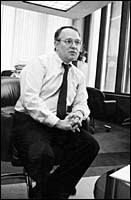
Name: Edward Lambert
Position: Fall River Mayor
Age: 44
Seifert Systems Invests in Energy Efficiency to Strengthen Operations
For manufacturers, energy is more than just another operating expense. It plays a critical role…
Learn More
Background: A former social worker and director of Social Services at St. Vincent Children’s Treatment Center, a youth home in Fall River. In 1988 he won a seat in the state legislature and in 1996 became Mayor of Fall River.
Education: Bachelor’s degree in psychology from Southeastern Massachusetts University (now the University of Massachusetts Dartmouth) and a master’s degree from Bridgewater State College.
Residence: Fall River
PBN: How did you get into politics?
LAMBERT: I was 21 years old and ran for the school committee in Fall River. I was a junior at the University of Massachusetts, which was SMU at the time, and had come to the realization that Fall River is where I wanted to stay and if I was going to stay I needed to get more involved in my community. It was really very sudden that it dawned on me that I could run for office. Some of my classmates decided they would help me and with no experience we ran a campaign for school committee. I led the ticket that year. I served on the school committee for 10 years until I ran for state representative.
Manufacturing was once the lifeblood to the city’s economy, how important is the industry now, and how important is it going forward?
Manufacturing continues to be very important for us. In fact, we have somewhat bucked the trend of communities that have lost manufacturing jobs – we have actually grown some segments of manufacturing, particularly textile manufacturing. We have lost significant jobs in the apparel sector, but in textile manufacturing, Quaker Fabrics, which is our largest private employer with 2,500 employees is looking to increase their employee base by as much as 1,200 employees over the next few years. We have worked with them, given them some tax deals and they have committed to that expansion. Main Street Textiles just built a brand new facility at the former airport that we closed and they are going to go from 500 to 1,400 employees. Those are good jobs for this region. They have helped to keep our manufacturing base strong, yet for the first time in our history, service-sector jobs slightly outnumber manufacturing jobs. We think it’s a good mix. We for too long were overly reliant on one industry and therefore suffered cyclical high unemployment. Our economy is much stronger now because it’s more diverse than it was even five years ago.
You mention unemployment. The city has made some great strides in terms of jobs, can you talk a little bit about that?
We just got the January figures, and as traditionally happens in January, they have spiked. It’s in the vicinity of 8 percent, up from 4 percent in December. Normally we find ourselves at least twice the state average, yet for the first time in anyone’s recent memory we are best in the state average. At the end of the 2001, we had rates below Boston, Lowell, Worcester, Springfield, which are traditionally middle of the pack cities. We were the tail being wagged by the dog and now in large part because of the diversification, we have changed that.
We hear a lot about the Fall River Office of Economic Development – how does that office work with yours, and has its presence brought the diversity that you talk about?
It’s a great model for us, and one that a lot of communities would love to emulate. Our lead economic development agency is the Fall River Office of Economic Development. It is a private, non-profit agency, and as such they have the flexibility to turn some deals around that government agencies sometimes don’t have and yet they are close enough to the city that we entrust them with being our lead agency. They work with the city in that regard. The links are very strong. Because they capitalized themselves more than 20 years ago, they are completely off the city’s budget, though we do give them some block grant funding. This office is also very involved with economic development primarily because Fall River is about the jobs. It’s about the work force. Our history is such that people didn’t locate here for the climate. Much, if not the majority of what happens in this office, relates to job creation because it’s a quality of life issue.
How is the city involved with the new Waterfront Development Park in Freetown?
We are involved with that project even though it’s not in Fall River’s borders – it’s in the town of Freetown, which is right over the line for us. We are trying to take an approach that a lot of communities don’t in terms of how to promote economic development in the region. This Waterfront Business Park, which is 600 acres in Freetown, if appropriately developed will have tremendous benefits to Fall River. We worked with the initial developer in terms of marketing, Greater Fall River Economic Development Corporation, and now we are working with the developer on permitting issues.
What are some of the other economic development issues the city is working on?
We are still working on an industrial park at the former municipal airport. Two major tracts have been developed – one by Main Street Textiles, and TJX Company has developed the other. They just purchased additional land to expand. There are still many parcels in that site that will be available.
We are also working with the state of Massachusetts to create the first bio-reserve in the state. Fall River is about 32 square miles. Only half of the city is developed, the other half is open space and most of that is watershed protection area because we have vast water holdings. There is some private land in there and some state forest land. We worked with the state to contribute to buying the private land. We contributed $2.4 to help the state purchase the private land. We are going to take that private land, and 4,300 acres that we own and put it together to create a 15,000-acre bio-reserve in Fall River. Environmental groups are also partnering with this effort and they are going to build a $2 million environmental education center in this bio-reserve and we are going to branch out into some eco-tourism and passive recreation. In exchange for that deal, the state is going to give the city 300-acres of state forestland that abuts Route 24. This 300-acre is going to be ideally suited for a business park. When you put the Freetown site and this site together, that’s 900 acres of developable land right off the highway that is going to bring tens of thousands of jobs.
As people seem to be moving here the cost of home buying is going up – is this good or bad? How does it affect the city’s municipal services?
We look at this in different areas. The city needs to progress, it needs to be able to accommodate growth in a variety of areas. The commuter rail coming from Boston in 2004 or 2005 is an issue we need to deal with. That is a significant gain. We think that the residential base can adapt because right now housing costs are so low in this area. Even though we expect prices to increase, there is room for that to happen. With all the development we also expect an increase in wages, so we aren’t overly concerned about the price increase. We do have an issue with public housing, primarily because we have a statewide housing program that tends to solve a statewide program by taking advantage of a surplus in certain communities. We know that every community, particularly cities, needs to have public housing, affordable housing. But we are also looking to bring down the number of public housing units we have because currently we are serving a non-local waiting list. Essentially we are trying to reinvent housing in Fall River.
With all of this development outside of the city, some shop owners along the city’s Main Street feel like they have been left behind – how do you respond to that?
We have already planted the seeds for the redevelopment of the downtown. The Cherry & Webb Building is going to have a significant impact in a positive way. We also have a $46 million courthouse planned for the downtown right across from the Cherry & Webb building. That is going to have a huge spin-off impact in terms of retail and office space. So actually an awful lot has been in the planning stages for downtown, it’s just now starting to happen. There are some people that want the downtown of 80 years ago to return. That’s never going to happen with malls and things like that. So, retail will always be a part of the mix, but it’s going to have to be a much healthier mix.
The city seems to be partnering with UMass Dartmouth on a number of projects – how did this relationship start, and what was its importance to the city?
I am really glad to see this partnership. I think there was a time when most colleges felt that they were in an ivory tower following the idea that they did what they did there and people should leave them alone. As an alumn of the university I really started to badger them and found a very receptive ear. We have worked for many years on the manufacturing and technology center, which just opened.(off Route 195, on the site of the old Kerr Mill) The Cherry & Webb thing we put together in a matter of weeks. (UMass plans to create a downtown campus at the former department store). There is a growing emphasis on education in the city. My practical, mayor’s hat says it also means coffee shops, bookstores, and some additional jobs in retail in downtown that would not be there if they didn’t have students with expendable income stopping in.
Fall River and New Bedford have long been joined in perception, now some are saying that New Bedford is pulling ahead– what do you say to that?
Well, whoever is saying that I would like them to tell me what makes them believe that. I don’t want to argue that and sound like I am not being supportive of New Bedford because over the last several years we have worked out a very strong relationship with that city that we have never had. The strength of Fall River right now, its economy, its unemployment, any number of indicators show that we are doing very well. We try not to compete with our sister communities. I think that we have pulled ourselves up by the bootstraps and we have some real momentum right now.