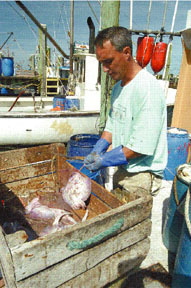
bait for lobster traps.
New regs would cut time at sea
Rhode Island fishermen are looking at new regulations that could downsize their catches as much as 65 percent. The fishing industry is concerned that the regulations – to take effect in May 2004 – could devastate small-boat inshore fishermen, and could impact all of coastal New England and even Canada.
Seifert Systems Invests in Energy Efficiency to Strengthen Operations
For manufacturers, energy is more than just another operating expense. It plays a critical role…
Learn More
Many Rhode Island fishermen are allowed 150 days or less to catch groundfish, said Jim O’Grady, owner of the boats Rhonda Denise and Iron Horse, of which he is also the captain. He is allowed 56 days this year, and a 1,500-page Amendment 13 – as it’s called – could reduce that number to 25.
O’Grady and other local fishermen catch squid, scup, sea bass and other species regulated by permits to supplement their groundfish, but there could be a mad dash to those species if other boats’ days are reduced. It’s a threat that could put O’Grady and others out of business.
“Boats north of Point Judith, in New Bedford and further north, don’t need the other permits,” he said. But if the amendment passes, “others will be forced to get permits to make it,” increasing competition.
The New England Fishery Management Council has presented fishermen with four alternatives to the current regulations designed to rebuild 12 species of groundfish, including a variety of flounder species, haddock, Atlantic halibut, Atlantic cod and white hake. The alternatives represent the 13th amendment to the Magnuson-Stevens Act of 1976, the basis for all fishing regulations.
The council recently held a hearing for public comment in South Kingstown, the third of nine hearings in September. The deadline for public comment on the amendment is Oct. 15, and the national fisheries council will vote on the amendment in November.
“Big business will seize the day,” said Bob Morris, captain of the boat Living Waters.
Council members said that fisheries can’t rebound on their own before the 2009 or 2014 deadlines that the council hopes to meet. The alternatives would set limits on what species of fish can be caught and how much, how many days a fisherman would be allowed to fish, and what equipment can be used.
Stocks are naturally beginning to return, but not fast enough to meet the deadline, said Eric Smith, a council member and assistant director of the Marine Fisheries Division of the Connecticut Department of Environmental Protection.
“Stocks are increasing on their own anyway,” he said. “The reason for Amendment 13 is that we’re not achieving those stocks quick enough. Fish stocks don’t grow fast enough to achieve that, even with the absence of fishermen.”
Fishermen said there’s no need for the amendment; the existing fishing regulations are stringent enough. Others argue that scientists have shown that stocks are being replenished by a combination of conservation and natural process, and that a no-action policy – which is listed as one of the alternatives – is the best approach.
“I don’t find it acceptable, especially in the fact that if we stay where we are under the judge’s ruling, we’ll reach the stock (goals) under the amendment, just not in that amount of time,” O’Grady said.
U.S. District Judge Gladys Kessler delayed the deadline for Amendment 13 from Aug. 22, 2003 to May 1, 2004.
“If we’ll reach the same goal, what’s the sense of causing” problems, O’Grady said. “We’re on the correct track, on an upward trend, so where’s the crisis?”
The alternatives will cause constriction of the fishing industry equal to the eradication of small farms, said Craig Pendleton, coordinating director of the Northwest Atlantic Marine Alliance.
“There are only so many fish in the sea,” he said. “The real debate over Amendment 13 is not about how many fish can be caught at a sustainable level, but who will be allowed to catch them. The clear message of these regulations is get big or get out.”
One of the alternatives could have fishermen bartering to transfer allowable fishing days to each other, or not having the power to transfer days at all. One option includes reducing available days at sea to 28,400 for all Rhode Island fishermen. A second alternative dictates specific gear for specific species and management areas.
Another alternative calls for area management, defining management areas for Maine, sections of Georges Bank and southern New England and the Mid-Atlantic. This alternative could also affect fishing agreements with Canada. Under this alternative, species-specific total allowable catches will be defined to each area, and alternatives for catch amounts are also included.
The final alternative includes restrictions on total allowable catch. If stocks not fished to their total allowable catch, the remaining amount could not be rolled over to the next year. In comparison, if fishermen exceed total allowable catch for a season, the overage would be deducted from the following year’s catch, further restricting catch levels.
According to Liz Rowell, owner of the Elizabeth R. out of Point Judith, the first two alternatives of the amendment “punishes” fishermen who abided by the existing regulations and restrictions.
“You said we wouldn’t lose our days (at sea),” she said to the council members at the hearing. “Do you understand the anger that generates? And there’s no show of profit (with any of the alternatives). Either you break even or you take a loss.”
The council never voted on whether fishermen would lose them, council member Smith said.
Members of the council explained that they presented an economic impact statement to describe all of the amendment’s alternatives, and for the industry to weigh all of the factors for each.
“You have to meet conservative targets, and economic and sociological assessments,” Smith said. “We’re trying to keep things fair. None of the weighing (however) allows you to avoid meeting your conservation targets. It’s conservation first and economic and societal impacts second, in a sense of balancing them.”
Some of the fishermen balked at the restrictions on mortality rates; one commented that mortality rates were so drastically reduced that more fish would die of natural causes before they died at the hands or nets of a fisherman.
“If the only way to meet the biological targets is to heavily restrict the mortality,” Smith said, “then that’s what the (council) says has to be done.”
Fishermen ultimately don’t want any part of Amendment 13, Rowell said, but the issue is too complicated to come up with a simple solution at this point, besides a no-action approach. And even if the amendment passes, the council can always change whatever they want, she said.
Rowell said that while she’s not sure if this amendment would mean the end of her business and others like hers, she’s confident that the bottom line is that conservationists want fewer boats trawling Narragansett Bay; fishermen are the reason for the devastated fish populations, conservationists say. What they need to be looking at, however, is the pollution that is a bigger problem, Rowell said.
In a worst case scenario, O’Grady said, the amendment will extinguish the local industry, fishing stocks will explode and only large corporations would be here to harvest them.
For the complete current issue, visit our subscription Web site, or call (401) 273-2201, ext. 227 or 234.