Harbor Corporation. (Brian
McDonald)
Heritage Harbor now represents a consortium of 19 organizations renovating the former South Street power plant of the Narragansett Electric Company.
Expected to open in late 2003, the new museum will be the latest and largest of new state tourism attractions. The museum is projected to contribute an estimated $30 million annually in economic impact to the Rhode Island economy.
Seifert Systems Invests in Energy Efficiency to Strengthen Operations
For manufacturers, energy is more than just another operating expense. It plays a critical role…
Learn More
The national search for a chief executive officer at Heritage Harbor began in November 2000. There were more than 70 applicants for the position.
R. Mark Davis, of Bethesda, Maryland, began his new job on May 7, 2001.
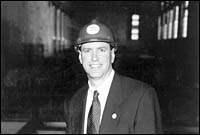
Name: R. Mark Davis
Age: 41
Position: Chief Executive Officer, Heritage Harbor Corporation
Background: Davis is the former CEO of Renew the Earth, and chief operating
officer of the Earth Conservation Corps. In Washington, D.C. There, he designed
and orchestrated a development plan for revitalizing the Anacostia River and Southeast
Capitol area. The project included the development of an eight-mile river walk
park, and the creation of two community learning centers in former power plants
that showcased renewable energy technology and green building products. An active
community volunteer, Davis has worked in both the public and private sectors,
domestically and overseas. He is a Hesselbein Fellow with the Peter F. Drucker
Foundation for Nonprofit Management, a program that recognizes the accomplishments
of individuals who have a record of leadership and entrepreneurial performance,
and who are engaged in programs that demonstrate community innovation.
Education: University of North Carolina (1982)
Family: Married, one daughter
Residence: Wickford
PBN: What in particular attracted you to this job?
DAVIS: Personally, I have roots in Wickford. To move back to Rhode Island
is very much a homecoming for me. My family lives in Wickford. I had lived in
northwestern Connecticut for 16 years and was recruited to Washington, to my last
position. After four years there, I had a great yearning to return to my beloved
New England. So on a personal level, this is very exciting for me.
And what about this project, the Heritage Harbor Museum?
From a professional perspective, it feeds a lot of my interests. I’ve been
in the business of education and making things happen for community development
all of my professional life. To capture the vision of Heritage Harbor and understand
the multi-cultural perspective and the historical perspective and the educational
opportunities that it has, not only for all of the people of Rhode Island, but
regionally and nationally… It’s an exciting project and it seemed to be a good
time to get in the door at the ground level.
What is the key to any non-profits’ financial stability and success?
Non-profits are a business and have to be run like a business. Just because
it has the tag line not-for-profit does not mean that you don’t manage your expenses
and income to make a profit — that profit is then filed back into operations.
From a pure management perspective, non-profits really have a lot that they can
teach the corporate sector. And the corporate sector should have a lot that they
can teach the non-profit sector. In what other sector of society do you have highly
dedicated, bright, articulate people working for low pay at long hours and loving
it? Those are some models of motivation and leadership that can be transferred
to the corporate community.
Heritage Harbor is composed of 18 organizations “exploring the heritage of Rhode Island people.” How do you make sure you are serving all of these interests? Is it a challenge to get them on the same page?
It is a challenge. And it’s an eclectic mixture of partners. Everyone from
groups that just recently coalesced because of the Heritage Harbor project to
more established institutions, like the Rhode Island Historical Society. What
we have done is that we have created a partnership agreement. We are running this
as a business. There is a formal agreement with all of the partners that spells
out what is expected of each partner and the roles they will play. Very clear
communication with expectations and definitive outcomes that are measurable are
key to the success of everyone being able to work together. If you leave it nebulous,
people just won’t know where they stand.
For whom is this project targeted – both in terms of people and the geographic
locations from which you hope to draw?
One of the significant things about Heritage Harbor is that it is a museum
of the people, by the people and for the people. It represents everyone in our
community. It doesn’t necessarily appeal to just a particular audience – or just
children, or just adults. What is unique is that it is not a museum with things
under glass. It’s highly interactive. In our program design we are looking at
having an interest and an education for everyone from the age of six to 60. People
will want to come back time and time again. And with our rotating exhibit structure,
people could come back to and three times a year and see something new in the
museum. There will be a broad appeal. As for the demographics of where people
will come from — certainly, the metropolitan Providence area – and the state
of Rhode Island. But also from a regional perspectivewithin 100 miles we have
a population of 25 million people. Everything that we are putting together here
represents that larger community as a whole. As a New England attraction, it will
become a destination point for many people.
Are you finding that the so-called renaissance of the capital city is a benefit as you move forward with the project in terms of gaining momentum, whether that is in your efforts to raise money or simply to attract attention?
The fact that you can stay here and the number of conventions we are having
in town now are certainly important. If we can add an additional 300,000 people
a year and maybe 50,000 to 75,000 hotel nights to the economy – that will help
everybody.
Are you comfortable with where the project is at this point in terms of financing?
Yes, very much so. To see $30 million raised to date is an impressive figure
for any non-profit. Heritage Harbor is at a critical juncture. In working with
the capital campaign committee and meeting all of the supporters of the organization,
I think that the museum will open if not on time – within a few months of the
targeted date of the opening.
This past November, Rhode Islanders defeated a referendum which would have delivered $25 in state dollars to the project. Why do you think that referendum failed to pass and how damaging a setback was it to the overall project?
I don’t know if I would refer to it as a setback. Certainly, it was in terms
of a major funding stream. What a lot of people did not understandthe message
did not get out that it is not just a Providence project. It’s for everybody in
Rhode Island. From a statewide benefit perspective, it could generate upwards
of $30 million in tourism dollars each year. That’s very important.
Once open, by what means will the museum sustain itself?
Mostly through admissions and a museum shop. We are also working on an endowment
campaign for long-term profitability. Also, once it is up and running there are
other funding opportunities through private foundations or federal grants to support
individual programs that will be happening at the museum.
You must be excited by the Route 195 relocation projects, which is expected to spur further development downtown – particularly in the Jewelry District where Heritage Harbor is located.
It is exciting. With regards to creating an urban park-like setting for festivals
and an animated waterfront that would be of great interest to people I think it
has been a shame in our society that as a culture we have ignored our waterfront
so badly – all across the country. It’s really exciting to see the waterfronts
coming back because they really are the heart of the city.
Is your family excited about the move to Rhode Island?
Very much so. My wife lived in New England for about 25 years, in Connecticut.
I have introduced her to sailing and my love of Narragansett Bay.
What drives you, personally – gets you excited about coming into work each day?
What drives me is working with people who are passionate about a concept or
a mission that will help other people build community. I think Heritage Harbor
is all about building social capital and lifting up and celebrating all of our
cultural heritages and the many things that make our society so rich.