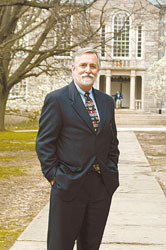
URI president outlines capital projects
Dr. Robert L. Carothers
Seifert Systems Invests in Energy Efficiency to Strengthen Operations
For manufacturers, energy is more than just another operating expense. It plays a critical role…
Learn More
Position: President, University of Rhode Island
Background: Prior to arriving as the 10th president of URI in 1991,
Carothers served as chancellor of the Minnesota State University system, and
president of Southwest State University. At URI, Carothers has initiated a Centennial
Scholarship program, which rewards students strictly on academic accomplishments.
As a result, the average SAT score for incoming freshmen has risen nearly 160
points since 1991.
Education: Bachelor’s degree from Edinboro University of Pennsylvania;
doctorate from Kent State University; and law degree from the University of
Akron.
Residence: Kingston
Age: 61
PBN: There is currently about $250 million invested in capital projects
at URI. At what stage is this work and where is the emphasis being placed in
terms of new buildings?
CAROTHERS: We’re in the middle of a major investment program here in the physical facilities at the university in Kingston and at Narragansett Bay, and of course, we made a major investment in downtown Providence in the mid-1990s. What we have completed are several of the key academic buildings, like Ballentine Hall for the College of Business and the Kirk Center for Technology in the College of Engineering. We have been able to restore historic buildings, like Green Hall, which is a signature building for the campus. And we have new athletic facilities that are as good as any in the region. We are in the process of building more housing. In many ways, the single-most important element to the university’s strategic plan is the increase in and availability of housing on campus. We have a lot of tired housing stock. We’ve replaced some of that. But we have a large number of students who live ‘down the line’ and that housing stock is being slowly eroded and bought up by people for single-family dwellings.
Q. So you’d rather see students living on campus?
A. I’d rather see them up here. I’d rather have them engaged in the life of the university after 5 p.m. It has always been a problem … that basically freshmen and sophomores live in Kingston. You’d like to have a better representation of maturity, if you will, on campus.
Q. And in addition to housing?
A. The big projects coming up over the next five years are going to be in our science buildings … beginning with a bio-sciences bond referendum which will be on the ballot this fall. And then we have a new College of Pharmacy facility and then a facility for chemistry and physics. That’s part of the plan we have for the north campus. We are developing that whole campus as a science park.
Q. Why science?
A. Well, URI’s history is in science. We have always been very strong – among the national leaders – in oceanography and marine sciences and turf management. … But now the sciences of the future are chiefly in the life sciences – in the bio-science and in the chemical side of that, as well. And that all relates to pharmacy, where we have always had a strong program. Everybody understands that the economy of the future is going to be built on knowledge, chiefly science-driven knowledge.
Q. Do you see a connection between a company like Amgen and the kinds of things you are putting a priority on at the university?
A. Amgen is largely a manufacturing facility and we need to be able to train people to work in, design, build and be a part of manufacturing in that regard. But we also need the scientists to help create the new companies. We made some progress with that in the last legislative session … to get over some of the hurdles dealing with faculty members owning or managing companies. And we’ve got a couple of more hurdles to overcome, freeing us from some of the bureaucracies that keep us from being as creative as we would like to be.
Q. Why does it make sense for Rhode Islanders to be investing in URI?
A. A university is many things to many people. The return on investment for the state as a whole is in developing an educated and creative citizenry that can create the jobs and work in the jobs of the future. It’s a tool for bringing science and technology and other kinds of knowledge to the people of the state as a whole. It’s a source of pride. People identify with everything from Bob Ballard (scientist/undersea explorer) to Jim Baron (head basketball coach). Those are very important symbolic touch points, if you will, for the people of the state. I think, whether you are a Master Gardener trying to figure out how to keep your roses blooming or whether you’re Raytheon trying to figure out how new acoustical systems will work on underwater warfare systems, the university touches all of that.
Q. Dr. Ballard will be returning to the site of the Titanic in June. How significant is that to URI?
A. Bob is a tremendous spokesperson for science. He takes the university and puts it on an international platform. One thing Bob has done throughout his whole career is to show the world how science works … from little kids to leaders of countries. He takes science and translates it to people in a way that they can understand, appreciate and be awed by it. He clearly is going to do that for us.
Q. The most recent state budget proposal calls for tuition hikes at URI, Rhode Island College and the Community College of Rhode Island. When does it worry you, as an educator, that we are pricing people out of reach of a college education?
A. First, you have to distinguish between Rhode Island residents and people who are not from Rhode Island. The policy with regard to Rhode Islanders is just that – it’s a public policy question. It has nothing to do with the marketplace. It has nothing to do with the cost of operating the institution. It’s a policy decision about how we are going to make education accessible to Rhode Islanders. It also has to be understood within the context of the higher education system. For many people, the first step on the rung is CCRI, which is a very low cost option for people to begin their education. When the price begins to take up a very significant portion of the average family income, then I really start to worry about that. It’s not the price itself that is important, as it is the percentage of family income. One of the things that worries me most is that with this current wave of immigrants – who are immensely important to our future – coming into Rhode Island … the average family income for those folks is not very high. So we’ve got to have strategies, whether they are scholarship programs or lower tuition or joint admission agreements with CCRI … we have to find vehicles to make sure that they get into the mainstream of life in Rhode Island and work their way into the middle class.
Q. Tell me about the state matching grant program.
A. More and more, state universities are public/private partners with their constituency, their alumni and the state. Some of the things that other states have done to help build excellence, either in facilities or endowed professorships or faculty chairs or student scholarships has been done in that partnership mode. So that if you go out to a donor and you are looking for an endowed chair in micro-biotics and you say to that person; ‘If you can put in $1 million here to endow this chair, the state will match that money.’ Not necessarily 1 for 1, but some ratio … that means people don’t feel as if they are doing everything they think a state ought to do. And conversely, the state uses money to leverage that gift. … URI is willing to do more with less state money if we have the tools to bring in the private dollars to the university.
Q. Can you expand on that?
A. URI gets about 21 percent of its total budget from the state. When you look down the horizon, it’s hard to see a time when that money – for operating expenses – is going to get much better. We can accept that if we also have some tools with which to operate more like an independent institution. More tools to raise money. More tools to be more efficient in purchasing and personnel and things of that nature. There are days when I think if the state could just pony up half a billion dollars we would walk away and never ask for another dollar again. We need to be free from some of the bureaucratic limitations on what we do and we need some incentives to bring partners into the mix.
Q. Would you say URI’s relationship with the General Assembly has improved over the past decade?
A. Yes. I always say to people: ‘It’s not that they’re mad at us up there. It’s that they don’t have the money.’ They’re committed to a whole array of social programs in Rhode Island and there’s not much left over for public higher education.
Q. There’s been talk of creating a retirement village here. Where does that stand?
A. That goes to the question of being free of some of the restrictions. URI has always been cash poor and land rich. One of the challenges here is to try and make that asset work more for us and produce more revenue. We’re working to develop a process where we can take advantage … whether that is Mike McMahon calling and seeing if the state can use some land to set up a new company that would be jointly operated with URI faculty members as key elements … to a proposal to do a riding academy at Peckham Farm to the idea of building a retirement community here, where URI alumni and faculty and staff can move in there. That brings up the perennial question of whether we can build a golf course down here and build a condominium community around it. All of those could be revenue-producing activities for a university. Should we have a hotel down here? There is no question that South County needs a hotel – and we need a hotel. … So the challenge is to get to the place where we can manage this asset in a way that produces revenue and still protect the rural quality of our campus.