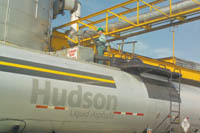
In 1955 John J. Hudson Sr. established The Hudson Companies with less than five employees, hoping that one day his company would become an industry leader in the development and distribution of high-quality liquid asphalt.
Now, as the company celebrates its 50th anniversary, it employs 75 full-time employees and has one of the largest liquid asphalt terminals in the Northeast.
Seifert Systems Invests in Energy Efficiency to Strengthen Operations
For manufacturers, energy is more than just another operating expense. It plays a critical role…
Learn More
“You don’t always have companies that last 50 years or stay in the same area for that long,” said Francis J. O’Brien, company president and chief operating officer. “Many companies end up being bought out or consolidated and moving to Texas or someplace. I think it’s nice to be here in Rhode Island, where we’ve been since the beginning.”
The Hudson Companies, whose corporate headquarters are at 89 Ship St. in Providence, began by servicing a few Rhode Island municipal contracts and private contractors, but what was then a small operation has now evolved into something much greater.
“A lot of people think we’re in the paving business, but we’re not. We are material suppliers,” O’Brien added. “We import asphalt cement from Spain, Canada, Mexico, Venezuela and domestic refineries. Our customers are primarily paving industries, those who pave highways or roads.”
Today, according to O’Brien, Hudson Companies works with many customers throughout the United States, including working with one of the country’s largest refineries, selling their services in Texas and Oklahoma. The Hudson Companies is comprised of five affiliates: Hudson Liquid Asphalt, Hudson Terminal, Hudson Laboratories, American Liquid Asphalt and Triram Connecticut.
“In our traditional business we sell (our product) throughout New England, we have little competition in Rhode Island because it’s such a small state, but we have a lot of competition in New England. We do twice as much business outside of Rhode Island than in the state,” O’Brien said.
The company, which has multiple facilities throughout New England, also has a state-of-the-art laboratory on the Providence waterfront, where it tests and develops a variety of asphalt cement grades to serve customers more efficiently.
“There’s been an evolution in this industry,” O’Brien added. “The Federal Highway Administration changed the specifications of asphalt; they spent about 10 years studying asphalt and developed the Strategic Highway Research Program whose basic premise was that the asphalt used in Wisconsin should probably not be the same kind of asphalt that might be needed in Miami Beach.”
It is these kinds of industry demands, O’Brien said, that keeps The Hudson Companies at the edge of technology and allows it to remain competitive.
“As the specifications became more complex, that was good news for us because primarily, I believe, the major refineries are in the gasoline business and they’re worried about gasoline and coincidently they get asphalt cement. In many cases, they’re happy to have us be their service representatives, if you will, then they don’t have to get as involved in the testing. The more complex the specifications got, the better off we were,” he said.
According to O’Brien, the chemical modification system the company has developed has taken the company out of New England and beyond.
O’Brien said that this past January the Korean government adopted the United States’ specifications for asphalt development, which presented a great opportunity for the company to sell their services abroad.
“Three weeks ago we had a booth at a trade show at Seoul South Korea, because now the refiners over there are saying, ‘How do you modify asphalt; what are they talking about.’ So now we’re partnering with some Korean chemical engineers and they’re basically going to present our products to the Korean market and frankly we’re hoping that establishing ourselves in Korea would lead us into the whole Pacific market,” O’Brien added.
O’Brien said he often thinks about what John Hudson Sr., the company’s founder who died in 1983, would think if he were to see the business today.
“He’d probably say, ‘Boy, this has really changed a lot’; but I’d like to think that if he looked further and saw the continued commitment to excellence in customer service he founded the company on, I hope at the end of the day he’d say, ‘Well maybe it hasn’t changed that much.’”