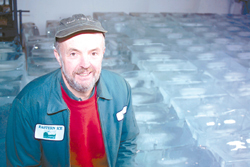
Eastern Ice President C. Joseph Rossi in his Newport refrigeration room containing 300-pound blocks of ice to be shipped to fishing businesses.
Eastern Ice
President: C. Joseph Rossi
Location: Newport and Brockton, Mass.
Beyond Cash Donations: How New Forms of Giving Are Transforming Not-for-Profit Accounting
Evolving Funding Landscape for Not-for-Profits Not-for-profit organizations are being asked to do more with less,…
Learn More
Type of Business: Ice manufacturing
Year Founded: 1928
Employees: 20; 50 during summer months
Annual Revenue: WND
In the 1920s, when “icemen” rode around town selling blocks of ice to be used in ice boxes, Angus Beaton chiseled ice from frozen ponds and sold the pieces.
Eastern Ice operations are a bit more complex today, with machines doing the freezing, cubing and bagging, but the business of selling frozen water has kept Beaton’s family busy for five generations.
Beaton’s great-grandson, C. Joseph Rossi, serves as president of Eastern Ice and heads the family-owned and -operated business with his brother, Vice President David F. Rossi, out of a 76-year-old plant at 10 Brown & Howard Wharf in Newport. A second plant in Brockton, Mass., is run by C. Joseph Rossi’s son, Chad Rossi.
The ice-manufacturing process begins with city water being sent through a filtration system. The water is then sent beneath the blue wooden floors in a 75- by 60-foot room of the plant, where it sits in gigantic refrigerated blocks for about 48 hours.
When the blocks are solid, the floor panels are lifted manually. A crane that runs along the ceiling reaches down and grabs the blocks from the floor units and moves them to another area to be cut into smaller cubes.
This time of year, blocks are pulled three or four times a week. During the peak summer season, blocks are pulled every single day, and up to 54 tons of ice is made, David Rossi said.
Once blocks are cut in to drink-size cubes, the pieces sit in an enormous, clear tank until they are sent through a bagging machine. The bags of ice are then sent on a conveyor belt through a metal detector to make sure no flickers of metal have crept in before sending them off to businesses.
The bags are piled onto palettes, put on trucks and delivered.
Retailers like convenience stores rely heavily on bagged ice sales because they are able to mark up the product 70 percent to 80 percent and make a tremendous profit, C. Joseph Rossi said.
“The markup on ice is huge, which is why it isn’t economical for places like restaurants to buy ice. Ninety-nine percent of them make their own,” C. Joseph Rossi said.
Separate from its bagged ice operations, large, 300-pound blocks of ice are made for the fishing industry, which makes up about 15 percent to 20 percent of the business, depending on the season.
The enormous blocks stand like dominoes in a refrigerated room in the plant before they are crushed, loaded onto dump trucks and sent to docks, where the ice is unloaded into fishing boat “ice holds” to keep the catch of the day cold.
The plant is able to make up to 200 tons of ice per day.
During the summer season, with refrigeration systems running at full tilt, electricity costs around $1,000 each day. The rising cost of fuel also affects the company, with seven or eight trucks running ice to retailers all day and double the labor cost, C. Joseph Rossi said.
Between its two locations, Eastern Ice delivers to about 1,000 businesses in Rhode Island, Massachusetts and Connecticut, David Rossi said.
Ice manufacturing competition is not at all cutthroat; there are two or three competing ice manufacturers in the area, and they have “friendly agreements with one another,” C. Joseph Rossi said.
As of 2002 – the latest U.S. Census Bureau information available – there were 492 ice manufacturing companies in the country, down from 682 in 1997. About 400 of the ice manufacturers in existence today have fewer than 20 employees and only five companies report more than 100 employees, the Census information shows.
“There used to be an ice plant in every community,” Rossi said.
Because of the decline, ice manufacturers are operating an expanded market geographically, making deliveries to business further from their hubs, reports the International Packaged Ice Association, of which Eastern Ice is a registered member.
Because there are plans for a 16-unit condominium on Brown and Howard Wharf and having outgrown its Newport facility long ago, the company is looking to relocate to a new facility in Fall River, possibly in the Industrial Park on Airport Road, to have more factory and delivery truck space, David Rossi said.
No definite plans were made by press time.