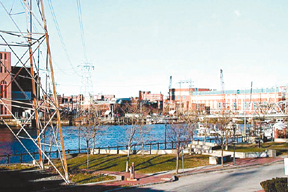
Point area in Providence.
A decision whether to bury the power lines strung along India Point Park and
the Providence and Seekonk rivers or to replace them above ground could be made
soon. Proponents of burying them say there are ample funds for the task.
Since Narragansett Electric filed a plan with the Energy Facilities Siting Board earlier this year, a number of organizations, state agencies and state and city officials have voiced their objections to keeping the lines visible. Attorney General Patrick Lynch and Providence and East Providence have stepped in to keep the electric company from passing a proposal to replace them.
“We’re happy to bury them if the money to pay for it is there, and as we understand it, no funding has been secured,” said Amy Atwood, a Narragansett Electric spokesperson.
Beyond Cash Donations: How New Forms of Giving Are Transforming Not-for-Profit Accounting
Evolving Funding Landscape for Not-for-Profits Not-for-profit organizations are being asked to do more with less,…
Learn More
The four parties reached an agreement that is equivalent to a full review, complete with public hearings and advisory opinions from agencies like Statewide Planning, the Department of Environmental Management, the Department of Health, the Public Utilities Commission and the cities’ planning departments, according to Paul Roberti, an assistant attorney general.
“We believe there are some substantial public safety concerns” with leaving the power lines above ground, he said. “From day one, Narragansett Electric’s fingerprints (on this) suggest that they were looking for one option all along and one option only.”
It will cost $8.2 million to bury the power lines when Route 195 is relocated, $6.5 million more than what it would cost to relocate them above ground. But the benefits of putting them out of sight far outweigh the costs, and would increase the aesthetic and socio-economic value of the waterfront, said David Riley, co-chair of the Friends of India Point Park.
In April, Narragansett Electric said it was not opposed to the alternative; people simply waited too long to object, and the Route 195 project might be delayed if the plans were altered. Now, according to Riley and Roberti, that excuse doesn’t hold water.
“They actually told the attorney general that there is time,” Riley said.
“Narragansett Electric said it would take about nine months and they have to be done by the end of (2005). Time is no longer an issue.”
Roberti said that Narragansett Electric had produced cost estimates for both options in 1992, as part of the impact statement for the I-195 relocation.
“They waited until the 59th minute of the 11th hour and said they didn’t have time,” he said. “Our lack of opportunity to consider this (option) can be directly pinned on the electric company.”
Atwood said that even if funding is secured, the design, permit and approval process is lengthy and alone would take months, and added that she wasn’t sure of a time frame for completing the project if it were funded.
“We are working with a time restraint here” by the time the state might get funds, she said.
The state Department of Transportation has offered to pay $2.5 million to bury the lines, in an effort to encourage that plan versus the $1.7 million to relocate them above ground, Riley said. The Providence Parks Department also applied for federal bond money and received $375,000 for next year. The roughly $5 million remaining could actually come from two Narragansett Electric funds, Riley said.
The fund has $15 million, the result of a recent rate settlement, one for economic development and the other a storm fund. Although Narragansett Electric has been considering giving the Navy $5 million in electricity upgrades to keep the fleet in Rhode Island or funds to help a local corporation upgrade, Riley said there’s plenty to go around.
“Those might be very good uses, but $5 million of that should be used to bury the power lines,” he said. “There is no way we can prevent the Navy and businesses from deciding to leave. And burying the power lines, this is something that will definitely last.”
Atwood clarified, however, that the power lines project could not be applied to either of the funds. The whole issue is a matter of money and time, she said, and the electric company isn’t against burying the lines.
“We feel bad that it’s often portrayed as a fight – them and us,” she said. “We’re not opposed to burying the lines – we’d be happy to do it if there are funds and if we have enough time.”
More than 50 acres of land will be freed by the I-195 relocation, and Riley said the Friends of Indian Point Park would like to extend the park and add a bike path that would extend into East Providence. There is a public hearing scheduled for Dec. 16 at 1 p.m. at the PUC in Warwick to discuss public safety concerns and costs.