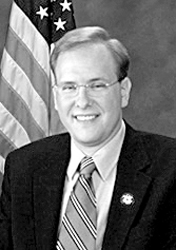
James Langevin
Position: United States Congressman, 2nd District
Background: A former state legislator and Secretary of State, Langevin
has announced that he will seek a third term in the U.S. House of Representatives
this November. As of this week, his opponents are Republican Chuck Barton, who
is president of the East Greenwich Town Council, and Ed Morabito, former chief
of staff to Gov. Lincoln Almond, who is running as an Independent.
ISO 9001:2026: A Practical Opportunity to Build for What’s Next
For Rhode Island manufacturers, ISO 9001 has been much more than a certificate on the…
Learn More
Education: Bachelor’s degree, Rhode Island College (1990); master’s
in public administration, Harvard University (1994)
Age: 40
Residence: Warwick
PBN: The news out of Iraq seems to be getting worse. What do you tell Rhode
Islanders who want to know if there is an end in sight to the violence and turmoil?
LANGEVIN: My primary concern is the safety of our troops. Both as a member of the House Armed Services Committee and as a member of Congress in general, I am constantly reminded of how dangerous the situation is, and yet, of the tremendous job our troops are doing. They are exercising great professionalism and dedication. I had the opportunity to go to Iraq in January and meet with some of Rhode Island’s National Guard soldiers, as well as other soldiers, and I was impressed by how much they believe in their mission and how dedicated they are. They definitely deserve our support.
Q. Do you see the turnover of power to Iraq as a positive step?
A. We’ll have to wait and see what the turnover actually achieves. Again, my primary concern is the safety of our troops. I want to see the mission in Iraq to be a success. Failure is not an option … but, success is by no means assured. Our troops have a very tough job on their hands. The June 30 turnover date was clearly a focal point for terrorists and insurgents to try and disrupt that turnover … and to try and hurt or kill a lot of people in the process. So anything to keep our troops safe – we all need to support that.
Q. What is your view of partisanship in Washington? Does our government move more slowly than it should because of it?
A. On some issues, there is clearly a big divide between Democrats and Republicans. Republicans have pushed forward with tax cuts, particularly for the wealthiest 1 percent of Americans. At the same time, they haven’t said what they are going to do in terms of spending cuts or to control the looming deficit. You can’t have tax cuts without somehow paying for it. If you are going to cut taxes in one area, you have to raise taxes in another area or you have to cut spending. All they have done is cut taxes, but they haven’t addressed spending.
Q. Are you confident the Rhode Island economy is turning in the right direction as quickly as other states?
A. There are still a lot of people out of work. And there are a lot of jobs that are going overseas. I’m not going to be one of those people who shrugs their shoulders and says, ‘That’s too bad … that’s the way it is.’ I’m going to continue to fight to protect the jobs that we have here as well as to create new jobs. Our economy is still in a recovery. I am hoping that we are in fact out of a recession, but we still have a way to go.
Q. What are the most common calls that come into your office, what is causing your constituents their most concern?
A. What we hear most about is the high cost of health care. We’re hearing that more and more Rhode Islanders are losing access to quality health care. It is becoming more expensive and out of reach for average people. I think it is incumbent upon the Congress to address this issue.
Q. While there may be no panacea to our health care crisis, in general, where do you see cost containment being possible. Where do we start?
A. There are a number of things that can be done. I certainly support this emerging talk of electronic medical records. That is something we should look to do because it would bring about efficiencies and reduce medical errors. Beyond that, in terms of the big picture, what I am pushing for – and I am getting ready to introduce legislation – is to achieve a type of universal health care system based upon a model that already exists, so we are not reinventing the wheel. And that is basing it on the federal employees health care benefits plan (FEHBP). It already provides insurance coverage for more than 8 million federal employees, their families and retirees.
Q. Does that include members of the military?
A. That’s something else. If someone is on Medicare or part of the VA system, I say we leave that intact. But for everyone else, we can model a health care plan on FEHBP. Again, it already works for more than 8 million federal employees, their dependents and retirees. What happens is that the federal government negotiates about seven different health care plans for all federal employees across the country. It ranges from the very basic plan with a small co-pay to the more comprehensive plans with a larger co-pay. Within that range it is able to satisfy the health care needs of more than 8 million employees. If it can work for them, it can work for everyone. I believe average taxpayers – citizens of this country – deserve the same kind of health care coverage that federal employees and members of Congress receive. Everybody would be participating – government, business and individuals and it would be funded through the income tax or payroll tax system.
Q. So even small businesses, with perhaps fewer than a half dozen employees, would be included?
A. Everybody. Businesses’ co-pay would basically be capped at about 6 percent of payroll costs. Employees would be paying a percentage of their income. The beauty of this system is that it is not reinventing the wheel. It is a template that already exists. It already works and it has a range of options.
Q. In terms of bolstering our local economy, what types of industries would you like to see Rhode Island approach more aggressively?
A. I am enthusiastic about expanding our role in the biotech field. And there are others, like nanotechnology. The key to creating wealth, prosperity and a stronger economy is an educated work force. We need to invest more in education. It is not enough to just protect jobs here from going overseas. If we are experiencing job loss because of all these free trade agreements, that concerns me because it puts American workers at a disadvantage. These trade agreements don’t factor in that we have tougher labor standards and environmental standards. If we are going to have these trade agreements and we are losing jobs, it makes it more important than ever that we invest in education. Our workers need to take advantage of emerging technologies – things like biotech and nanotechnology, areas in which we could be leaders.
Q. Do you agree with the General Assembly’s decision to put the question of the Narragansett Indians/Harrah’s casino on the ballot in November?
A. I think it is important and appropriate to put the question on the ballot. I do not support casino gambling and I will be voting no in November. But people have the right to decide. So let’s get the issue on the ballot. The reason I don’t support the casino is because I do not think it is the panacea that everybody describes it to be. I’ve never heard of any solid statistics that support the idea that when a casino comes into an area it helps the surrounding community and the surrounding businesses. The money seems to go into the casino and stays in the casino. If anything, it seems to have a negative effect on the surrounding community with crime. There is also the social price that goes along with it, with respect to addictions to gambling and people losing their homes or jobs or families because of that. I understand the argument on the other side, when you see so many Rhode Island cars at Foxwoods or Mohegan Sun and you know there are millions of Rhode Island dollars going to those casinos in Connecticut. That’s what people see. But I just don’t think the benefits offset the costs.
Q. The Pentagon is in the process of collecting information, preparing for its 2005 BRAC (base realignment and closures). Are you confident that Rhode Island will maintain its military bases – and the thousands of jobs attached to them?
A. I believe we are prepared. We have a strong, unique facility in the Naval Undersea Warfare Center in Newport. It is my hope and expectation that we will be fine. We are doing everything we can to ensure that we have a competitive advantage, or at least are on equal footing, against whomever we may be competing against.
Q. Is it more realistic right now for a business owner in Rhode Island to feel optimistic or pessimistic about the prospects for the economy?
A. There are heavy burdens right now on businesses. There are people who are unemployed. For small businesses trying to make ends meet it is a struggle. Costs are rising, whether it is health care or the high cost of energy here in New England. Gasoline prices are going through the roof. I am very concerned about all this.