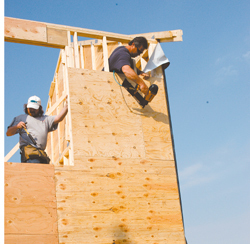
Rising prices may not deter building – for now
Escalating lumber prices have done little to slow homebuilding in
Rhode Island, but industry experts warn that other negative market conditions
could take a toll.
Seifert Systems Invests in Energy Efficiency to Strengthen Operations
For manufacturers, energy is more than just another operating expense. It plays a critical role…
Learn More
“A lot of projects are still in the works, and this has been the busiest spring in a long time,” said Bruce Charleson, president of Arnold Lumber in West Kingston. “For the long term, we have to wait and see, but (rising lumber prices) and an interest rate increase could really slow things down.”
Rod Mitchell, co-owner of Meridian Custom Homes based in Providence, which builds fixed-price homes, said rising lumber prices by itself won’t stop the demand for homes.
“The market is still good,” he said. “I don’t think this will slow down the market, but it could. (Price) is certainly not a factor that helps it accelerate.”
As of April 30, framing lumber cost $451 per 1,000 board feet, up 40 percent from the beginning of 2004 and at the highest level since July 1999, according to Random Lengths, a trade publication.
Roger Warren, executive director of the Rhode Island Builders Association, agrees that higher prices won’t have much of an impact.
“As current housing demand significantly exceeds availability, I believe that the impact of price increases will not significantly reduce demand,” he said. “What is unfortunate is that in Rhode Island, the cost of housing is increasing at a much faster rate than our income. Materials costs have contributed somewhat, but it’s mostly due to a lack of housing supply.”
Mitchell said it now costs an average of $8,000 more in building materials to build the average 2,500-square-foot colonial house. Meridian will now finish its current projects and absorb the higher materials costs, but from here on, will raise rates, he said.
“It’s just another reason to raise prices,” Mitchell said of the effects on the industry. “No one needs to work for eroded margins for long” in a hot market.
Charleson said builders and contractors haven’t canceled or delayed projects, but have eliminated certain amenities or put off certain parts of a project due to increased costs.
“An additional $15,000 in costs could have bought you granite countertops and whirlpool tubs,” Mitchell said. “People spend what they’re prepared to spend, so they might have to sacrifice some things.”
Escalator clauses – which call for the contractor to absorb materials cost increases only to a certain point, after which time the homeowner is responsible – are becoming more common, Charleson added.
Other building materials are also following suit with plywood paneling and oriented-strand board, Charleson said, leaving little room for substitutes. Steel, used in nails and metal joists, insulation, sheet rock, interior trim, framing and timber prices are also increasing, though not as drastically.
“Lumber prices have traditionally fluctuated based on factors such as demand, weather and production capacity and there is no reason to believe that this won’t continue into the future,” Warren said. “I would also anticipate the overall price trend line to be rising given the current state of demand in the housing market.”
Shortages are also a problem, Charleson said, “even if we’re willing to pay a certain price.” Nationally, there is increasing demand yearly on plywood for housing. According to the RIBA, single-family home permits increased from 338 in the first quarter of 2003 to 413 at the end of the same period this year, a 22 percent increase. And with mills closing, a lack or shortage of supply and virtually no increase in production, the problem is self-perpetuating.
One economist, however, said he doesn’t expect any drastic changes within the industry.
“The supply of lumber in the U.S. is relatively limited, so there’s scarcity…but with plywood, I don’t believe we have a big supply problem,” said William Sweeney, professor of economics at Bryant College. “A 5 percent increase in price is not going to have a big impact, but a 10 or 20 percent increase in one year’s time is going to inflate the price of building a home.”
Sweeney said there are mitigating factors: one of the biggest reasons home prices have increased is lack of land; and contractors can absorb a 5 percent to 10 percent increase in lumber costs.
“With the supply of Canadian and U.S. wood, we’re not really going to get into a tight lumber market. I don’t think it’s going to happen,” he said. “Maybe stock will be tight, but the housing market is just too strong.”
As for Charleson’s concern that rising interest rates and lumber prices together could hurt the homebuilding market, Sweeney said, “I think he’s right. Steadily rising new home prices and steadily rising mortgages could combine to slow the market down.” It wouldn’t have a drastic impact, though, he said.
So what can people in the industry do in the meantime?
“You can’t just roll with it,” Charleson said. “In the short term, it’s a matter of buying the best we can and keeping an adequate stock. In the long term, it’s what impact does it have on housing?”
Although the homeowner and builder shoulder most of the price increase – the end costs are higher for the homeowner and eat away at the builder’s profits – Charleson said everyone involved feels it.
“It’s not good for anyone to have such a drastic increase in price,” he said. “It makes it difficult for the builder to price a job. It creates a lot of uncertainty.”