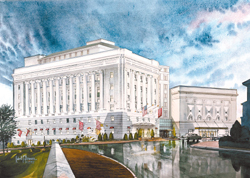
Before the transformation begins on the Masonic Temple into a Marriott Renaissance
Hotel, workers must erect a $1.5 million bracing system to hold up the limestone
façade, shore the unfinished interior with a steel curtain, tear up concrete
foundations and floors and start the reconstruction from the basement up.
But the hardest part of the ambitious $62 million project will be making sure the finished product – a 272-room hotel – satisfies everyone involved, according to Michael Coolidge, senior vice president of developments for Sage Hospitality Resources, the Denver-based hotel developer. There are standards the project must meet for the historic tax credits that are helping finance the project, as well as standards set by Marriott, the city and state, he said.
“There are cards that we have already been dealt, and there are certain things you can’t do,” he said. “It’s definitely the most complex project to date. With this building, it’s almost like starting completely from scratch, with the exception of the façade.”
Seifert Systems Invests in Energy Efficiency to Strengthen Operations
For manufacturers, energy is more than just another operating expense. It plays a critical role…
Learn More
Others have come before Sage.
In 2002 New Rochelle, N.Y.-based developer Algen Construction and Development abandoned their proposal. According to John J. Macliver, president of MPM LLC Property Management Construction Services in Providence, a few others failed to get very far.
More than a decade ago, Macliver, when he worked for Marsella Development, looked at the building for a possible development a few times, but nothing materialized.
“It never worked out – we tried to find a good use for the building, but we didn’t come up with one,” he said. “Right now it looks like this hotel is going to happen, and it’s really a no-brainer because of the tax credits.”
Maguire Group also studied the building in the early 1980s for the state for possible use by the Department of Administration, but construction would have been more expensive than to build new, and the state needed more space than the building would provide.
“At that time, construction would have been difficult,” said Peter Morrison, director of the buildings group for Maguire. “It’s been an eyesore for years. I think it’s a great location for a hotel. Whatever the use, having someone develop it with use of the tax credits is great.”
One of the vital elements in making the project feasible is the state and federal historic tax credits it qualified for, which will provide credits for a total of 50 percent of the eligible costs for the project: 30 percent from the state, and 20 percent federal. But Macliver acknowledged that even with the credits, converting the building into a hotel won’t be easy.
The property presents a number of physical restrictions that Sage had to work around in order to make the hotel feasible. The rooms will be more narrow and longer than normal at about 11.5 feet wide by 36 feet long.
There are 350 to 400 existing window openings that dictated the placement of the rooms; some rooms will have one window; corner rooms will have two. The foundation is in good condition, Coolidge said, but crews will have to demolish all the floors down to the basement.
“This building was never put into use, so all of the utilities you’d normally find aren’t there,” Coolidge said. “With the last four or five projects, we’ve started with a base level.”
“It will be difficult from a construction standpoint, but it’s doable,” Macliver said. “Just to re-fasten the limestone skin, and the placement of the windows – it’s a very ambitious project.”
The façade bracing and interior demolition alone is complicated and could take six months, which Sage said would be complete in spring 2006. Construction hasn’t yet begun on the eight-and-a-half-story edifice, but Coolidge said that Francis Street has been blocked off, and construction fencing is going up. De-construction and the bracing are slated to start in the second week of July, he said.
“The bracing is one of the biggest challenges,” he said. An exterior skeleton around three sides of the building will help the façade withstand wind and construction. After the interior skin is built and shored up, the façade will be tied back to it, and then crews will clean, re-point and repair the exterior, Coolidge said.
“It’s a fairly intensive process,” he said. The west side of the building will be extended to connect the temple with the Veterans Memorial Auditorium, and Sage will add an extra row of windows at the top of the building to gain rooms.
Structurally, the building was designed with no interior columns or supports. Coolidge said the only other interior structural work will include repairing and replacing some damaged steel beams and some foundation work to ensure it can withstand the weight of floors and rooms.
“We’ll start in the basement and go up, pouring the floors, putting in the partitions and putting in plumbing and utilities,” he said. “The finished product won’t really be visible until the end of 2005, early 2006.”
Construction of the Avenue of the Arts, which will reconfigure the street area in front of the Masonic Temple and VMA, will be under construction simultaneously. According to Coolidge, there will be a maximum of 200 workers at the Masonic Temple site on a regular basis, and the project will employ 600 to 800 total.
Macliver said that even with those credits, the state probably would not have been financially able to rehabilitate the building for government use. He doesn’t doubt Sage’s ability to fund and build the hotel; whether the hotel will be profitable in the city is the burning question.
“In the beginning we couldn’t understand how they could make it work economically,” he said, but the tax credits make it work.
“It’s not your typical construction project. I think out-of-state developers over-estimate the market. It’s still a small marketplace and they don’t realize it’s not quite as big as they thought. It will (depend) on what the daily rate turns out to be.”
Morrison said that for so long, the buiding was too difficult to redevelop, but things have changed.
“It never had a specific use – the structural framing was built specifically
for use as a Masonic Temple,” Morrison said. “The longer it sat there, the more
it deteriorated. Maybe the time had to be right for it, and now it is.”