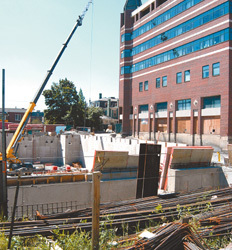
The College Hill Neighborhood Association is trying to stop Brown University
from building its new life science building, alleging the facility will emit
toxins harmful to the environment and area residents.
The new 168,800-square-foot, $95 million research center on Meeting Street is being built adjacent to Brown’s BioMedical Center.
The neighborhood association filed a Complaint for Declaratory and Injunctive Relief May 21 with U.S. District Court of Rhode Island to force Brown and the two federal agencies helping fund the project to conduct a more in-depth environmental study before moving forward with the project, which is already under construction.
Rhode Island's Market Has Changed. Developers, Builders, Investors and Sellers Must Change With It.
By Emilio DiSpirito IV License Partner | Engel & Völkers Oceanside Leader | The DiSpirito…
Learn More
The three parties have until Aug. 31 to file responses to the injunction. A judge will decide if a more in-depth environmental study needs to be performed.
Under the National Environmental Policy Act, when a federal agency contributes funding to a project, the agency has to study the environmental impacts. The Department of Energy is contributing $1 million to the building and the National Aeronautics and Space Administration awarded Brown $5.25 million.
When there are no obvious impacts or the effects on the environment are expected to be minimal, a project is screened with an environmental assessment. If the assessment shows possible significant harm to the environment, a detailed environmental impact assessment is performed.
The energy department and NASA submitted a final environmental assessment in August 2003. Because the report showed “no significant impact” on the “human environment,” Brown went forward with construction in June 2003. The project is expected to take 30 months to complete.
The College Hill Neighborhood Association claims the report is “glaringly deficient” and alleges the energy department and NASA did not take a “hard look” at the environmental issues. The group is asking a judge to prevent further construction of the building until NASA and the energy department completes a detailed EIS.
“Brown University laboratories release 4,800 pounds of toxins into the environment each year. The new building will emit 1,500 pounds,” said William Touret, a neighborhood association board member and a resident who lives one block from the development. “This science campus is in the heart of a dense residential area next door to another huge biomedical facility. We want them to study the cumulative effects over time.”
Brown filed a response to the complaint on June 16 saying it “admits that the labs will generate some hazardous, radioactive, medical and biological wastes, but denies that the building will cause chemical air emissions from the labs directly to the outdoors through windows, doors and other openings.”
Brown also admitted there will be “wastewater discharges associated with activities,” managed in compliance with federal, state and local environmental policies, but denies that people will be adversely affected.
The project is currently under construction and will continue unless a judge decides an EIA is necessary.
Rhode Island does not require environmental studies before developments can be built, but many major projects are built on lands that require variances and permits from the state, said Roger Warren, executive director of the Rhode Island Builders Association.
“The lots being built on today aren’t the ideal spaces that were built on years ago, so developers have to come up with different strategies and do things that require permits from the state, and those can hold up projects,” Warren said.
Projects that impact the environment – by altering wetlands, for example – must be in compliance with state environmental protection policies.
Developments that require federal funds or cross the line from state to federal jurisdiction – like a proposed Keyspan LNG facility upgrade project – have to undergo a federal Environmental Impact Study by the appropriate federal agency, said Ron Gagnon, chief of the office of technical and customer assistance from the Rhode Island Department of Environmental Management.
In Keyspan’s case, the Federal Energy Regulatory Commission is performing an Environmental Impact Assessment.
The process begins with a draft assessment, followed by scoping period where the public is allowed to file motions to intervene, protest and comment on a project. The issues are noted to determine what needs to be evaluated in the EIA.
The final report, which can take years to complete, depending on the project, determines if the development will harm the public and the environment and if it is either allowed to move forward or is denied.