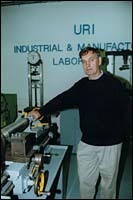
professor and department chair
of industrial manufacturing, URI
The factory of the future could consist of one person and a dog.
The person to control the one switch at the factory, the dog to keep the person
company. This, according to Manbir Stodir, an associate professor and graduate
program director in the industrial and manufacturing engineering department at
the University of Rhode Island.
Beyond Cash Donations: How New Forms of Giving Are Transforming Not-for-Profit Accounting
Evolving Funding Landscape for Not-for-Profits Not-for-profit organizations are being asked to do more with less,…
Learn More
"The goal is to reduce labor," he said. "To work with as little
labor as economically possible."
Dr. Winston Knight, professor of industrial manufacturing and chairman of the
department, said the relatively small undergraduate program prepares students
for what is available in the manufacturing world today.
"It doesn’t only prepare them for manufacturing," he said. "It’s
essentially a scientific form of management. Most respectable manufacturing companies
will have an industrial engineer department."
Industrial engineering was first offered at URI in 1947, but in 1985 the emphasis
of the program was changed to include manufacturing engineering. Stodir said the
program was one of the first of its kind in the United States. He said the fit
is a good one for the two fields because, like a computer, the knowledge needed
for engineering acts as software, and the manufacturing skills are like the hardware.
And like computers, the concept of manufacturing is changing all the time.
"It depends on how we reposition ourselves," said Stodir. "In many
ways manufacturing is a commodity."
"There are many implications that need to be considered," he said. "We
are becoming more of a service-oriented society."
Dr. Knight said there are about 45 students in the program. Approximately 10 per
year graduate from the undergraduate program, and there are currently eight students
in the Ph.D. program. There are six full-time faculty.
Although manufacturing jobs have fallen by 32,000 since 1989, according to local
economists, Dr. Knight feels the field still holds a great deal of promise for
graduates of the program.
"I think it’s a myth to say Rhode Island has no manufacturing economy,"
he said. "It’s just changing. And I think Rhode Island has a very substantial
amount of its economy from manufacturing."
"There has been reduction in defense-related manufacturing over the past
ten to fifteen years," he said, "but there’s still a fair number of
relatively small, competitive manufacturers."
John Crane Mechanical Seals, with a presence in over 46 countries and a location
in Cranston, manufactures engineered sealing systems for the industrial process
and automotive industries. A 1993 graduate of the industrial and manufacturing
engineering department at URI, Meredith Westner is the company’s quality assurance
manager.
"It’s given me a good background in a wide variety of problems you’d encounter
in the manufacturing department," she said of the URI curriculum.
Westner’s place of work has been through a lot of changes since she arrived there
the August after graduation. Formerly the headquarters for EG&G Sealol, when
the company was bought out by Illinois-based Crane, there were layoffs in sales,
marketing, and accounting departments. However, the staff of the manufacturing
department was increased.
Regarding skilled labor, she said the Northeast is a difficult area, because of
the premium salaries the workers demand.
"Right now the job market is good, but we still have difficulty bringing
machinists in," she said.
Westner said the biggest problem facing manufacturers in the area is keeping engineers,
with all of the tempting high-tech jobs available.
"We’re getting the short end of that stick," she said. "If we keep
somebody two years, we figure we’re doing pretty well here."
Westner also supervises the inspection department, maintains the company’s ISO
9001 quality system, and works on continuous improvement efforts.
Stodir said the industrial and manufacturing engineering program teaches students
how to use the newest computer-based models to ensure that continuous improvement
efforts are made in the manufacturing industry, itself.
"Our engineers are trained in ability to look for ways of making manufacturing
more efficient," he said. "When they go out into the workforce our
hope is that they carry on using these models because they are entering an industry
that doesn’t use them [the models]."